The Hill
U.S. Sailors and Marines aboard the USS Tripoli arrived at the U.S. Central Command area in the Middle East on March 27. CENTCOM stated March 28 that the flagship delivered about 3,500 Sailors and Marines from the Tripoli Amphibious Ready Group of the 31st Marine Expeditionary Unit, along with “transport and strike fighter aircraft, as well as amphibious assault and tactical assets.”
Gift link
The Wall Street Journal
President Trump is weighing a military operation to extract nearly 1,000 pounds of uranium from Iran, according to U.S. officials, a complex and risky mission that would likely put American forces inside the country for days or longer.
The Associated Press
Pakistan announced March 29 that it will soon host talks between the U.S. and Iran, though there was no immediate word from Washington or Tehran, and it was unclear whether discussions on the monthlong war would be direct or indirect.
The Mitchell Institute for Aerospace Studies
For decades, adversaries like China have pressed hard to erase the spacepower advantage of the United States. This includes weapons to attack our space systems and technologies on orbit to hold U.S. forces in all domains at risk. Bottom line, space is more contested today than ever before. Our Mitchell Institute team explores these realities with Chief Master Sergeant Ron Lerch, Senior Enlisted Advisor to the Deputy of Chief of Space Operations.
POLITICO
Ukrainian President Volodymyr Zelenskyy accused Moscow of helping Tehran target U.S. military assets in the Middle East, including with satellite images ahead of Iranian strikes on an American base in Saudi Arabia.
The War Zone
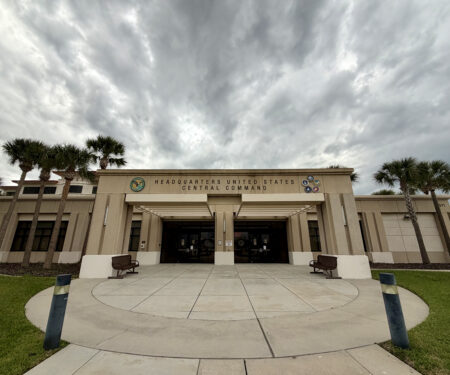
With its facilities in the Middle East frequently targeted by Iranian missiles and drones, U.S. Central Command is looking for better ways to protect its troops and capabilities. This week, the command and its subordinate units put out two calls for information from companies that can design and provide hardened infrastructure, including underground facilities, as well as shelters.
Defense One
Space Command aims to move about 200 people from Colorado to its new headquarters in Alabama by year's end. “I'm happy at the progress that we're making, and that progress will continue over the next couple of years as we work to get a significant portion of our staff there, even while the permanent headquarters is being built,” Gen. Stephen Whiting, who leads U.S. Space Command, told senators during a Senate Armed Services Committee hearing March 26.
The Mitchell Institute for Aerospace Studies
Register now for the April 1 Spacepower Security Forum featuring Chief of Space Operations Gen. Chance Saltzman, Lt. Gen. David Miller, Lt. Gen. Doug Schiess, and more. Don’t miss this unique and intimate gathering in Arlington, Va.
Defense News
After years of trying to stop Iran-designed Shahed drones over its own cities, Ukraine is now sending counter-drone teams to Gulf partners—and pitching the help as a trade between equals.
Breaking Defense
NATO officials have identified up to $145 billion in shared munition and air defense requirements across member-states, with Secretary General Mark Rutte vowing to push weapon production as a top priority at the next NATO summit.
Breaking Defense
Federal Judge Rita Lin issued a sweeping preliminary injunction in Anthropic’s favor March 26, the latest move in the weekslong conflict between the AI company and the U.S. government.
NBC News
The Yemen-based Houthi militant group claimed responsibility for an attack on Israel on March 28, marking the Iran-backed group’s entry into the widening conflict in the Middle East, one that could further disrupt the region’s vital shipping lanes.
One More Thing
People
What began as a routine military flight over Alaska on Feb. 5, 1954, turned into a catastrophe that killed seven passengers, three crewmen, and left six Airmen—Rupert Pratt, Eli LaDuke, Huey Montgomery, Ed Fox, Ed Olsen, and Bobby Sallis—scattered across a frozen wilderness, forced to fight for survival.