
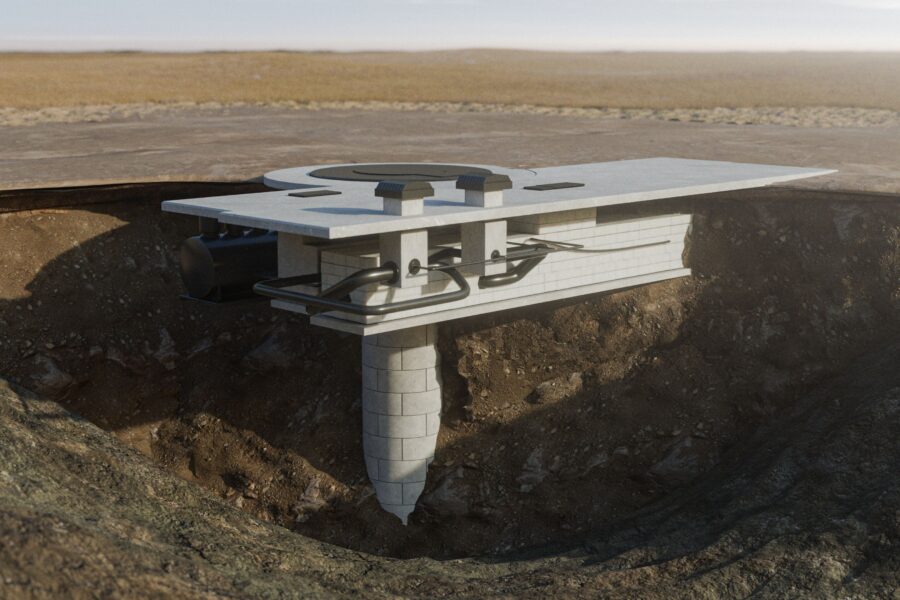
The Air Force and industry partners have broken ground on a prototype launch silo for the service’s next-generation nuclear intercontinental ballistic missile.
The service said March 27 that the full-scale prototype silo for the LGM-35A Sentinel ICBM is being built in Promontory, Utah, and “marks a key step in modernizing the land-based leg of the nation’s nuclear triad.” Leaders from the Air Force and contractors Northrop Grumman and Bechtel took part in the undated groundbreaking ceremony.
Sentinel is planned to replace the Air Force’s aging, Cold War-era Minuteman III ICBMs and is expected to reach initial capability in the early 2030s. But the program has encountered several setbacks, including some related to the state of the existing Minuteman III silos.
The LGM-30G Minuteman III silos were originally expected to be refurbished and upgraded so they could launch the Northrop Grumman-made Sentinel missiles. But in May 2025, the Air Force said tests showed repairing and adapting the Minuteman III silos would cost too much and cause the program to fall even further behind schedule.
The service concluded a better strategy would be to dig and build entirely new launch silos, largely on land already owned by the Air Force.
In the March 27 statement, the Air Force said the Sentinel silo prototype will use a digitally designed, modular construction approach that it hopes will speed up fielding, reduce cost growth, and allow the program to learn lessons before moving into full-rate production.
“This prototype is a critical step in proving the design and reducing risk before production,” said Brig. Gen. William Rogers, the Air Force’s program executive officer for ICBMs. “We are accelerating delivery while ensuring the system is sustainable and ready for Airmen to operate for decades.”
The Air Force also said building new silos will allow the existing Minuteman III missiles to maintain uninterrupted alert coverage and not be taken offline until the newer silos are ready.
“The new silo design delivers operationally relevant capability on a predictable cost and schedule,” Gen. Dale White, director of Critical Major Weapon Systems, said in the statement. “We are accelerating delivery while ensuring the system is sustainable and ready for airmen to operate for decades.”
Sen. Deb Fischer (R-Neb.) said at Defense One’s State of the Air Force event March 25 that creating a new network of silos will be the best way forward.
“We’re going to have to dig some new silos,” Fischer said. “But given how old some of those silos are … it’s going to be actually faster and it’s going to be cheaper to dig those new ones.”
The Air Force said the silo prototype construction is the latest in a series of milestones for the Sentinel program, including ongoing construction of a wing command center at F.E. Warren Air Force Base in Wyoming, and successful test fires of multiple propulsion stages of the Sentinel system.
The Sentinel program will be one of the biggest projects in Air Force history. In addition to building the new missiles themselves, Northrop Grumman and the Air Force will build launch control centers and about 450 silos spread out over thousands of square miles across the Great Plains region, in addition to replacing thousands of miles of outdated copper cabling with an upgraded fiber-optic network.
But the projected cost of those sprawling construction projects rose dramatically in recent years, and what was once expected to be a $77.7 billion project ballooned into a $160 billion program. The cost and schedule overruns triggered a review process under the Nunn-McCurdy Act in January 2024.
The Pentagon concluded that July the program was too critical to cancel, but the top brass ordered the Air Force to restructure it and bring costs under control. A revised cost estimate is not yet available, but the Pentagon did offer a preliminary estimate in 2024 of nearly $141 billion under a revamped acquisition process.
Fischer told Defense One that despite the daunting scale and challenges the Sentinel program presents, it is so vital that the Air Force has no choice but to make it work.
“It is a huge infrastructure project,” Fischer told Defense One. “It is a huge civil works project. When you take into account that these missile fields, they’re large than some states. So we need to make sure that we get it right, and we need to take the time to make sure that we get it right so that we have the best system.”