
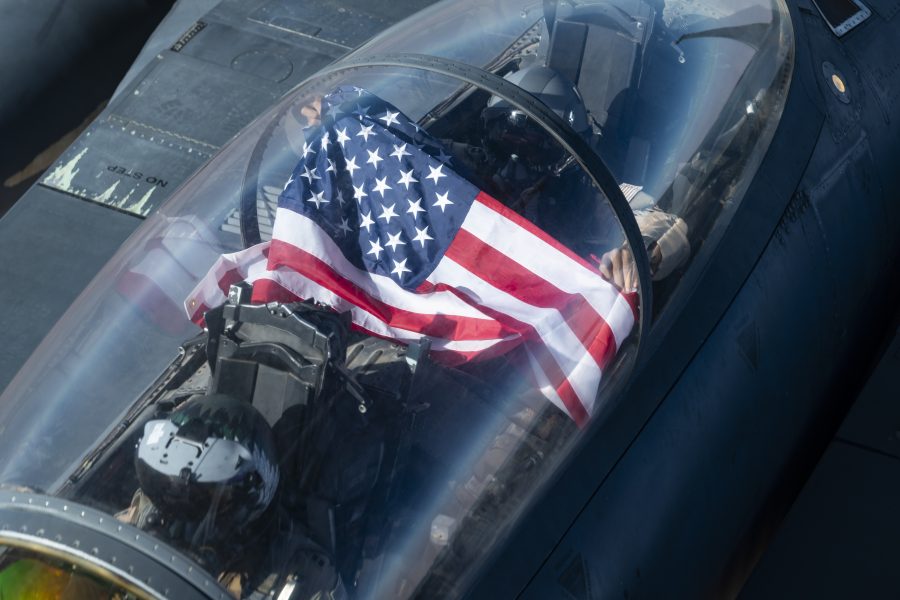
For weeks, Operation Epic Fury showcased the breathtaking reach, precision, and persistence of American air and space power: more than 13,000 combat sorties and more than 12,300 targets struck by April 1. The striking figures speak to extraordinary military capability, global reach, relentless operational tempo, and the unmatched technical excellence that defines the United States Air Force and United States Space Force.
But numbers do not tell the most important story.
What is truly important is what happened on April 3, when an F-15E Strike Eagle was shot down over Iran. After weeks of combat and thousands upon thousands of sorties, the enemy destroyed a U.S. fighter aircraft for the first time in this conflict. In an instant, this war was no longer just about sorties, targets, and battle damage assessments, but about the survival and rescue of two American Airmen on the ground in hostile territory, separated, exposed, and in mortal danger.
What followed was a rebuttal to one of the criticisms often aimed at the Air Force and Space Force.
Both crew members ejected safely, but they landed in different locations in rough and hostile terrain. One was recovered within hours, but the other—a wounded weapons systems officer—spent more than 24 hours in evading capture in the mountains while enemy forces hunted him. Every minute increased the danger and raised the stakes. Somewhere in that unforgiving terrain was an American service member who knew the enemy was looking for him, knew capture or death was a real possibility, and yet fought for his survival.
And somewhere above him, around him, and far beyond his line of sight, hundreds of fellow Americans were rallying to his cause, doing what Americans in uniform have always done: refusing to leave one of their own behind.
This is more than a rescue mission; it is a declaration of values.
U.S. helicopters took enemy fire and crew members were wounded. An A-10 supporting the operation was dealt a deadly blow, but its pilot successfully made it to friendly airspace. The effort to save the second Airman required capabilities no other country posesses: extraordinary intelligence, deception, special operations forces, air cover, strike coordination, not to mention uncommon courage. It was an enormous effort, involving far more aircraft—both in number and variety—than one might assume. But those details, while fascinating and surely the subject of future films, are not the point. It required Americans in the air and on the ground risking their lives for one reason above all others: One of their own was still out there.
And they were going to get him home.
Too often the simplistic charge that the Air Force and Space Force are too enamored with technology, too centered on their platforms, too focused on hardware over humanity, simply misses the mark completely.
As important as technology is—aircraft, satellites, secure communications, precision navigation, resilient networks, and intelligence fusion are all indispensable to modern warfare—the Air Force and Space Force have never been about technology for its own sake. These services are about people empowered by technology, people sustained by trust, people bound by duty, and people willing to risk everything for one another.
Contrary to popular misconceptions, the Air Force and Space Force do not worship machines. They do not elevate platforms over people or technology over the human dimension. On the contrary, they see technology and the human dimension as complementary and inseparable, not competing priorities. The machine extends the reach of the warrior, and the warrior gives the machine purpose.
And when one of our own is down, every Airman, every Guardian, every aircraft, satellite, sensor, and network matters for only one reason: because a fellow American is in danger.
That is what made this mission so powerful. It was not just a feat of operational integration. It was the visible expression of loyalty, duty, and the sacred promise that binds those in uniform together: If you go down, we will come for you.
That promise is not sentimental. It is not ceremonial. It is not something recited on special occasions and forgotten in battle. It is real, imposing obligations and demanding action in the face of danger. It demands that others climb into cockpits, helicopters, command centers, and travel into kill zones not to destroy but to rescue, for the sake of a fellow servicemember in peril. Here, courage is no abstraction; it is a choice.
Space Force Guardians may not fly into danger in the same way, but they are no less woven into the campaign, providing critical communications, navigation, targeting support, and warning functions. Those contributions, while technical, are deeply human in purpose. They are protecting lives. They are helping find the isolated. They are helping bring warriors home. Behind every signal, every warning, every transmission, every coordinate, and every operational decision is an Airman or Guardian whose work can mean the difference between rescue and loss.
This is the human dimension of air and space power.
War is never remote and antiseptic. It involves real people risking their lives for missions in the face of true danger. Even after thousands of sorties and weeks of successful combat operations, danger endures. The enemy always gets a vote.
What Americans should recognize in the wake of this weekend is not that a U.S. jet was shot down but that the character of our American military is unparalleled.
Under pressure, under fire, and against the clock, Airmen and Guardians, Soldiers, Sailors, and Marines, performed exceptionally: They focused on the mission, trusted one another, accepted the risk, and refused to leave their comrades behind.
We saw Airmen and Guardians prove that the soul of these services is not cold machinery, but human devotion. We saw the professionalism that prepares people to perform under the harshest conditions. We saw the discipline that enables clarity amid chaos. And above all, we saw the love of comrades that compels men and women in uniform to risk everything to save one of their own.
That is the promise our Airmen and Guardians make to each other. And that is why this mission should be remembered: Not simply as a successful combat rescue, but as a living testament to the heart, character, and humanity of American air and space power.