
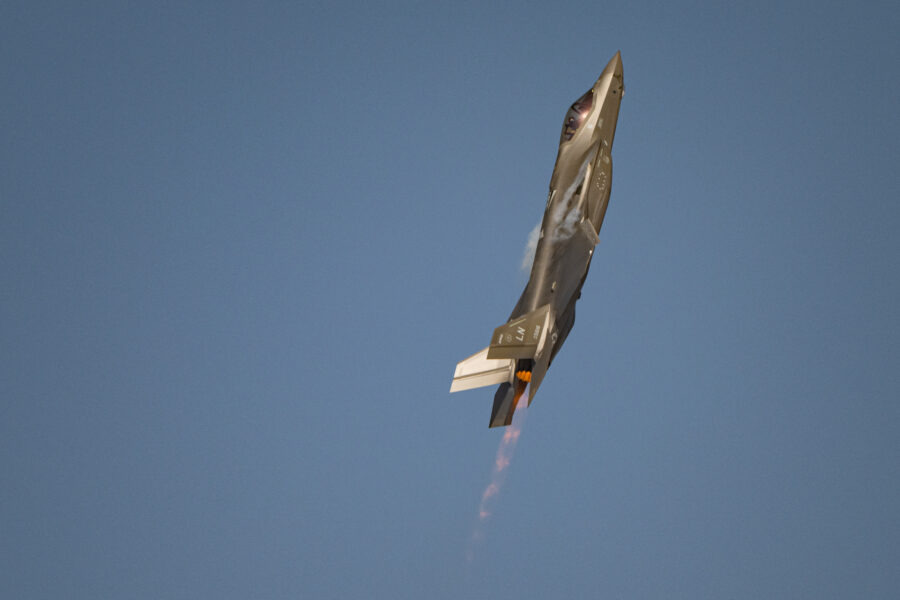
The reported damage to a U.S. F-35 by an Iranian surface-to-air missile system is operationally noteworthy. It should not, however, be seen as anything more.
High-end combat against a capable, integrated air defense system has always entailed risk, and historically, that risk has translated into significant aircraft losses. What is remarkable in the current Iran war is not that a U.S. aircraft was hit—but that combat losses to date have been all but nil, and with no friendly manned aircraft losses at all to enemy action.
What makes the current campaign particularly significant is the scale of operations relative to the absence of losses. U.S. Central Command has stated that coalition forces have struck thousands of targets inside Iran—exceeding 7,800 aimpoints over the course of the campaign to date. This level of activity necessarily implies thousands of combat sorties flown within range of Iranian surface-to-air missile systems.
During the Vietnam War, the United States conducted sustained strike operations against one of the most sophisticated air defense networks of its time, North Vietnam’s Soviet-supplied SA-2 SAMs, dense radar-directed anti-aircraft artillery, and interceptor aircraft. The cost was substantial. Of 833 F-105 fighter aircraft produced, 382 were lost in combat—nearly 46 percent of the entire inventory. The war saw a total of over 1,700 fixed-wing combat aircraft losses. These losses occurred despite continuous adaptation in tactics, including the emergence of Wild Weasel missions dedicated to suppressing enemy air defenses.
Attrition of this scale was not anomalous—it was the norm, characteristic of high-intensity air operations against a layered defense. The U.S. expected aircraft to be lost—and in significant numbers. That was the price of penetrating defended airspace.
Iran’s defenses present a modernized but conceptually similar challenge: a layered integrated air defense system (IADS) incorporating radar and infrared-guided SAMs, mobile launchers, and overlapping sensor coverage. Iranian systems—ranging from legacy platforms to more modern, domestically produced variants—are designed to complicate access, impose cost, and deny air superiority.
Throughout repeated operations within the engagement envelopes of these systems, U.S. and Israeli manned combat aircraft have suffered no confirmed losses to Iranian air defenses. The March 19 F-35 incident, in which the aircraft was damaged but successfully recovered, reinforces this point rather than undermining it. It demonstrates that even when an adversary achieves a degree of tactical success—tracking, engaging, and hitting an aircraft—the outcome does not translate into a mission kill.
This is the defining characteristic of modern Western airpower: not invulnerability, but survivability paired with dominance.
Fifth-generation aircraft such as the F-35 are designed to operate inside contested environments, combining stealth with advanced electronic warfare, sensor fusion, and networked operations. Stealth is not invisibility across the electromagnetic spectrum, but it does dramatically increase the probability of survivability and mission success against advanced air defenses. These capabilities are integrated within a broader operational construct that includes suppression and destruction of enemy air defenses, or SEAD/DEAD, stand-off weapons, cyber and electronic attack, and real-time intelligence.
The result is not merely the ability to penetrate an IADS, but to systematically degrade and dominate it.
Air superiority—defined as the ability to conduct operations at a given time and place without prohibitive interference by the opposing force—and in many cases, air supremacy, which means operating at will at all times against a foe—are the conditions that enable all other military operations. Without one or the other, every force is vulnerable.
Where air superiority is achieved, friendly forces gain freedom of maneuver, precision strike capability, and the ability to shape the battlespace at will. Where it is absent, the character of war changes fundamentally.
This is precisely the case in the Russia-Ukraine war, where neither Russia nor Ukraine has achieved air superiority. For Russia, this reflects a combination of underperformance in SEAD/DEAD operations, and failures in leadership, training and coordination. For Ukraine, it reflects limitations of resources and fighter aircraft and reliance on a defensive, principally ground-based air defense strategy, along with a remarkably resilient and innovative layered air defense system.
The resulting contested airspace leaves both sides severely limited.
Neither Russia nor Ukraine can conduct sustained, large-scale maneuver under the protection of airpower. As a result, the conflict has devolved into a war of attrition—characterized by artillery and drone duels, static front lines, and incremental territorial gains at high cost. The inability to dominate the air has imposed a ceiling on operational tempo and strategic maneuver.
In contrast, U.S. and Israeli operations against Iranian air defenses demonstrate what air superiority—moving toward air supremacy—looks like in practice. Aircraft are not only surviving within contested airspace but doing so while denying the adversary any meaningful success in contesting control of the skies.
The key takeaway is not that modern air warfare is risk-free. There is always a risk when you fly into a war zone. Rather, it is that the United States and its allies have fundamentally changed the cost calculus. Where previous generations accepted high attrition as the price of access, today’s force is engineered to minimize losses while maximizing operational effect.
The damaged F-35 is a reminder that the threat is real. The absence of losses, however, is a testament to just how far airpower has advanced—and how decisive true air superiority remains.
