
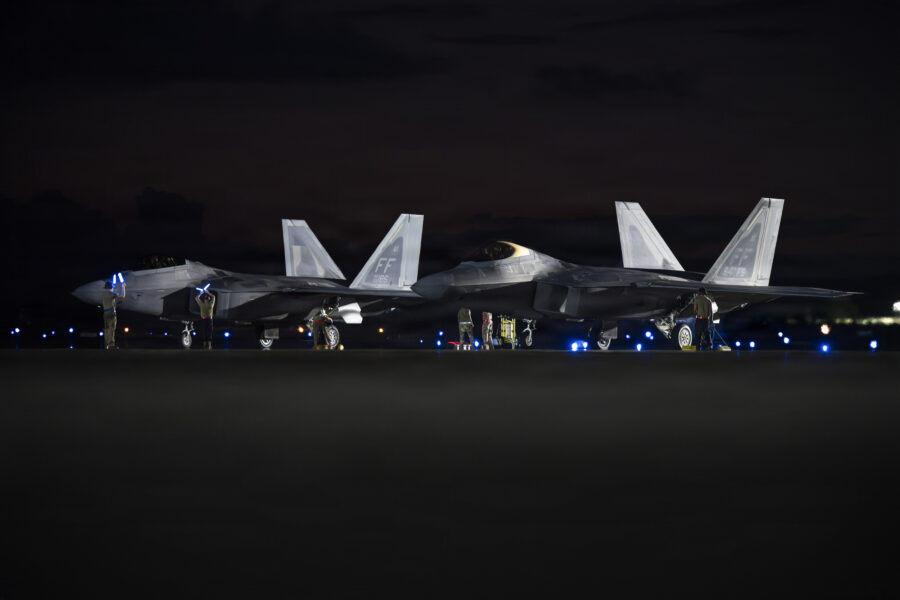
Operations Midnight Hammer and Absolute Resolve demonstrated the remarkable flexibility and overwhelming force possible when nations command control of the skies.
It’s an object lesson to all who, having watched the carnage over more than four years of Russia’s war on Ukraine, some of whom have come to the erroneous belief that air superiority is no longer necessary or even achievable, and that a strategy of denial is necessary in the future.
Those theorists could not be more wrong.
Achieving air superiority, as demonstrated in each of these operations, delivers an overwhelming advantage to a combatant force. Air superiority means a temporal control of the skies over a contested area to enable freedom of movement in the air to conduct combat operations and deny the adversary the ability to do the same.
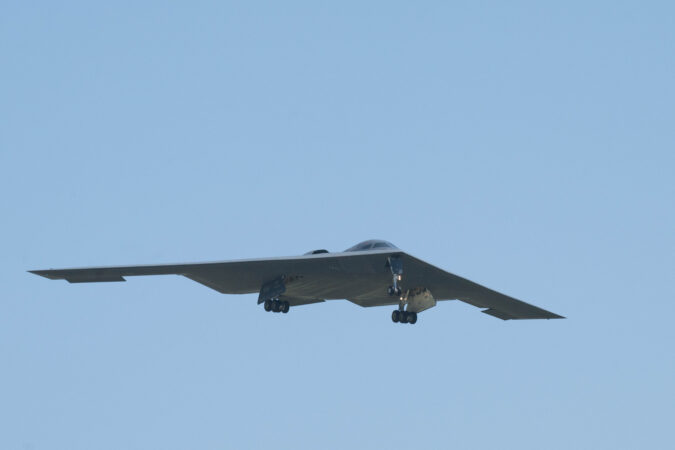
Whether the objective was the capture of the President of Venezuela by a Special Forces team or the unimpeded B-2 strike in June 2025 on hardened deeply buried nuclear enrichment facilities, achieving air superiority is a prerequisite to enable the follow-on Joint Force to achieve operational objectives. Achieving air superiority leaves the enemy effectively blind, incapable of stopping attacks from the sky.
China is amassing military infrastructure and capability at record pace, threatening U.S. Allies and interests in the Pacific. Russia, mired yet determined in its ongoing war against Ukraine, remains a threat to Europe and NATO. North Korea and instability in parts of the Middle East continues to foment regional conflict.
All of that suggests the world remains a dangerous place and that the U.S. ability to impose its superior airpower is a crucial means of achieving America’s military objectives around the world.
There is consensus among many in the National Defense enterprise that the U.S. military must increase both capacity and readiness, as indicated by President Trump’s call for a $1.5 trillion defense budget. How and where the Nation directs these potentially increased resources will be critical to meeting the growing threats facing the nation. As the past year has continued to prove, achieving air superiority is the barrier to entry of conducting a successful military operation. The Nation must increase investment in capacity and lethality of air superiority and strategic attack platforms plus their associated weapons to maintain the ability for the U.S. to deter our nation’s adversaries. If deterrence fails, the U.S. must have the ability to gain control of the skies and hold any target at risk at the time and place of our choosing.
Decades of underfunding the Department of the Air Force during a sustained high operations tempo has left the Air Force with the smallest and oldest fleet in history.
Operation Desert Storm’s air campaign was a masterclass in what U.S. airpower can achieve to set favorable conditions and create decisive strategic effects. U.S. and coalition fighters and bombers targeted Iraqi Centers of Gravity with effects-based operations to cripple enemy leadership, communication, logistics, and fielded forces. Those operations took a combination of mass, survivability, and speed to set conditions for the ground invasion’s rapid disposal of the Iraqi Army. Now 35 years later, the same attributes of airpower apply. Mass, survivability, and speed give the ability to achieve air superiority then strike critical nodes to set conditions for strategic effects.
Suggesting the U.S. should drastically change doctrinal concepts to something unproven and inherently defensive is misguided. Such an approach may be “cheaper,” but will not be more effective. If air denial were truly a more effective option, other nations, including China, would be following suit. They aren’t.
Turns out a world class Air Force is expensive. Defeat is even more costly. There are no shortcuts.
Lt. Col. Ryan “Duke” Stillwell is a B-1 Command Pilot and former Weapons School instructor with over 2,700 hours, including 1,400 in combat. He is currently serving as an Air Force Fellow at the Mitchell Institute for Aerospace Studies.