
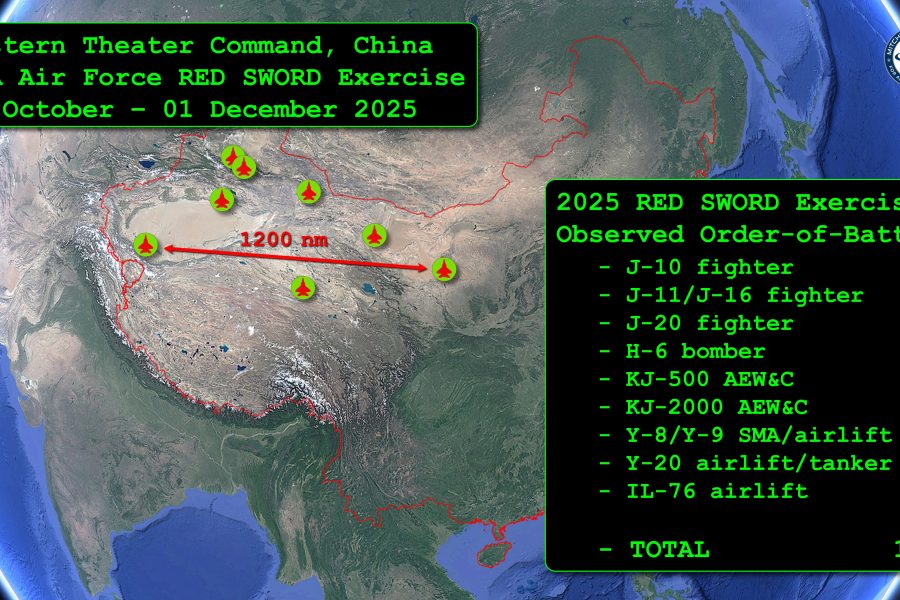
AURORA, Colo.—Analysis of commercial satellite imagery indicates China held a major five-week air exercise encompassing eight bases and some 200 aircraft, across a 1,200-nautical mile swath of the country in late 2025.
The exercise appears to have been Red Sword, similar to the U.S. Red Flag exercises, was uncovered by retired Navy intelligence officer J. Michael Dahm, senior fellow at AFA’s Mitchell Institute for Aerospace Studies, and was briefed at AFA’s Warfare Symposium here Feb. 25.
The People’s Liberation Army Air Force’s doesn’t talk publicly about its Red Sword Exercises, which are unlike “the flashy one- or two-day exercises the PLA conducts on the Taiwan Strait, mostly because that’s what the PLA wants you to focus on,” Dahm said.
Held in the remote western regions of China in a largely uninhabited part of the country, Red Sword is the PLAAF’s premiere large-scale air combat exercise. Observers have noted a few details about previous exercises in 2013, 2017, and 2020, but Dahm’s analysis of the 2025 edition offers new insights.
Using imagery from commercial satellite imagery providers Planet and Vantor, along with Google, Dahm’s observations were triggered as he studied images of a base that hosts J-16 fighters last October, discovering J-20 fighters, H-6 bombers, Y-20 transports, and KJ-500 airborne early warning and control aircraft also were on the flightline.
“There was nothing in the news about tensions on the China-India border, or something that would justify a buildup in western China,” he said. “When I started looking at activity at other airfields in the western theater command, it became pretty obvious that I had found a major PLA Air Force exercise involving eight air bases.”
At each of those bases, he observed similar aircraft massing. All told, he counted 194 airframes—and that’s not counting fifth-generation J-20s that may have been stored in hangars instead of left on the flightline.
“The total exercise count could be north of 200, maybe as many as 250,” Dahm said. “Maybe more impressive is that the exercise area in western China appeared to span an area of over 1,200 nautical miles. This is the largest Red Sword exercise we’ve observed over the past several years through open source intelligence.”
By comparison, the latest edition of Red Flag held at Nellis Air Force Base earlier this month—combined with the new Bamboo Eagle exercise—lasted about three weeks and included 150 aircraft. The bulk of the exercise spanned about 1,000 miles across the western U.S., though it did include elements spanning from Hawaii to Florida.
In late November, Dahm observed most of the aircraft involved in the exercise gathering at Dingxin Air Base in the Gobi Desert—a base sometimes compared to Nellis.
“We saw over 100 aircraft on the ramp, not counting those that might have been tucked away in hangars. Those aircraft operated out of the desert air base for a little over two weeks,” Dahm said. “Saying this was a Red Sword exercise is an assessment. We can’t tell the name of the exercise just by looking at imagery, but when 200 aircraft walk into a bar in western China, there are only a couple of ways that that joke ends, and Red Sword is at the top of the list.”
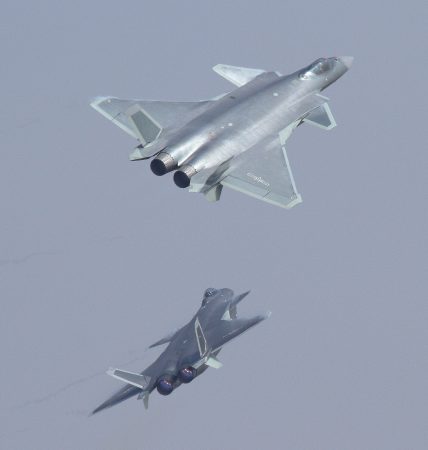
Beyond the raw numbers of aircraft, Dahm said the satellite imagery also suggested something about how the PLAAF was running the exercise. Pointing to one image that showed small detachments of J-10, J-16, and J-20 fighters gathered at one airfield, he speculated as to why the Chinese would be mixing and matching different types together.
“I’d say best case scenario, these aircraft might be conducting dissimilar air combat training: fighters fighting different types of fighters,” he suggested. “Worst case scenario, the PLA Air Force has moved on to fighter integration, developing tactics, techniques and procedures to combine the capabilities of fourth- and fifth-generation fighters.”
Dahm’s analysis also reveals a marked buildup of infrastructure for the PLAAF and the Aviation Industry Corporation of China.
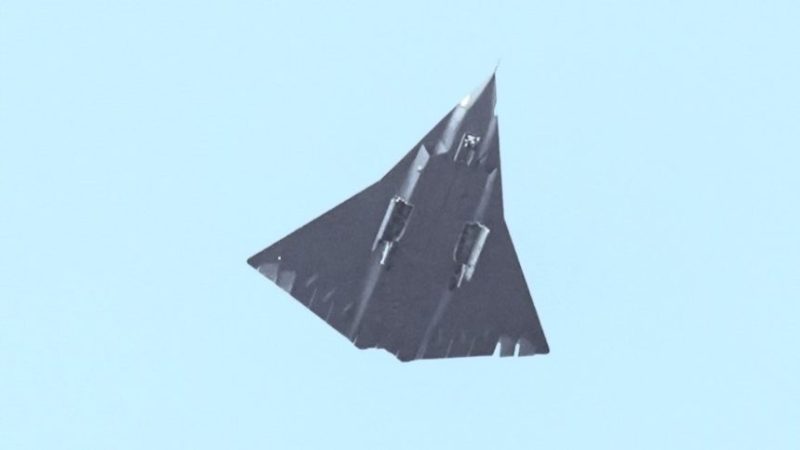
At a remote PLAAF base used to test and evaluate secretive programs, for example, Dahm noted that in the past six months, the Chinese have built “an additional 60,000 square feet of hangar space and over 300,000 square feet of additional facility space.” He also spotted the prototype sixth-generation J-36 and J-50 fighters in satellite images parked in the open—suggesting the PLA may be deliberately showing off its latest developments.
China’s commercial aerospace industrial base is also growing rapidly, as indicated by comparing satellite images of four facilities belonging to AVIC. Dahm estimated that the Chinese have added 8 million square feet in aircraft manufacturing space since 2021—“more than the entire F-35 manufacturing complex in Fort Worth, Texas,” he noted. That space is on top of what AVIC already had, he added.
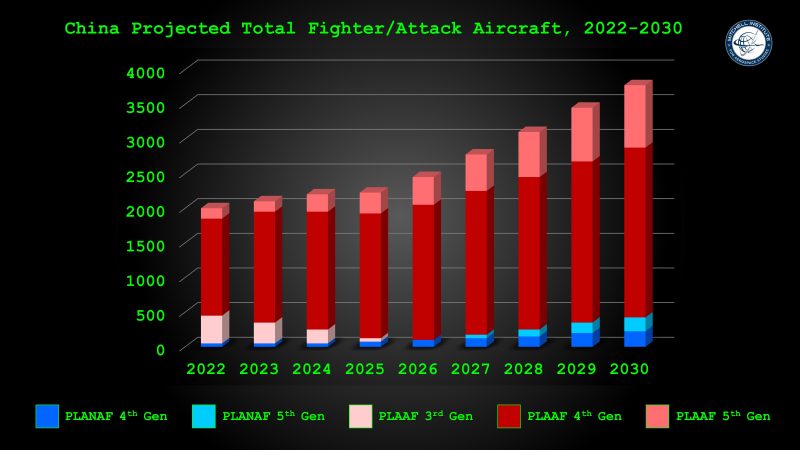
That rapid growth in capacity sets the stage for a major change in China’s fighter fleet. In recent years, Dahm said, the PLA has been purging itself of older third-generation aircraft while adding fourth- and fifth-gen airframes. The end result has been the overall size of the fleet has stayed relatively steady. Citing open source intelligence, Dahm said the third-gen fighters are now almost completely gone—and the extra manufacturing space means rapid growth is coming.
“I’d say that starting next year, AVIC will have the capacity to produce 300 fourth- and fifth-generation fighters for the PLA each year,” Dahm said. “Will they? They have the infrastructure. … We’ll have to see. Maybe annual production will cap out at 250 fighters per year, but I seriously doubt if it would be less than that.
“Based on the worst case numbers, the PLA Navy and Air Force will have a fighter force as large as the U.S. fighter force by 2028 that includes all U.S. Navy, Marine Corps, and Air Force fighters. By 2029, China will have the largest fighter force on the planet and will continue to grow.”
Such a massive air force, Dahm argued, isn’t just about threatening Taiwan. Rather, he noted that Chinese officials have spoken of developing an expeditionary air force capable of projecting power around the globe.
“We’re going to be challenged in other places, not just the Taiwan Strait,” he warned. “If we want to get ahead of China, we should start to prepare for that.”
Dahm and the Mitchell Institute have launched a new “China Airpower Tracker” website using open-source intelligence to collect information on the PLA’s growing air capabilities. The tracker, available at https://www.mitchellaerospacepower.org/china/, includes a map of Chinese bases and a database of PLA aircraft.