
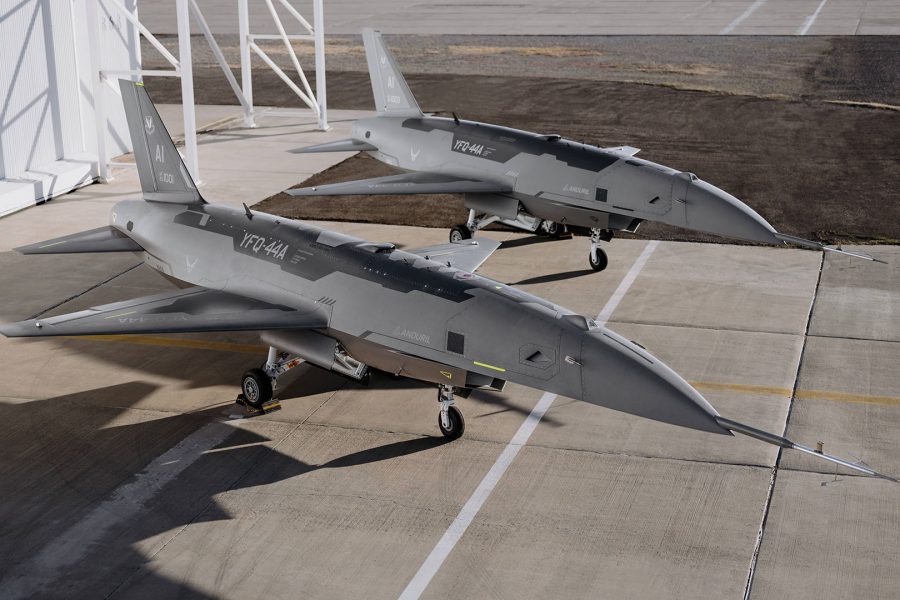
AURORA, Colo.—The Air Force has put inert weapons on its new uncrewed fighters for the first time and plans to conduct live weapons tests later this year. Those steps come as the service is moving to bring its new drone wingmen into service more rapidly than traditional aircraft.
“Collaborative Combat Aircraft development is progressing rapidly,” Air Force Chief of Staff Gen. Kenneth S. Wilsbach told a crowded ballroom of Airmen, Guardians, and civilians here.
“Our modernization efforts are two-pronged,” Wilsbach said of the service’s broader effort to overhaul its aging fleet and address its limited capacity. “First, we will ensure we have fight-tonight capability. We must guarantee that the joint force has air superiority. Delayed or drawn-out timelines could limit our ability to do that, so getting platforms from concept to employment as quickly as possible is our focus. But we also need to be able to fight tomorrow, next month, next year, and next decade.”
In addition to progress on the CCA program, Wilsbach said the new F-47 sixth-generation fighter “remains on track to fly soon,” and that the first B-21s will be delivered to Ellsworth Air Force Base, S.D., next year.
The new CCA milestone is the latest for a program that has maintained steady progress under two presidential administrations and multiple Chiefs.
“From concept to prototype in 16 months, to recently integrating inert weapons, the development teams are moving much faster than a traditional program,” Wilsbach said.
Collaborative Combat Aircraft recently carried inert AIM-120 AMRAAM air-to-air missiles, an Air Force spokesperson told Air & Space Forces Magazine. That capability was tested less than two years after awarding the first development contracts and roughly half a year after the two prototype aircraft, General Atomics’ YFQ-42A and Andruil’s YFQ-44A, first flew.
Both platforms are on track with weapons integration, the spokesperson said. The service has not yet committed to buying a specific platform—or platforms—Air Force officials say. The service will make a decision on the YFQ-42A and YFQ-44A later this year.
“We are following the same detailed approach used in every other aircraft developmental test program to validate structural performance, flight characteristics, and safe separation,” Wilsbach said in a statement. “This ensures the CCA can safely integrate inert weapons before future employment.”
Andruil’s YFQ-44A—which carries its weapons externally—has flown with the inert variant of the AIM-120, called Captive Air Training Missiles, the service spokesperson said. General Atomics’ YFQ-42A, which was nicknamed Dark Merlin by the company earlier Feb. 23, “is expected to begin this same phase in the very near future.”
“Currently, CCA weapons integration efforts for both the YFQ-42A and YFQ-44A platforms are focused on air-to-air weapons, utilizing variants of the AIM-120 missile system,” the Air Force spokesperson said.
GA’s YFQ-42A has an internal weapons bay, unlike its chief competitor, and will carry the missiles internally during the captive-carry testing.
“General Atomics has been integrating weapons for decades,” company spokesperson C. Mark Brinkley said. “No one wonders if we can put steel on target.”
The first CCAs are envisioned as aircraft tailored for air-to-air engagements, supplementing crewed aircraft such as the F-35A and future F-47, increasing weapons capacity and reducing risk to aircrews—what the Air Force calls a “human-machine team.”
“CCA is a critical part of a larger, integrated system-of-systems that will give our warfighters the overwhelming advantage,” Wilsbach added. “This program is about delivering a network of effects that will sense, strike, and shield our forces in contested environments. We are empowering our teams to take smart risks and deliver this capability faster, ensuring we can deter and, if necessary, defeat any adversary.”
Air Force officials stressed that the service is not yet ready deploy live weapons operationally from CCAs. And they emphasized that humans—not autonomous software—will retain the authority to release weapons through the developmental testing process, and the weapons will be employed as they would on a crewed aircraft.
“CCA is designed to operate within established command structures and legal frameworks that govern all Air Force weapons systems,” the Air Force said in a news release.
Shield AI is developing the operational software for Anduril’s YFQ-44A and Collins Aerospace is developing the software for General Atomics’ YFQ-42A, the service announced earlier this month. That so-called “mission” autonomy software will let CCAs fly missions alongside crewed fighters, taking complex action when given basic directions from a pilot.
The Air Force added it was conducting its weapons testing in a “deliberate and transparent manner” as it modernizes its force through “responsible innovation.”