
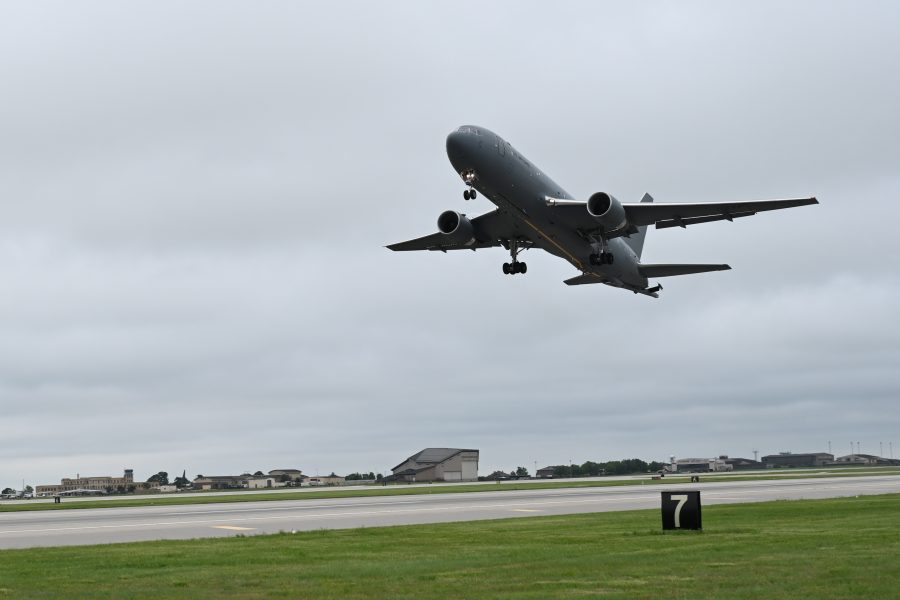
Boeing announced a new $565 million charge on its contract for the KC-46A Pegasus tanker, its first loss on the program since 2024.
In a Jan. 27 earnings call, company leaders said the charge is due to cost growth on the 767 airliner, which is the basis for the tanker, as well as an increase in engineering support to improve efficiency and quality on the KC-46 production line.
Boeing has now lost more than $7 billion on fixed-price contract for the KC-46, which CEO Kelly Ortberg acknowledged has been a “bad contract for the last decade.”
“While it’s disappointing to recognize another impact on this program, we are seeing encouraging operational performance trends which, if sustained, should enable us to meet our customer delivery commitment and sets us up well for the next tanker order beyond the current program of record,” Ortberg said. “You’re never done until you’re done on any of the development programs.”
Boeing is on contract to deliver 183 KC-46 refuelers for U.S. and international customers and will deliver a total of 188 as part of the baseline program. Last year, the Air Force revealed plans to extend Pegasus production and buy another 75 aircraft to recapitalize the aging KC-135 fleet.
While the production increase signals Air Force support for the program, it follows years of development challenges. Those challenges include deficiencies with the tanker’s boom actuator, persistent visibility issues with the Remote Vision System, and fuel system leaks. Last year, the company had to halt deliveries for three months due to cracks in the aircraft’s wings.
The latest KC-46 charge is Boeing’s first since October 2024, when it took a $661 million hit due to a machinist strike, which saw more than 30,000 union members stop work on the tanker and other key defense and commercial programs.
Executives said the recent cost growth doesn’t tell the full story of Boeing’s performance on the program of late. Chief Financial Officer Jesus Malave said during the call that production support investments cut “average factory rework levels” by 20 percent in the fourth quarter of last year compared to the first half of 2025.
“The added production costs include keeping higher levels of quality and engineering support in the factory, which are a key part of driving improvement,” Malave said. “While these investments are starting to evidence progress, we need to sustain them for longer than previously planned to promote stability.”
Boeing delivered 14 KC-46s in 2025 and is targeting 19 deliveries in 2026. As it wraps up its baseline production contract in 2026, the company is slated to start negotiating pricing for the tanker’s follow-on contract this fall. Ortberg said the company is “laser focused” on setting the right baseline and not repeating past mistakes.
“This has been a bad contract for the last decade, this existing contract,” Ortberg said. “As we enter into a new opportunity where we get to reprice, we want to make sure that we underwrite that contract to ensure it’s a fair contract and we can make money on that.”