

Boeing announced Feb. 20 it has opened a new production line dedicated to building electro-optical infrared sensors for the Space Force and other customers.
The 9,000-square foot manufacturing line is housed within the company’s satellite production facility in El Segundo, Calif. The expansion will help the firm’s small spacecraft arm, Millennium Space Systems, fulfill its contract to deliver 12 satellites in 2027 for the Space Force’s Resilient Missile Warning and Tracking program, or MWT MEO.
“By combining Millennium’s agility with Boeing’s EO/IR payload capability, we can deliver superior mission performance for the MWT MEO program,” Millennium CEO Tony Gingiss said in a statement. “We will continue investing in and expanding our production footprint to advance our capability and drive future mission success.”
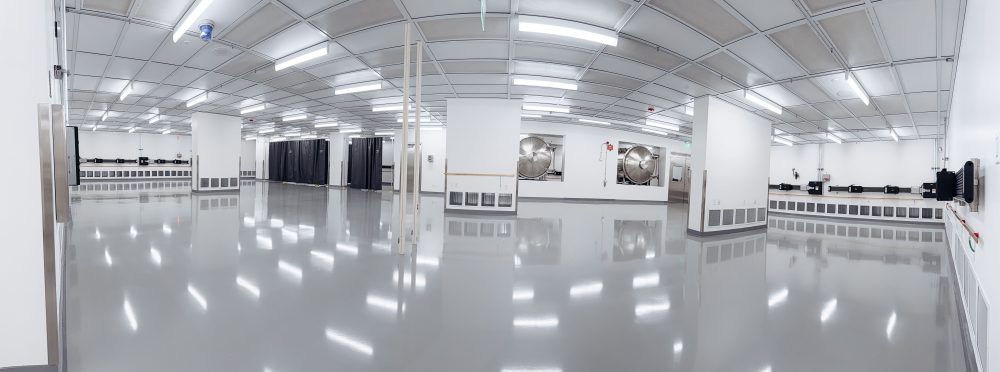
The missile warning and tracking satellites will be launched to medium-Earth orbit and are part of the Space Force’s broader architecture to detect and track enemy missiles from space. That architecture will likely play a key role in the Pentagon’s Golden Dome effort, which aims to create an advanced missile defense shield by stitching together new and existing capabilities, like space sensors and command-and-control systems.
The Space Force plans to launch the MEO satellites in batches or “epochs,” with Millennium’s spacecraft making up the first installment. The first launch was initially slated for 2026 but has since been pushed to mid-2027 due to supply chain issues. The service has also awarded a contract to BAE Systems to provide 10 satellites for Epoch 2, and L3Harris is on contract to develop a prototype for the program.
Beyond the Missile Warning and Tracking program, Boeing expects the added capacity will help the company rapidly scale production across its satellite production lines. The company has set a target to deliver 26 spacecraft this year—more than twice what it produced in 2025.
“We’re moving to more than double our satellite output this year, and investments like this, along with other factory upgrades and continued investment in our team, are how we do it with schedule credibility,” Sam Greaves, Boeing’s interim vice president for space mission systems, said in a statement.
The company’s emphasis on scaling satellite production comes amid Defense Secretary Pete Hegseth’s campaign to put defense industry on “wartime footing.” Last November, the Pentagon issued a strategy to transform the way it buys and delivers systems, increase production, and hold companies accountable for poor performance. Hegseth has since been on a nationwide speaking tour of the defense industrial base, visiting factories and encouraging the workforce to meet the moment.
During a Feb. 18 visit to Boeing’s St. Louis, Missouri factory—where the company builds the F-47 and F-15EX fighters, the T-7 trainer, and weapons like the Joint Direct Attack Munition—Hegseth urged Boeing employees to adopt the same sense of urgency.
“Our only job is to say, run faster, cut more deals, invest more deeply—not just in another shift but a new production line and then another line next to it,” he said. “It’s not enough to just provide a little bit more. We need a lot-a-bit more given the states and the threats in front of us.”