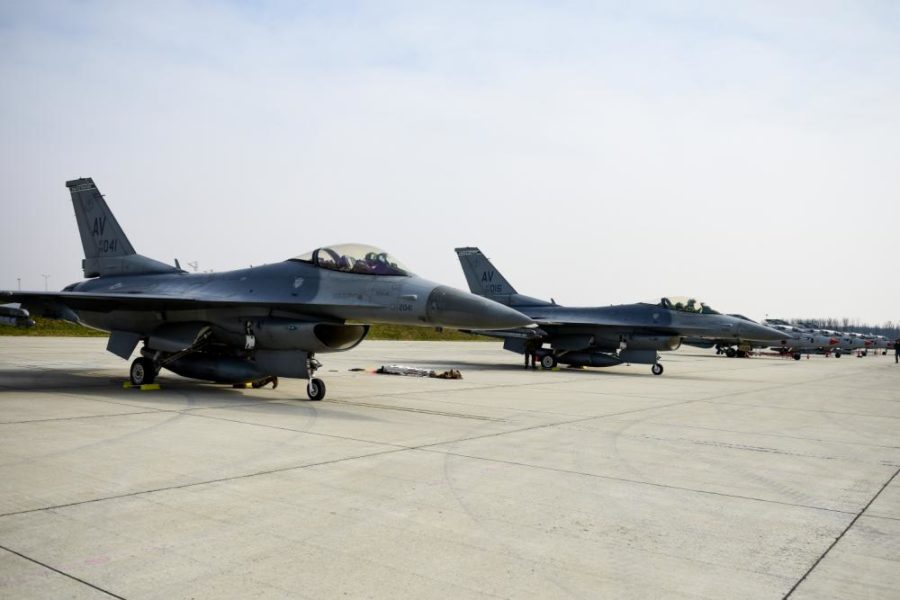
Two U.S. Air Force F-16C Fighting Falcon aircraft assigned to the 555th Fighter Squadron from the 31st Fighter Wing, Aviano Air Base, Italy, fire up jets next to Croatian MiG-21 aircraft assigned to the 191st Fighter Squadron at Croatia’s 91st Air Base at Pleso, March 17, 2022. U.S. Air Force photo by Tech. Sgt. Miquel Jordan.
Audio of this article is brought to you by the Air & Space Forces Association, honoring and supporting our Airmen, Guardians, and their families. Find out more at afa.org
A pair of F-16s deployed from Aviano Air Base, Italy, to Croatia on March 16, taking part in agile combat employment exercises and bolstering NATO’s southeastern flank, the Air Force announced.
The F-16 fighters’ arrival comes just a few days after a military drone crashed in the Croatian capital of Zagreb amid nearby war between Russia and Ukraine. Croatian officials say the drone had a bomb, but they have not determined whether it was Russian or Ukrainian. The incident has led Croatian leaders to criticize NATO for a perceived slow response.
On March 15, Newsweek reported that Croatian Prime Minister Andrej Plenković said in a press conference that the U.S. would send the F-16s to “give support of Croatia’s security.”
A subsequent press release from U.S. Air Forces in Europe stated that the fighters would deploy to Croatia’s 91st Air Base at Pleso, just outside the capital.
“Our enduring alliances and partnerships throughout the European and African theaters have enabled our multi-capable Airmen to execute our mission as a dynamic coalition force,” Gen. Jeffrey L. Harrigian, USAFE-Air Forces Africa commander, said in a statement. “Directing our strategic capabilities from any number of forward locations builds a resilient force, ready to pivot and counter aggression anywhere at a moment’s notice.”
This marks just the latest deployment of fighters to Eastern Europe. In the lead-up to Russia’s invasion of Ukraine, F-16s deployed to Romania, F-15s went to Poland, and F-35s landed in Germany. As the invasion first unfolded, F-35s from Germany were deployed to NATO’s eastern flank, including Romania. A B-52 also deployed to the region around the same time, as part of what USAFE called a “long-planned Bomber Task Force Europe mission over the Arctic and Baltic Sea regions.”
While President Joe Biden has repeatedly said the U.S. will not deploy forces into Ukraine to help them resist the Russian invasion, he has pledged to defend “every inch” of NATO territory. Croatia became a full NATO member in 2009.
Audio of this article is brought to you by the Air & Space Forces Association, honoring and supporting our Airmen, Guardians, and their families. Find out more at afa.org
The Air Force’s future strategy for fighting wars could include arming bombers with air-to-air strike capabilities, the service said in a new report to Congress.
The Pentagon has concluded a new agreement to buy laser-guidance kits that turn rockets into drone-killing weapons. BAE Systems and the Defense Department announced a framework deal of up to seven years for 25,000 Advanced Precision Kill Weapon System guidance kits annually for the U.S. military.
The Pentagon and Lockheed Martin on Oct. 22 announced a framework agreement to buy F-35 Joint Strike Fighters for the next 10 years. But the deal, touted by the Pentagon as “landmark” and a first of its kind, depends on Congress granting the military authority to enter into such a…
At least two KC-135 Stratotankers that were seriously damaged during Operation Epic Fury are still undergoing extensive maintenance depot repairs, the head of Air Force Materiel Command said Oct. 21.
As the Air Force wrestles to solve the logistics of dispersed operations in the vast Indo-Pacific, it’s investing $3.5 million to help develop a new kind of aircraft: a blended-wing body freighter that’s smaller than a C-130 but larger than a Cessna for “sub-tactical” lift.
Roughly two of every five fighters in the Air Force fleet could be F-35As by 2035, according to a new fighter force structure report the service submitted to Congress on Oct. 16. Lt. Gen. David Tabor, deputy chief of staff for plans and programs, revealed the new estimate during an…
The Air Force Life Cycle Management Center is moving forward with a program to upgrade a quarter-century-old computing system for some F-16 fighter jets.
The U.S. Navy on Oct. 15 accepted a C-130J-30 Super Hercules plane that it will modify to become the first of its new nuclear command, control, and communications aircraft—a route the Air Force is considering for a similar NC3 mission under congressional direction.
More than 40 years after the original YF-117 operational prototype flew test runs from a Lockheed Martin Skunk Works facility, an F-117 returned for a $1 million refurbishment to look its best when it assumes its place in history alongside other iconic aircraft on permanent exhibit at the National Air…
✓
Thank You!
Check your inbox to verify your email address and finish setting up your AFA account.
★
Welcome Back!
An account with this email already exists. Please log in to continue.
Subscribe to the Air & Space Forces Daily Report
The latest news from Air & Space Forces Magazine, as well as news from other leading publications, delivered right to your inbox every morning!
We’re sorry, there has been an error. Please review your input or try again later.