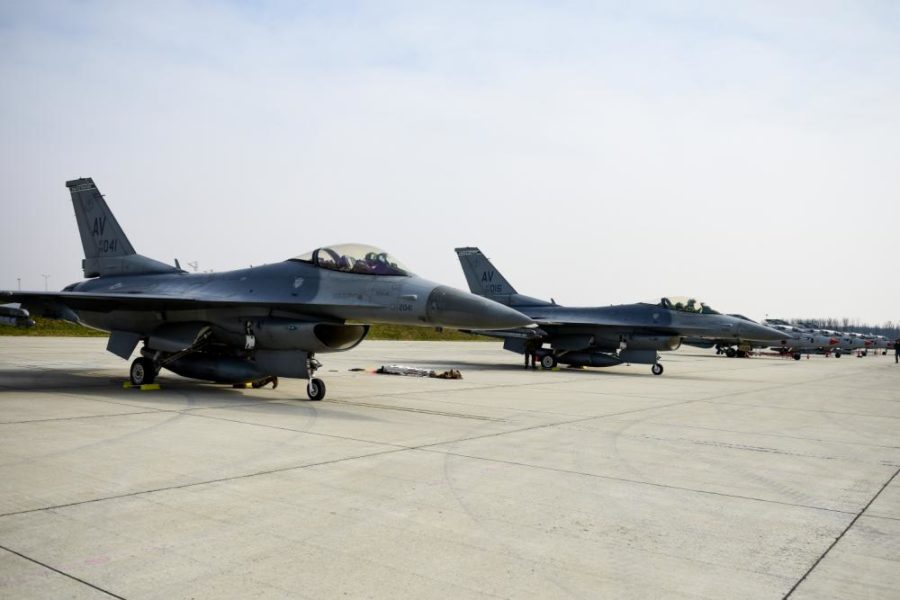
Two U.S. Air Force F-16C Fighting Falcon aircraft assigned to the 555th Fighter Squadron from the 31st Fighter Wing, Aviano Air Base, Italy, fire up jets next to Croatian MiG-21 aircraft assigned to the 191st Fighter Squadron at Croatia’s 91st Air Base at Pleso, March 17, 2022. U.S. Air Force photo by Tech. Sgt. Miquel Jordan.
Audio of this article is brought to you by the Air & Space Forces Association, honoring and supporting our Airmen, Guardians, and their families. Find out more at afa.org
A pair of F-16s deployed from Aviano Air Base, Italy, to Croatia on March 16, taking part in agile combat employment exercises and bolstering NATO’s southeastern flank, the Air Force announced.
The F-16 fighters’ arrival comes just a few days after a military drone crashed in the Croatian capital of Zagreb amid nearby war between Russia and Ukraine. Croatian officials say the drone had a bomb, but they have not determined whether it was Russian or Ukrainian. The incident has led Croatian leaders to criticize NATO for a perceived slow response.
On March 15, Newsweek reported that Croatian Prime Minister Andrej Plenković said in a press conference that the U.S. would send the F-16s to “give support of Croatia’s security.”
A subsequent press release from U.S. Air Forces in Europe stated that the fighters would deploy to Croatia’s 91st Air Base at Pleso, just outside the capital.
“Our enduring alliances and partnerships throughout the European and African theaters have enabled our multi-capable Airmen to execute our mission as a dynamic coalition force,” Gen. Jeffrey L. Harrigian, USAFE-Air Forces Africa commander, said in a statement. “Directing our strategic capabilities from any number of forward locations builds a resilient force, ready to pivot and counter aggression anywhere at a moment’s notice.”
This marks just the latest deployment of fighters to Eastern Europe. In the lead-up to Russia’s invasion of Ukraine, F-16s deployed to Romania, F-15s went to Poland, and F-35s landed in Germany. As the invasion first unfolded, F-35s from Germany were deployed to NATO’s eastern flank, including Romania. A B-52 also deployed to the region around the same time, as part of what USAFE called a “long-planned Bomber Task Force Europe mission over the Arctic and Baltic Sea regions.”
While President Joe Biden has repeatedly said the U.S. will not deploy forces into Ukraine to help them resist the Russian invasion, he has pledged to defend “every inch” of NATO territory. Croatia became a full NATO member in 2009.
Audio of this article is brought to you by the Air & Space Forces Association, honoring and supporting our Airmen, Guardians, and their families. Find out more at afa.org
In a dramatic flare-up in the hostilities between the U.S. and Iran, American forces struck and destroyed five Iranian oil tankers Sept. 8, U.S. Central Command said. Iran retaliated by lobbing ballistic missiles toward a major U.S. base in Jordan.
After months of delays, the first F-15EX fighter jet the U.S. Air Force will permanently base overseas left Boeing’s facilities in St. Louis on Aug. 28. Eventually, the aircraft will fly to Kadena Air Base in Japan and join the 18th Wing there, but for now it is going to…
The Air Force is accelerating its plans to field an MQ-9A replacement in the wake of heavy Reaper losses in operations against Iran, top officials said Sept. 3, and they’re targeting a price point of just $10 million per aircraft.
The U.S. is rotating fresh fighter squadrons to the Middle East to support the Trump administration’s open-ended campaign of economic and military pressure against Iran.
An F-16 Air National Guard unit’s six-month deployment to Kadena Air Base, Japan, this year illustrated the capabilities the Guard’s oldest fighter units can still offer—but also the challenges they face, officials told reporters this week.
The last EC-130H Compass Call in the Air Force’s active inventory made its final flight Sept. 2, as the service prepares to retire the venerable electronic warfare aircraft and pivot to the new EA-37B.
Air Force B-52 Stratofortress bombers landed at a northern Australian air base this week, a major display of the U.S. military’s ability to project force in the Pacific.
The base cost of an F-35A, the Air Force variant of the Joint Strike Fighter, is going up 11.5 percent from $82.5 million to $92 million for the latest lots of the fifth-generation aircraft, Air & Space Forces Magazine has confirmed.
✓
Thank You!
Check your inbox to verify your email address and finish setting up your AFA account.
★
Welcome Back!
An account with this email already exists. Please log in to continue.
Subscribe to the Air & Space Forces Daily Report
The latest news from Air & Space Forces Magazine, as well as news from other leading publications, delivered right to your inbox every morning!
We’re sorry, there has been an error. Please review your input or try again later.