
The People’s Liberation Army Air Force is growing at an alarming rate.
The world is changing—fast. And you don’t need to have exclusive access to bespoke intelligence capabilities to see those changes yourself. Open-source intelligence sources can now inform public debate on national security issues like never before. Commercial satellite imagery accessible with a credit card offers anyone a store of information about economic and military developments in areas once totally obscured to the public, including Iran, Russia, North Korea, and China.
At the end of the Cold War, spy satellites like the “Keyhole 9” were the world’s only source for collecting images of sites like the “132 Plant” in central China. The ability to capture those sites was so
secretive that the images themselves were classified. In the early 1980s, 132 Plant, an aircraft factory, had just started full-rate production of the third-generation J-7 fighter, a Chinese copy of the 1960s-era Soviet Mig-21. Forty years later, commercial satellite images of that same plant in Chengdu, China, offer insights about the production of the People’s Liberation Army Air Force (PLAAF) fifth-generation air superiority fighter, the J-20 Mighty Dragon. If you know where to look, commercial satellite imagery reveals a great deal about China’s growing air force —and what it might do next.
In the 1980s, the Keyhole 9 satellite, code-named Hexagon, peered down from orbit on enemies and potential adversaries around the globe. Built by Lockheed Martin, Keyhole 9 was the size of an
articulated two-segment city bus—60 feet long, 10 feet wide and weighing 15 tons. Even compared to the space shuttle, the Hexagon satellites were probably the most complicated mechanical platforms any nation has ever put into space. Inside Hexagon, 30 miles of high-resolution film fed through over 100 rollers at speeds up to 200 inches per second, enabling cameras to capture unique imagery.
Exposed, the film was automatically rolled up into film recovery capsules and then ejected and sent back to Earth like an escape pod. A specially equipped C-130 snagged the capsules as they parachuted over the ocean and brought the film in to be developed.
Commercial satellite imagery reveals a great deal about China’s growing air force—and what it might do next.
Many governments still satisfy their most pressing intelligence requirements using highly classified imaging satellites, although today those images are captured and transmitted digitally. What’s changed is that hundreds of commercial satellites can now match many of those capabilities. Vantor’s Worldview Legion satellite is a fraction of the size of the Keyhole 9, but captures extremely high-resolution color as well as multispectral and near-infrared images that can be downloaded soon after they are taken. Planet Labs’ SkySat satellite, just about the size of a mini fridge, has similar capabilities. The number of companies offering commercial satellite imagery is growing every year. Some can even deliver synthetic aperture radar imagery or hyperspectral imagery.
Today’s smaller, less costly satellites are deployed in constellations and enable increased revisit rates against targets around the world—sometimes even several times a day. This creates opportunities to observe military activity over time and chart changes in the scale and scope of operations and tactics. A series of satellite images captured in the fall of 2025 offer a compelling story about remote desert air bases in Western China and a large-scale PLAAF exercise.
An Oct. 30, 2025, satellite image of Hotan Air Base in China’s Xinjiang region revealed 24 J-16 fighters belonging to the PLAAF’s 99th Air Brigade, the only unit stationed at the base. The image also showed four H-6 bombers, 12 J-20 fighters, four Y-20 transports or tankers, and eight special mission aircraft, including several KJ-500 airborne early warning and control (AEW&C) aircraft. At the time, there were no reports of tensions in Xinjiang or on the nearby China-India border. The presence of such an array of aircraft indicated an unusaul deployment in western China. Examining other commercial satellite images in the PLA’s western theater command at routine intervals revealed a major PLAAF exercise involving as many as eight air bases.
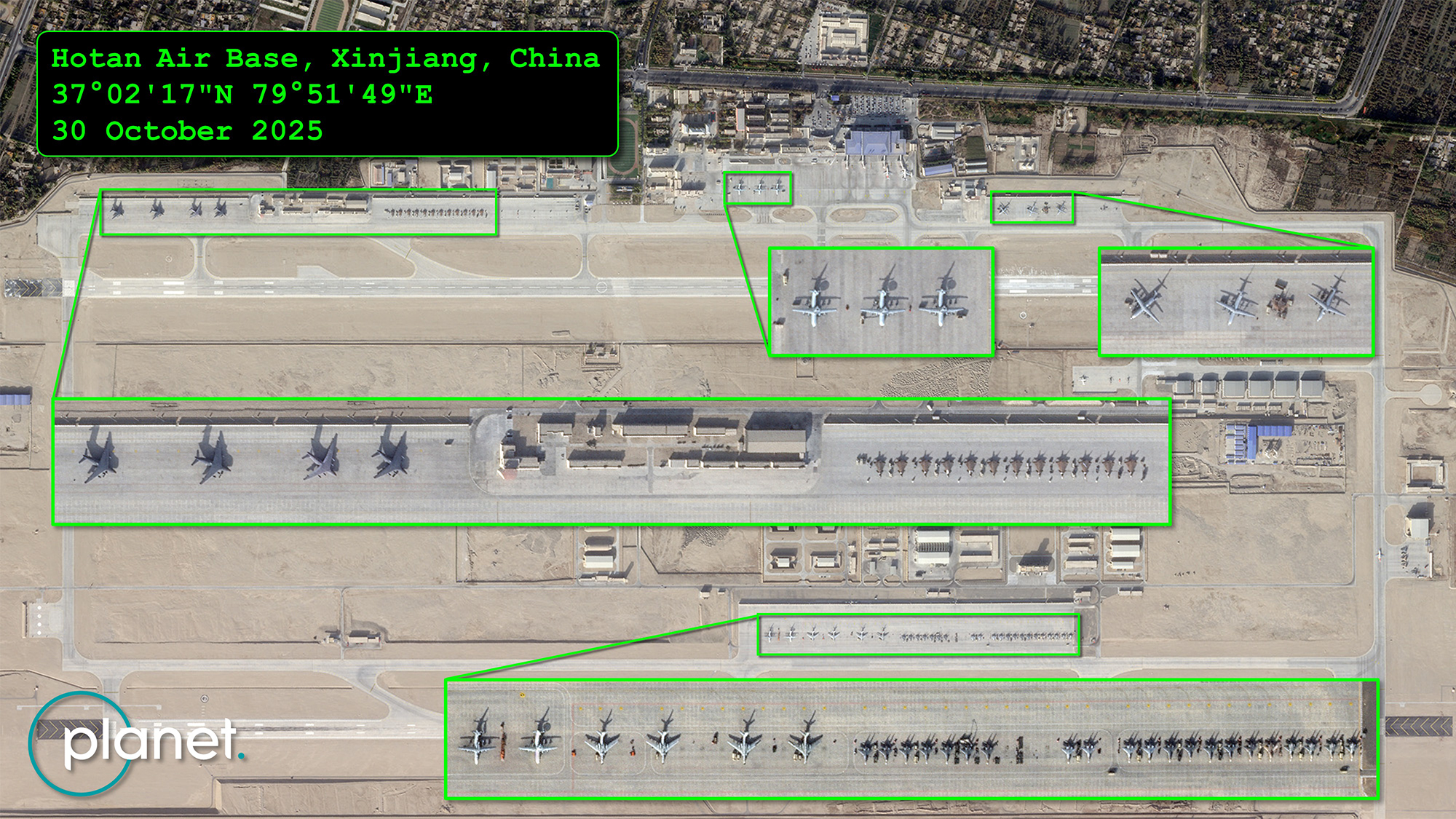
The exercise was most likely the PLAAF’s annual “Red Sword,” which is modeled after the U.S. Air Force’s Red Flag exercises. It brings together PLAAF units from all over China. Several years ago, the PLAAF issued press releases about the large-force air combat exercise, but it has since gone quiet about the annual event. Commercial satellite imagery now allows open-source analysts to glimpse what is happening behind the veil of PLA operational security.
In early November 2025, all eight air bases involved in the exercise were imaged within a 24-hour period, allowing for an accurate count of aircraft at each base and a reasonably accurate total for all eight. We counted 194 aircraft on the ramp at the eight air bases, and while not all of those necessarily participated—and because others may have been flying or hidden in hangars when the satellites passed overhead—it is reasonable to surmise that the total exercise count could have exceeded 250 aircraft operating in an area spread over an area of over 1,200 nautical miles.
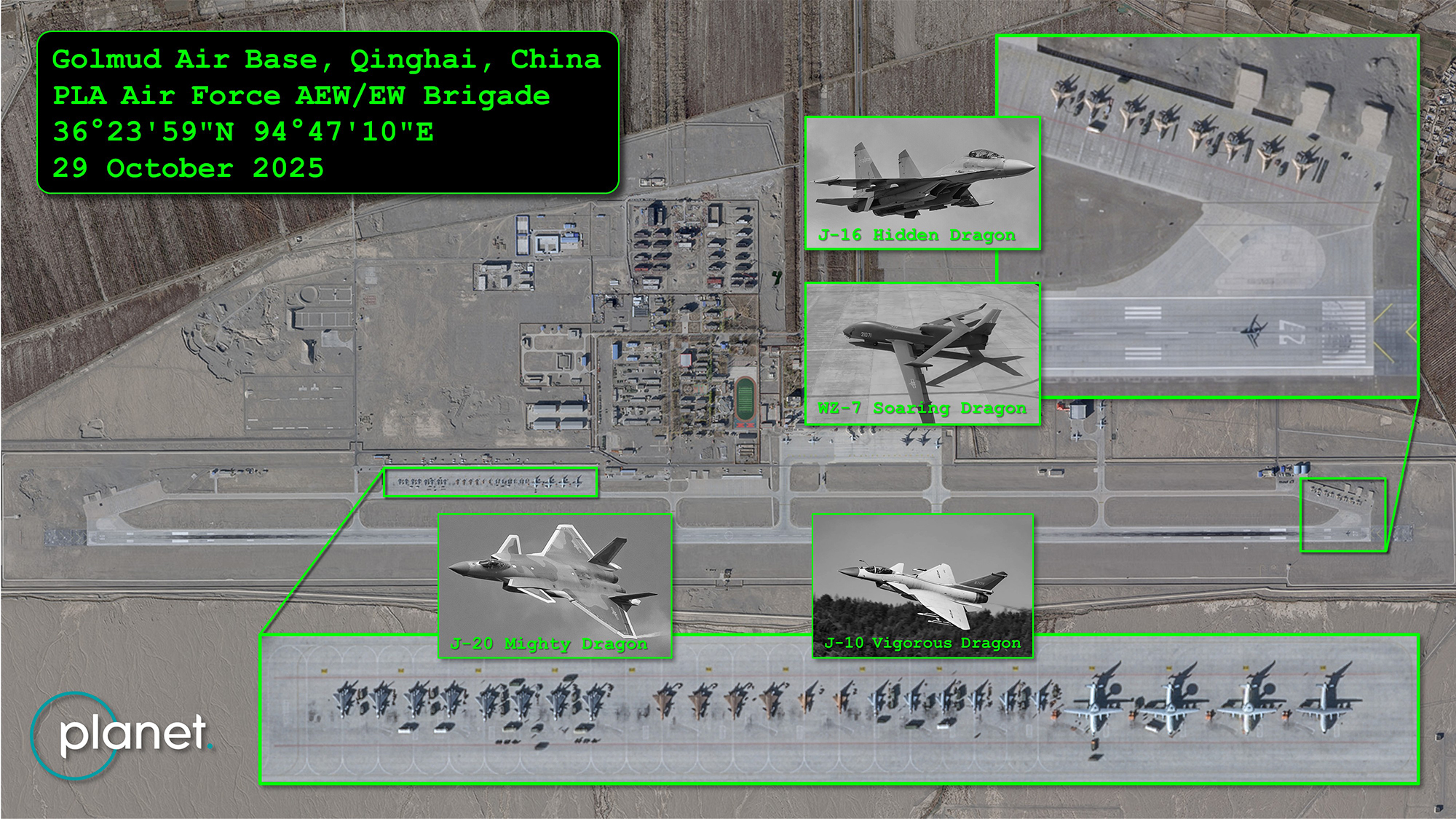
Satellite imagery alone cannot tell an analyst how many aircraft flew in a particular event, whether there was an opposition force, or how well the PLA aircraft executed their missions. What it can do, however, is offer insights. Golmud Air Base at the base of the Tibetan Plateau is home to a brigade of special mission aircraft. An October 2025 satellite image shows 12 J-20, eight J-10, and eight J-16 fighters lined up on the ramp next to three KJ-500 AEW&C aircraft. There is also a WZ-7 Soaring Dragon high-altitude long-endurance (HALE) UAV preparing to take off. A typical PLAAF fighter brigade comprises 24 or 36 aircraft, which raises questions about why these small detachments may have been deployed to this remote base. These aircraft might have been conducting dissimilar air combat training (DACT): fighters flying against different types of fighters. They might have made up part of an exercise “blue force.” (PLA exercises dub enemy forces “blue” and friendly forces “red,” the opposite of U.S. designations.) Taken as a single force package, however, the mix of 4th- and 5th-generation fighters and the KJ-500s may indicate that the PLAAF is advancing toward exercising fighter integration—developing tactics, techniques, and procedures to combine 5th-generation sensing and stealth capabilities with 4th-generation aircraft in mixed formations.
Archived commercial satellite imagery is also a powerful tool to monitor developments in military activity over time. Satellite images of probable Red Sword exercise activity at the end of 2023 and 2024 reveal that the 2025 exercise was the largest Red Sword event over the past several years in terms of participating air bases and number of aircraft.
Each year, the PLA Air Force executes a series of weeks-long large-scale exercises to hone combat capabilities and prepare for large-scale conflict. Red Sword exercises are about force-on-force, system-of-systems air combat. “Blue Shield” is the PLAAF’s principal air and missile defense exercise, while “Qingdian” is a large-scale electronic warfare exercise. There are also PLAAF-wide aircrew competitions each year—“Golden Helmet” for fighter air combat and “Golden Dart” for ground attack and bombing.
The PLA, meanwhile, attempts to actively shape narratives surrounding Taiwan and East Asian security by announcing and executing flashy one- or two-day exercises in the Taiwan Strait with names like “Joint Sword” and “Justice Mission.” Social media and news outlets amplify these PLA influence operations by reposting PLA video of live-fire drills and the potential threat to Taiwan. But the PLAAF can only generate two days of sorties in southeast China for these displays without stressing aircrew, maintenance, or logistics. In contrast, using open-source intelligence to analyze large-scale exercises offers less filtered indicators about PLA capabilities and the air threat facing China’s neighbors.
Commercial satellite imagery is also useful in examining how foreign military infrastructure changes over time, enabling analysts to discern force development trajectories and future intentions. Extensive construction at or near Chinese air bases, naval bases, and space launch facilities indicates aggressive growth.
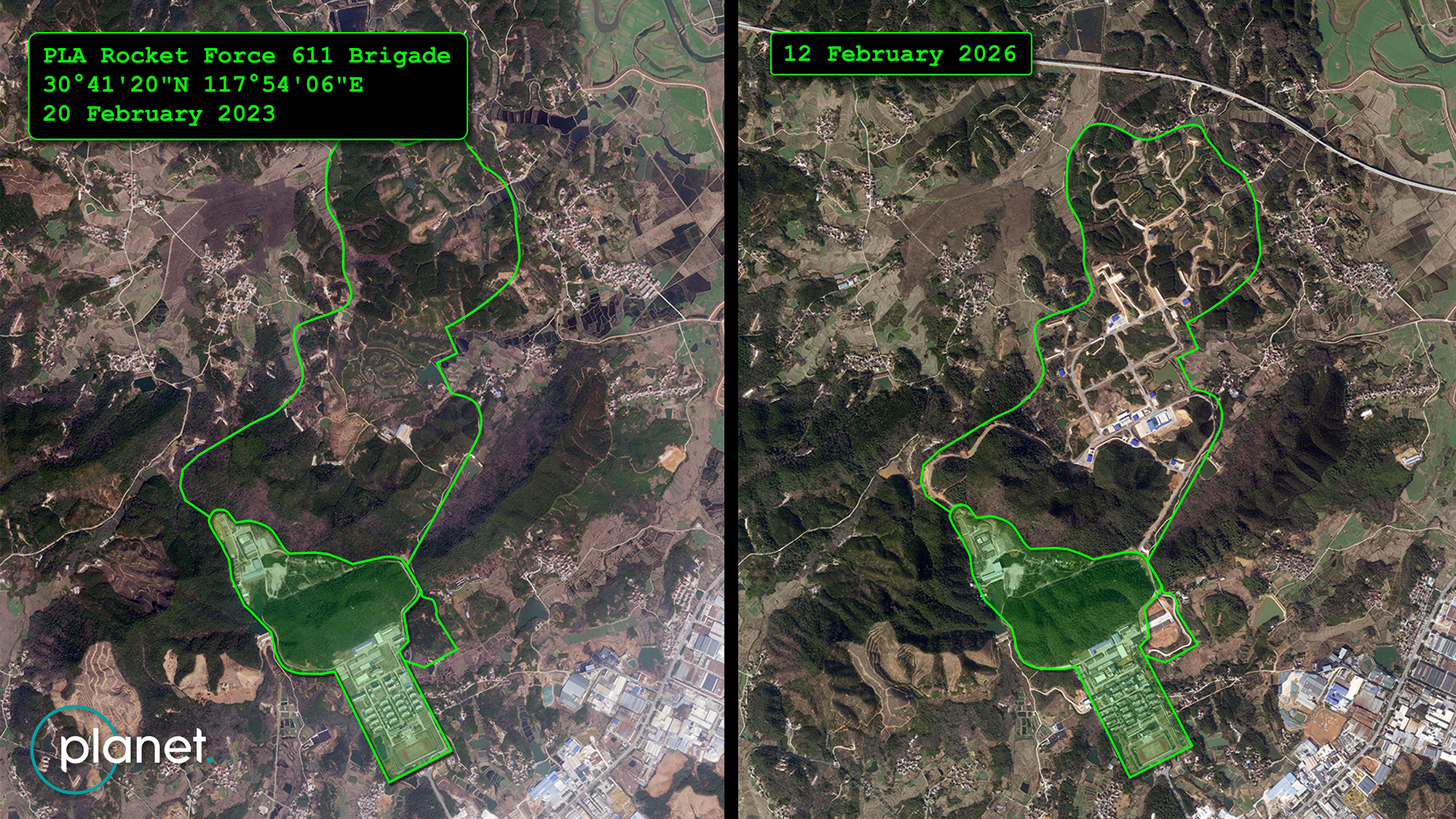
One example can be found near a PLA Rocket Force garrison in eastern China. The 611 Brigade operates the DF-26 road-mobile, intermediate-range ballistic missile. The DF-26 can deliver a 3,000-pound warhead over 2,000 nautical miles—far enough to earn it the nickname “Guam Killer” or the “Guam Express.” The missile can cover the distance from the 611 Brigade garrison to Guam in about 17 minutes. With a high-loft trajectory, the missile could reach U.S. and Japanese bases in Okinawa and the Ryukyu Islands in about half that time.
In the event of a war, the 611 Brigade most likely would not shoot missiles from its garrison location, but by means of mobile transporter-erector-launchers (TELs), the brigade would disperse to hide sites from which troops would set up, launch, break down, move, set up, and shoot again. Those “scoot-and-shoot” operations in public areas are not without counter-targeting risks. They also add to missile firing timelines and make logistics and resupply more difficult. A simple solution would be to construct missile hide sites in a secure area near the missile brigade garrison—and that may be exactly what the PLA Rocket Force did.
A review of archived commercial satellite imagery reveals that the 611 Brigade has built a network of roads, man-made tunnels, and over four dozen launch pads in the hills north of the garrison. The sprawling facility may be nothing but training infrastructure: a “combat town” for missile TELs where they exercise movement, set up, camouflage, fire, and reposition. But the size of the facility and the number of concrete shelters and launch pads suggest instead that the DF-26 brigade may intend to use the area to play a “shell game” in military conflict: Now you see the TEL, now you don’t.
An integrated deception strategy might have dummy missile TELs and camouflage netting distributed throughout the complex. The hide sites are in a secure area, away from public view near the garrison. Personnel and supplies are only minutes away, allowing the brigade to stay on high alert for weeks. Hitting every hide site and launch pad in the complex might take over 100 weapons, based on a rough weaponeering analysis of the facility. Even then, the complex could be filled with decoys and devoid of any operational TELs and missiles.
Hunting mobile missiles, especially deep inside adversary territory, is an extremely challenging mission that consumes intelligence, reconnaissance, and airstrike resources. The United States and its allies learned this lesson by conducting extensive, but often unsuccessful, “Scud hunts” for Iraqi Scud missiles during the 1991 Gulf War. U.S. and Israeli forces have reportedly met with greater success against Iranian missile TELs in more recent operations, but the after-actions on those engagements are not yet available. In any case, the infrastructure developments at the 611 Brigade—either as a training facility or an operational launch base—are an indication that the PLA Rocket Force is actively working to create a next-level “Scud hunt” challenge for China’s adversaries and employ a survivable force to strike targets across East Asia.
This openly available intelligence literally hides in plain sight. While a purportedly leaked video of a new PLA aircraft or weapon will generate headlines around the world, images like these offer more information but less drama. The airplane videos fit a PLA narrative—true or otherwise—about advanced Chinese military technology and capabilities. The satellite images, however, require significant commitments of time and money to acquire and analyze. But they tell a story the PLA cannot easily hide. Examining satellite imagery of military infrastructure investments probably provides better indicators of PLA goals and objectives than a few images of new PLA hardware flashing across social media.
In December 2024, Chinese aircraft manufacturers revealed what social media and news outlets quickly identified as a PLA “6th-generation” aircraft. What aviation enthusiasts dubbed the “J-36” fighter-bomber and “J-50” fighter were photographed conducting initial flight testing over Chinese aircraft factories in Chengdu and Shenyang, respectively. What followed was a steady drumbeat of “leaked” photos and additional flight tests over these densely populated areas before the aircraft disappeared from public view in summer 2025.
In August 2025, Planet Labs satellites captured an image of the J-36 at China’s aircraft test and evaluation base in Lop Nur, China. Seventeen days later, another satellite image of the base revealed the J-50 sitting outside the hangar. It is possible that extraordinarily security-conscious Chinese
engineers made a mistake in revealing the J-36 at Lop Nur—and then made a second mistake in revealing the J-50. The base, which has been called China’s “Area 51,” is located in an area so remote that it once served as China’s testing ground for above-ground nuclear tests.
But perhaps the exposure of China’s next-generation prototype aircraft was not an accident. As China and the PLA attempt to shape narratives about military capabilities, Chinese authorities may now assume that someone is always watching from space. If China wants to continue a drip of information about their next-generation aircraft that predictably creates a torrent of speculation on the internet, commercial satellite imagery now provides a vehicle for that effort as well.
Beyond the appearance of two prototype aircraft that may never go into production, we can zoom out to literally see the bigger picture at the test and evaluation base. Looking at the base infrastructure provides a better indication of China’s investment in advanced aircraft development. Construction activity at the Lop Nur base began in August 2025, around the time when the J-36 was first spotted at the base. Six months later, in February 2026, the base added 60,000 square feet of hangar space and over 300,000 square feet of facility space. Some of that is probably test and evaluation facilities, and some may be additional housing for personnel. Whatever the case, in just a few months China effectively doubled the size of this remote testing base. These infrastructure investments underscore how seriously China takes its aircraft development competition with the West.
Possibly more concerning than new types of aircraft is the number of aircraft that Chinese factories can produce. Again, examining PLA infrastructure and military aircraft factories provides critical insights into what China aims to do in terms of inventory.
China’s military aircraft industry is controlled by a state-owned conglomerate known as the Aviation Industry Corp. of China, or AVIC. There are seven major aircraft factories across China that specialize in the production of different types of military aircraft.
Commercial satellite imagery of AVIC’s Changhe Aircraft Industry Corp. reveals the plant is currently completing about 1 million square feet of additional manufacturing space, having begun construction in mid-2024. The Changhe plant is responsible for building attack helicopters and heavy-lift transport helicopters—the types that would likely play a key role in a cross-strait operation against Taiwan. The expanded facility represents a 30 percent increase in manufacturing space and likely indicates that China will acquire new attack helicopters and heavy-lift helicopters in the coming years.
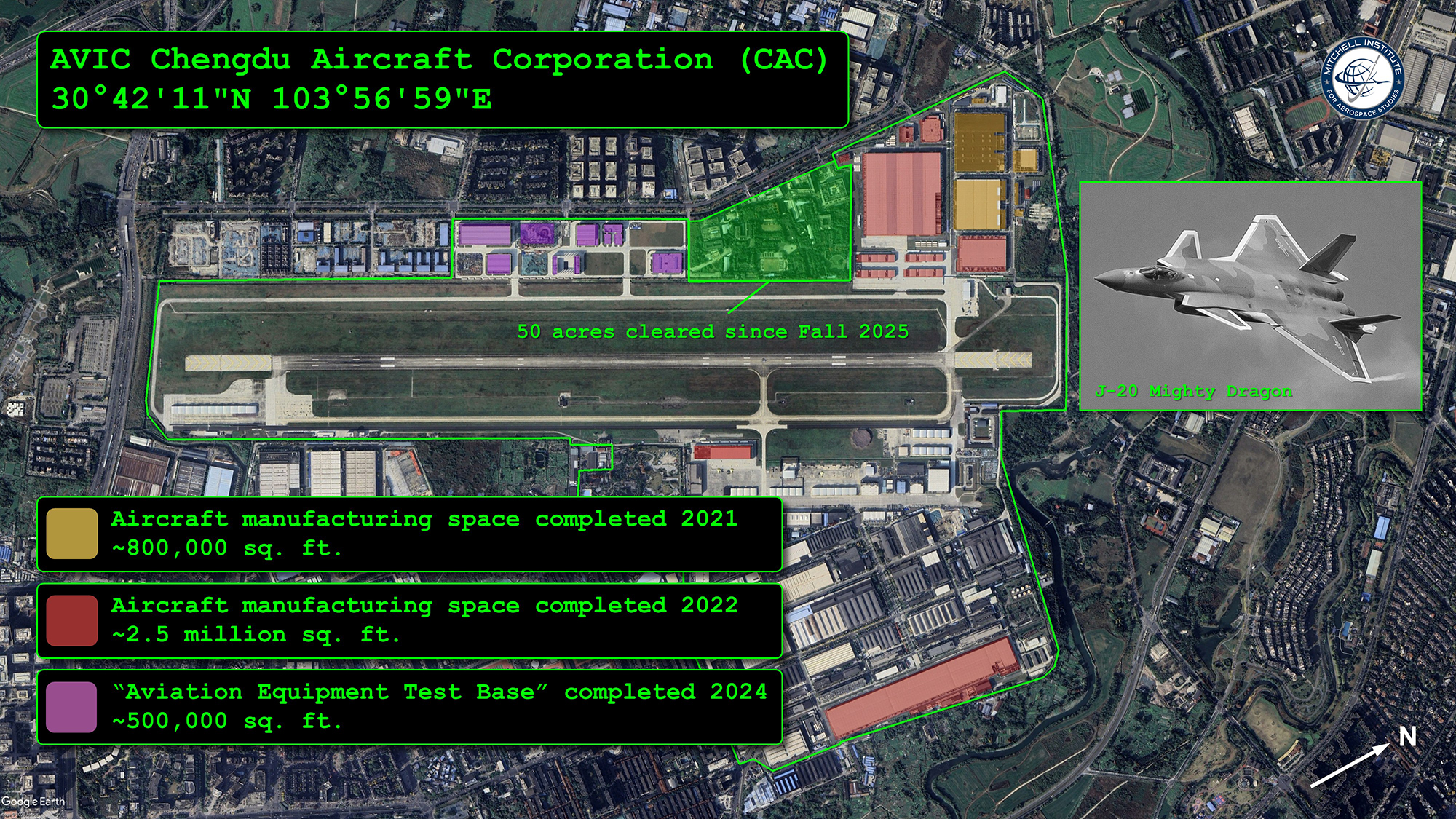
The Chengdu Aircraft Corp. factory featured at the top of this article is the plant where the J-36 was seen taking off and landing in 2024 and 2025. Beyond research and development, the factory is now almost completely dedicated to manufacturing 5th-generation J-20 air superiority fighters. The plant is reportedly running five production lines for the J-20, with estimated production between 100 and 120 aircraft per year. Looking back at infrastructure development over time supports that assessment. Satellite images show some 800,000 square feet of additional manufacturing space was completed by 2021. By 2022, another 2.5 million square feet of manufacturing space was added, and in 2024, what Chinese sources describe as an “aviation equipment test base” was added—another 500,000 square feet of manufacturing space, which may represent the research and development facility behind the J-36.
As of early-2026, 50 acres on the north side of the plant have been cleared, probably for another expansion of the Chengdu plant.
Infrastructure expansions have not been observed at China’s other fighter production plant in Shenyang, where the J-50 was seen performing flight tests last year. The Shenyang Aircraft Corp. factory only saw a modest increase in manufacturing space since 2023—about 500,000 square feet. The plant currently produces the PLAAF’s J-16 and the carrier-based J-15 for the PLA Navy—the planes are Chinese derivatives of the Russian Su-30 and Su-33, respectively. The Shenyang factory is also responsible for initial production of the 5th-generation J-35, which, based on external appearances, is a Chinese copy of the U.S. F-35. AVIC recently announced that, in addition to producing the J-35 for the PLA Navy, the PLAAF has also ordered a variant designated the J-35A.
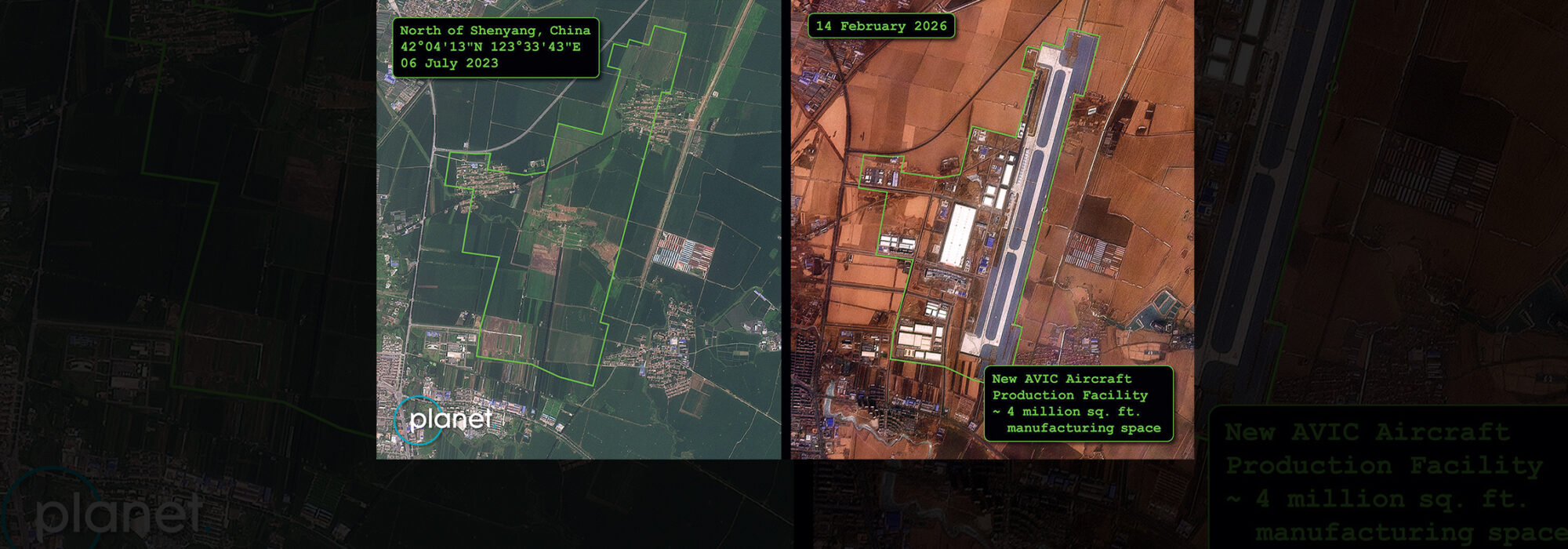
In order to facilitate production of the J-35 at the Shenyang plant, AVIC would need to stop or significantly slow production of J-15s and J-16s. But AVIC seems to have selected a third option—build an entirely new aircraft production plant. Two and a half years ago, two small villages were razed just 10 miles north of the existing plant and construction is underway on what appears to be a new production facility.
The factory is still in the final stages of construction. My analysis of commercial satellite imagery indicates the manufacturing complex has about 4 million square feet of total manufacturing space, a 12,000-foot runway, and what appears to be a large glass and steel headquarters building. This new factory is probably where AVIC will produce the J-35 for the PLA Air Force and Navy and could play a role in future aircraft development and production.
The expansions at the two fighter production plants, combined with the new manufacturing facility north of Shenyang, represent over 8 million square feet of additional aircraft manufacturing space—more square footage than Lockheed-Martin’s entire U.S. F-35 manufacturing production complex in Fort Worth, Texas.
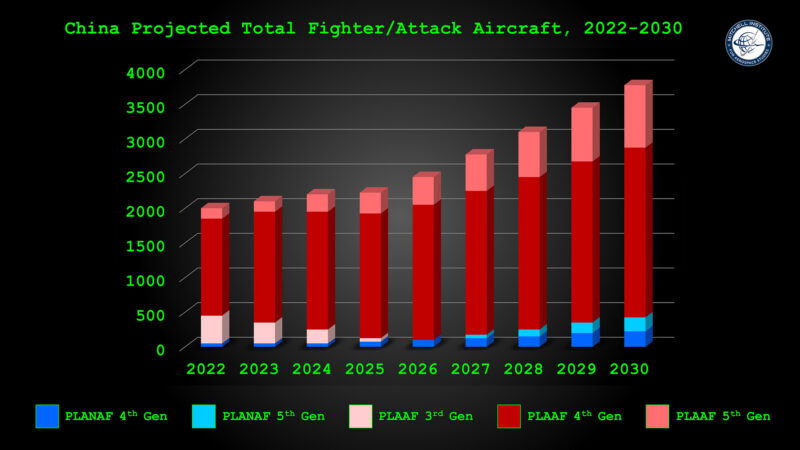
By any measure, China’s inventory of fighter and attack aircraft will grow significantly over the next five years. Chinese media reports supported by commercial satellite imagery analysis shows the PLA Air Force purged itself of its 3rd-generation J-7 and J-8 fighters by or before 2025. Having now replaced those older aircraft with newer models, the PLAAF can focus on growth.
Based on observed factory infrastructure growth and other open-source reporting, AVIC may soon have the capacity to produce as many as 300 4th- and 5th-generation fighters for the PLA each year. That would put the PLA Navy and Air Force on a trajectory to have more fighters than the U.S. Air Force, Navy, and Marine Corps by 2028. By 2029, China could have the largest fighter force in the world—and be poised to continue to grow.
All of this raises a central question: Why is the PLA trying to grow its Air Force and aircraft carrier fleet. It is overkill to generate so much capacity simply for a Taiwan contingency. The more likely reason is ambition.
For decades, China has declared its intention to build a world-class military by the middle of this century—to be on par with the U.S. military by 2049. China’s military has been given a mission by the Communist Party to defend China’s overseas interests and secure China’s investments along its “Belt and Road.” China’s economy craves natural resources and foreign markets, which are growth drivers that must be secured against threats. This is a mission that China’s military, and the PLA Air Force in particular, has struggled to fulfill up to this point in time.
A larger, more capable future force could change that. Based on Chinese investments and the expansion of their aircraft manufacturing infrastructure, China is clearly building an expeditionary air force. Nothing observed suggests China will limit its military to an East Asian sphere of influence in the next decade. By the 2030s, China’s air force will seek to expand its reach far beyond East Asia.
Taiwan, therefore, is just an opening act. Global resource competition is China’s main event.
In the very near future, the U.S. Air Force will face challenges from the PLAAF in parts of the world for which there is no U.S. operational plan and in which the U.S. Air Force lacks force design, basing infrastructure, and, most importantly, capacity.
The time is now for the U.S. Air Force to prepare for that future.