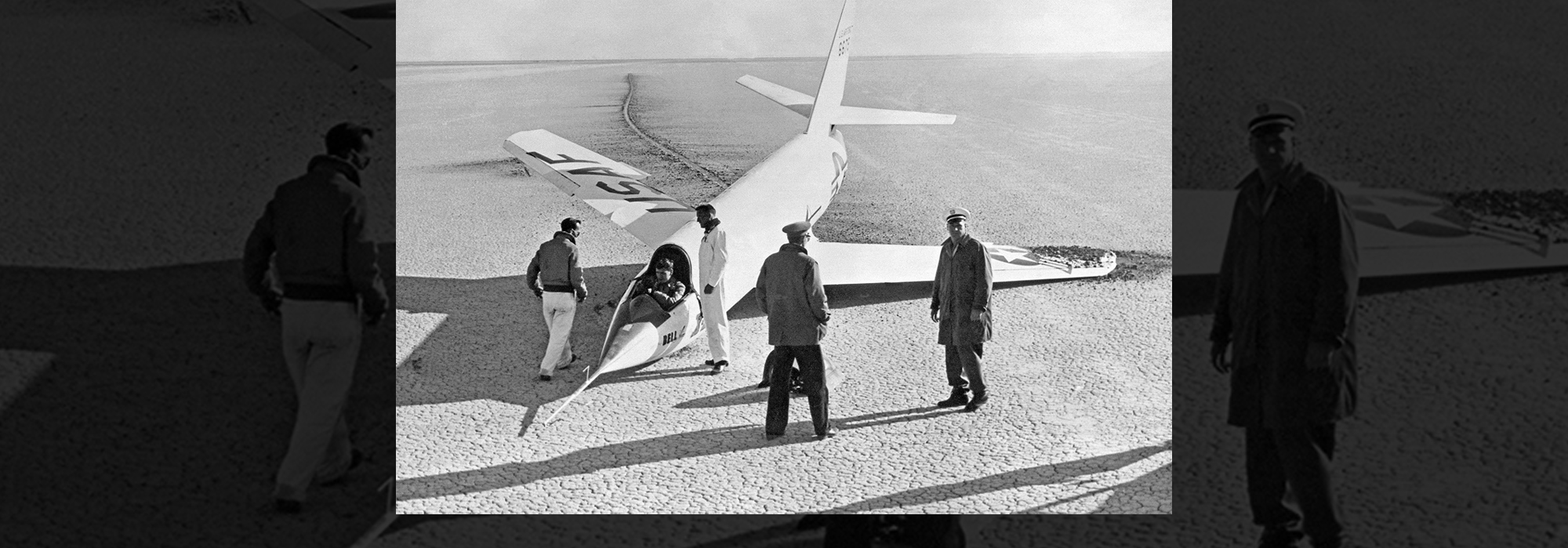
This photograph shows the X-2 #2 (46-675) with a collapsed nose landing gear, after landing on the first glide flight at Edwards Air Force Base. The aircraft pitched at landing, slid along its main skid, and contacted the ground with the right wingtip bumper skid, causing it to break off. The nose wheel had collapsed upon contacting the ground. In the photo, Bell test pilot Jean Ziegler is still in the cockpit as ground crewmen stand by the aircraft. The X-2 #2 was subsequently destroyed in an explosion during captive flight on May 12, 1953, killing Ziegler and EB-50A crewmember Frank Wolko. NASA photo
Audio of this article is brought to you by the Air & Space Forces Association, honoring and supporting our Airmen, Guardians, and their families. Find out more at afa.org
“X” airplanes and missiles—flown by various combinations of military and civil organizations—have pushed the art of the possible in aerospace.
The term “X-plane” has been practically synonymous with cutting-edge aeronautical research since 1945. In that year, the Army teamed up with the National Advisory Committee for Aeronautics (NACA) to award Bell Aircraft Co. a contract to fabricate three aircraft. They were not to be prototypes of combat airplanes, but pure research craft, specifically designed to investigate flight faster than the speed of sound.
Designated XS-1 (for experimental, supersonic, and later simply X-1), these rocket-powered aircraft were the first to fly beyond Mach 1. Then-Capt. Chuck Yeager made the first supersonic flight on Oct. 14, 1947, just a couple of weeks after the Air Force became an independent military service.
The X-1 was closely followed by a wide variety of research craft that have become known as the X-planes. Not all of them were airplanes; some were missiles, some were hybrid air vehicles meant to fly both in air and space, some have been rotorcraft, and some uninhabited air vehicles. Sometimes a particular military service pursued these vehicles; sometimes in partnership with other services, or with NASA (the successor to NACA), and various incarnations of the Defense Advanced Research Projects Agency (DARPA).
While the initial aircraft in the X series focused on flying higher and faster, there soon followed craft that explored particular refinements of flight. These included airplanes with swept, forward-swept, and variable-sweep wings; airplanes with different-shaped wings or unusual control surfaces; new geometry for air inlets, aircraft with wings of different camber, or to explore laminar flow, shifting shock waves, or computer-aided flight controls. The purpose of these programs was to develop basic technologies that could make US aircraft—mainly military, some civil—more efficient, maneuverable, or otherwise more capable. A number explored a variety of approaches to vertical flight, and there were also gliders and craft that investigated technologies applicable to potential future spacecraft. One was to be nuclear powered. Some were secret, and many never even reached the hardware stage.
While some X-planes that explored rather esoteric technologies are practically unknown even to aviation fans, others have become part of the national consciousness.
Yeager’s X-1 flight made magazine covers months after the fact and was immortalized in the 1980 film, “The Right Stuff.”
The North American X-15 rocket plane competed with NASA’s Mercury program and made astronauts of a number of test pilots who flew to the edge of space, broke speed and altitude records for winged flight, and returned to a controlled landing on a runway.
The Boeing X-20 “Dyna-Soar” was the first attempt to develop a space shuttle-like capability (it was never flown, eclipsed by the Mercury program).
President Ronald Reagan featured the Rockwell X-30 National Aero-Space Plane program in his 1986 State of the Union address. The mention was meant to reassure America that US leadership in space would continue, coming only a week after the Challenger space shuttle disaster. Unfortunately, the planned single-stage-to-orbit craft, which Reagan dubbed the “Orient Express,” struggled because of immature technologies. It was canceled before flight hardware was built.
Boeing and Lockheed Martin, with the X-32 and X-35, respectively, vied to build the Joint Strike Fighter. Though fighter prototypes usually receive a YF nomenclature, the two airplanes earned their X designations by virtue of being the first jet-powered aircraft to take off conventionally, fly supersonic, and land vertically. Lockheed Martin won the competition, and its F-35 fighters are now equipping the US Air Force, Navy, Marine Corps, and other countries’ militaries.
The Northrop Grumman X-47B made headlines by being the first unmanned autonomous aircraft to launch from an aircraft carrier via catapult and recover on the same ship using the arrestor cable system. The Northrop Grumman X-47B made headlines by being the first unmanned aircraft to launch from an aircraft carrier via catapult and recover on the same ship using the arrestor cable system.
The X-51 Waverider—a small unmanned vehicle that achieved 200 seconds of hypersonic speed—proved scramjet technologies were viable and paved the way for future US hypersonic efforts.
Not all experimental aircraft were labeled X-planes. The Air Force flew a large number of secret aircraft designed to test breakthrough military technologies. The Have Blue stealth demonstrator, for example, led to the F-117 Nighthawk attack aircraft. Other platforms that broke speed or altitude records bore different nomenclature, such as the Lockheed NF-104, adapted from surplus F-104Cs in the 1960s to train pilots for the presumed coming age of flight in both air and space.
The X-plane program has had its ups and downs, sometimes going years between new experiments, while at other times many were underway at once. The latest potential X-plane is being pursued by Lockheed Martin, with its Quiet Supersonic Technology aircraft. The aircraft is designed to muffle the hard sonic booms that accompany supersonic flight, often breaking windows and frightening animals. The new jet could make it feasible to develop supersonic aircraft that could fly over inhabited areas, potentially ushering in a whole new era of high-speed commercial flight. It has not yet been awarded an X designation.
Audio of this article is brought to you by the Air & Space Forces Association, honoring and supporting our Airmen, Guardians, and their families. Find out more at afa.org
The Space Development Agency is set to launch 21 Tranche 1 data transport satellites on Oct. 5—its fourth Tranche 1 mission since last fall and the first to carry Northrop Grumman-built satellites.
Air Force Global Strike Command has fielded a new prototype system for beyond-line-of-sight communications on the B-52H Stratofortress in a step forward for modernizing the Cold War-era heavy bomber.
After a two-year experiment that created F-16 “Super Squadrons” at Osan Air Base just 50 miles away from North Korea, the U.S. Air Force has returned some of the fighters to its other base on the peninsula.
The Air Force adjusted its fiscal 2026 recruiting goal down by a few hundred enlisted Airmen due to higher-than-expected retention and the number of available training slots—but it is aiming high in fiscal 2027 with its biggest goal for the Active-Duty Air Force in nearly 25 years, and the Space…
Some lawmakers in the Senate are advocating for a more bipartisan approach to paying for the Pentagon’s $185 billion Golden Dome missile defense project, arguing that the effort’s goal of bolstering homeland defenses has support across ideological lines but the process for funding it has been politically charged—leaving the program’s…
Seven F-22 Raptor pilots have recently been awarded one of the military’s highest decorations for their actions during operations in the Middle East. Six of the pilots were decorated with the Distinguished Flying Cross for their role in Operation Midnight Hammer, the June 2025 strikes against Iranian nuclear facilities.
The Air Force will officially kick off a major overhaul of maintenance career field next year with a pilot program, but the plan for the revamp is still evolving—while officials once intended to condense 50 aircraft maintenance specialties down to just seven, now they are targeting 14 Air Force Specialty…
More than 50 years after the U.S. military launched its first Defense Support Program satellite, the Space Force has officially decommissioned the missile warning constellation as it prepares to start fielding its next-generation architecture.
Three T-7A Red Hawk trainer jets flew together at Joint Base San Antonio-Randolph, Texas, on Sept. 16—one physical aircraft in the air and two virtual ones controlled from simulators on the ground, all sharing one common operating picture.
✓
Thank You!
Check your inbox to verify your email address and finish setting up your AFA account.
★
Welcome Back!
An account with this email already exists. Please log in to continue.
Subscribe to the Air & Space Forces Daily Report
The latest news from Air & Space Forces Magazine, as well as news from other leading publications, delivered right to your inbox every morning!
We’re sorry, there has been an error. Please review your input or try again later.