

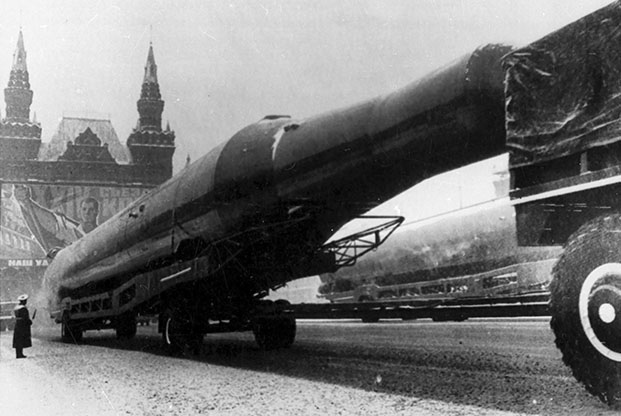
A Soviet SCARP ICBM (SS-9) in a Red Square parade in Moscow marking the 53rd anniversary of the Bolshevic Revolution on Nov. 7, 1970. Photo: CIA
As the Cold War built toward its peak in the 1960s and into the 1970s, the US Central Intelligence Agency was remarkably mild in its assessments of the strategic plans and intentions of the Soviet Union.
The CIA’s National Intelligence Estimate of Sept. 19, 1962, said the Russians were not likely to introduce missiles into Cuba. That was four days after the first missiles had arrived there.
In October 1964, the NIE said, “We do not believe that the USSR aims at matching the US in numbers of intercontinental delivery vehicles,” adding that circumstances appeared “to have ruled out this option.”
The Department of Defense, and particularly the Air Force, disagreed with the CIA estimates, believing them to understate both the goals and the capabilities of the USSR.
Between 1965 and 1970, the number of Soviet ICBMs grew from 224 to 1,440, while the size of the US missile fleet remained essentially level. The Soviets also introduced the huge SS-9, twice as large as the US Minuteman and for which the only plausible targets were Minuteman silos.
Concurrently, the NIEs found that it was “highly unlikely” the Soviets would “try for strategic superiority” (1969 estimate); that the Soviets sought only “strategic parity with the US” (1970); and that “the USSR has concluded that the attainment of clear superiority in strategic weapons … is not now feasible” (1972).
In 1976, Drew Middleton of The New York Times pointed out that “the Russians have developed and produced four new ICBMs” while the US was still “talking in conceptual terms” about its proposed new missile, the MX.
Among those alarmed by the direction of the NIEs was the President’s Foreign Intelligence Advisory Board. In 1976, the PFIAB—prominent public figures from business, government, and politics—persuaded new President Gerald R. Ford and the new director of Central Intelligence, George H. W. Bush, to order an independent parallel assessment.
The most significant part of the effort was analysis of Soviet strategic objectives by “Team B,” headed by Harvard professor Richard Pipes. These findings were presented alongside those of the regular CIA analysts, who were designated “Team A.”
The Team B report was top secret until 1992, but the gist of it leaked to the press. It said the USSR sought strategic superiority, not parity or defensive deterrence. It further said the CIA was wrong about Soviet intentions and motives, underestimated the Soviet threat, and based its evaluations mainly on assumptions rather than on what the Russians actually did and said.
Critics vehemently attacked the report—which most of them had not seen—as erroneous and harmful. One CIA analyst described Team B as “howling right-wingers” and the Washington Post called it a “kangaroo court.”
Whatever it was, Team B’s arguments so overwhelmed the weak Team A presentation that the CIA revised its position. Pipes called the ensuing NIE “the first realistic assessment of Soviet strategic intentions” presented to the PIAB.
The controversy continued for years. Even after the Cold War ended in 1991, the exchange rolled on with both sides claiming validation from events and developments.
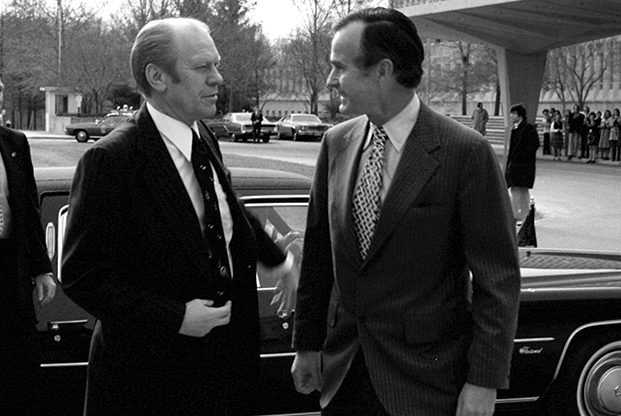
President Gerald Ford (center)with his new CIA chief George H. W. Bush (r) in 1976. That year, prominent public figures from business and government persuaded Ford to perform an independent analysis of Soviet strategic nuclear objectives. Photo: CIA
TEAM B ENTERS
The Team B drama played out against the political backdrop of arms control. In the middle 1960s, the United States abandoned its position of strategic superiority, canceled weapons programs, imposed a ceiling on missile and bomber forces, and sought parity with the Soviet Union. In 1969, the objective of détente—the relaxation of tension—was adopted, with the planning principle of “strategic sufficiency.”
Credibility of this policy depended on faith that the Russians would respond in the same spirit and with similar objectives. The conviction that they would do so was a staple of the NIEs.
The important thing, in the opinion of the minimizers, was that the US not try to gain strategic superiority. In a widely noted essay, “Apes on a Treadmill,” theorist Paul C. Warnke argued that the Russians were engaged in the arms race because they were following the US example. To break the “monkey-see, monkey-do phenomenon,” Warnke said, “we can be first off the treadmill.”
Even national security adviser Henry Kissinger—who practically invented détente—noted that the CIA analysts “reflected the most liberal school of thought in the government.” In 1971, Kissinger warned President Richard M. Nixon of “serious defects” in discussion of Soviet purposes and objectives in the NIE.
The question, as posed by Middleton in The New York Times, was “Why are the Russians steadily increasing their combat power during a time of supposed détente in Europe?”
The CIA in 1975 managed to head off a proposal by the PFIAB for an independent assessment parallel to the NIE, but when the suggestion was repeated in 1976, President Ford and CIA Director Bush agreed to it.“Team B,” as it was called, consisted of three groups. There was a panel on air defense and another one on missile accuracy, but the important one was the third group, assigned to examine Soviet strategic objectives. Virtually all subsequent mention of Team B in the news media and elsewhere refers to this group—scholars, former ambassadors, and retired generals with deep experience in Soviet affairs, headed by the formidable Pipes, the foremost US historian of Russia and the Soviet Union.
The group did not have much time to work. Its first meeting was in late August, and its report was due in November. Its charter was specific. As Pipes said later, “No attempt has been made in this report to arrive at anything like a net assessment: US capabilities are not touched upon except to give perspective to certain Soviet programs. The report concentrates on what it is the Russians are striving for, without trying to assess their chances of success.”
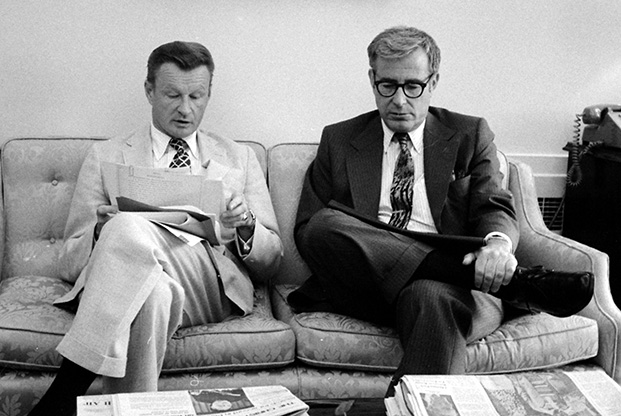
President Jimmy Carter’s national security adviser, Zbigniew Brzezinski (l) and Secretary of Defense Harold Brown (r) meet in the White House in 1977. Brown sounded much like Team B when he said Russia continued to build its arsenal even if the US did not. Photo: White House via National Archives
ENGAGEMENT
Teams A and B exchanged drafts but did not meet in person until Nov. 5. The Team A chief, a seasoned analyst, entrusted the opening confrontation to a junior staff member. According to Pipes, “The champion of Team A had barely begun his criticism of Team B’s effort—delivered in a condescending tone—when a member of Team B fired a question” that stopped him in his tracks.
By all accounts, the CIA analysts were completely outgunned, especially by Pipes and Paul Nitze, whose distinguished government service dated back to World War II. “We were overmatched,” a Team A member said. “People like Nitze ate us for lunch.”
The two teams presented their findings to the PFIAB on Dec. 2. “I listened with mounting disbelief as Team A advanced an estimate that in all essential points agreed with Team B’s position,” Pipes said.
That was reflected in the new National Intelligence Estimate on Dec. 21. In his cover letter, Bush said that, “this estimate presents a starker appreciation of Soviet strategic capabilities and objectives” than previous NIEs had done.
This NIE said that the “ultimate goal” of the Soviet Union was “achieving a dominant position over the West, particularly the United States.” It acknowledged that “Soviet military doctrine calls for capabilities to fight, survive, and win a nuclear war.” It said the Soviets regarded détente “as a framework for nurturing changes favorable to Soviet interest.”
Meanwhile, the story was loose in the press. An article by William Beecher in the Boston Globe Dec. 17 described the Team B report as “the most devastating indictment ever made of the CIA’s Board of Intelligence Estimates.” Both sides denied responsibility for the leak.
The Washington Post on Dec. 26 quoted “high-ranking officials” of the CIA who said the new national estimate was “more somber than any in more than a decade.” Bush, interviewed for the article, declined to discuss the substance of the estimate but he confirmed that a shift in the assessment had occurred as a result of “competitive analysis.”
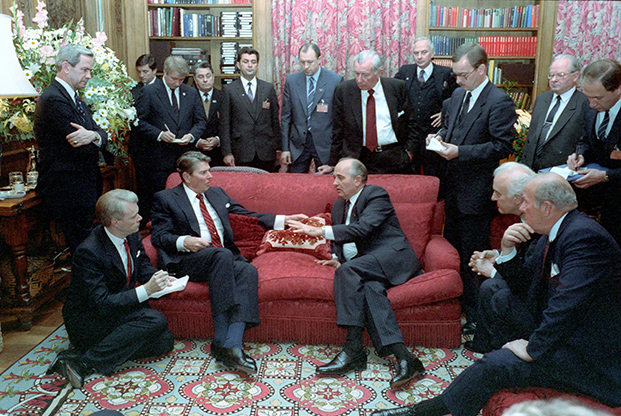
President Ronald Reagan and Soviet Premier Mikhail Gorbachev (seated l to r) met for the first time in Geneva, Switzerland, to hold talks on diplomatic relations and the arms race. Reagan was among those who believed Team B’s assessments of the Soviet threat. Photo: White House via National Archives
TEAM B’S REPORT
Pipes proposed declassifying the Team B report. The CIA refused. The document was not released until October 1992, when the CIA, without any public announcement, posted a copy in the National Archives.
The principal finding was that the NIEs through 1975 had “substantially misperceived the motivations behind Soviet strategic programs and thereby tended consistently to underestimate their intensity, scope, and implicit threat.”
Team B said that “neither nuclear stability nor strategic sufficiency nor ‘parity’ play any role in Soviet military thinking” and that since the 1960s, “an intensified military effort has been underway designed to provide the Soviet Union with nuclear, as well as conventional, superiority.”
Turning to the run of CIA analyses, the report said, “the NIEs either gloss over in silence the question of Soviet strategic objectives or else treat the matter in a perfunctory manner.”
The main reason for this was that “drafters of the NIEs have fallen into the habit of injecting into key judgments of the executive summaries assessments based on ‘mirror imaging,’ i.e., the attribution to Soviet decision-makers of such forms of behavior as might be expected from their US counterparts under analogous circumstances.”
In addition, “on some occasions the drafters of the NIE display an evident inclination to minimize the Soviet strategic buildup because of its implications for détente, SAL [Strategic Arms Limitation] negotiations, congressional sentiments, as well as for certain US forces.”
Only a small number of persons had seen the report in 1977, but that did not impede comment on it. “The story broke at the very time the Ford administration was about to vacate the White House,” Pipes said. “Journalists, and following them, some legislators, hastened to interpret Team B as nothing but a crude political ploy.”The Washington Post described Team B as “supposedly experienced professionals” who put undue pressure on Team A. Pipes responded with a letter saying, “You cannot have it both ways: imply that we are incompetent and at the same time blame us for allegedly overwhelming CIA analysts with the weight of our prestige and reputation.”
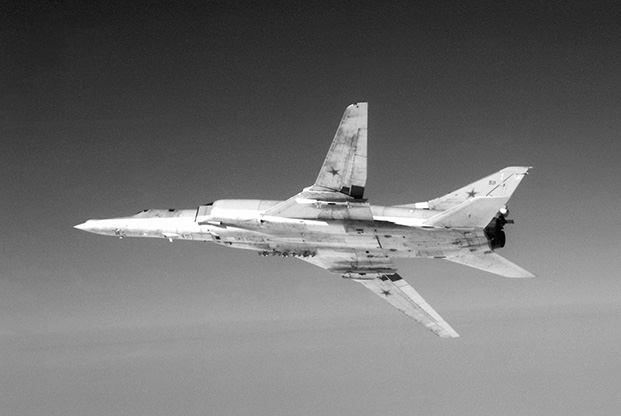
Critics of Team B pointed to the prediction that the Soviets may have had as many as 500 Tu-22M Backfire bombers by 1984. They only had 235 by that date—but eventually reached an inventory of 497. Photo: DOD via National Archives
CARTER JUGGLES THE ISSUE
The incoming Carter administration, committed to arms control, was caught by surprise and juggled the issue. Reacting in January 1977 to news of the Team B report, President-elect Jimmy Carter said the United States remained stronger than the USSR—which was not a point the report had addressed.
Paul Warnke, nominated to head the Arms Control and Disarmament Agency, acknowledged in his confirmation hearings that it was “possible” the Russians were seeking strategic superiority, marking some distance from his “Apes on a Treadmill” concept.
Carter and his new CIA Director, Stansfield Turner, abolished the PFIAB in May 1977. (Ronald Reagan reinstated it when he became president.) On Turner’s watch, the NIEs reverted to describing the Soviet position as one of “approximate nuclear parity” and mutual deterrence.
In the spring of 1977, the Senate Subcommittee on Collection, Production, and Quality of Intelligence made an investigation of sorts of the Team B affair. The sole source of information was the CIA. Team B’s perspective was added to the consideration only after Pipes complained to the subcommittee chairman.
The subcommittee declared it would make “no attempt to judge which group’s estimates concerning the USSR are correct.”
By then, the Soviets were fielding ICBMs with improved capabilities and had begun to deploy the SS-20 intermediate-range missile, which could reach all of the capitals of NATO Europe within five minutes.
Carter’s best strategic thinker, Secretary of Defense Harold Brown, sounded much like Team B. “When we build, they build,” he said. “When we stop building, they nevertheless continue to build.”
Team B’s conclusions were taken up and advanced by a group of conservatives called the Committee on the Present Danger. Pipes and Nitze were members, as were Eugene Rostow, Jeane J. Kirkpatrick, George Schultz, and Clare Booth Luce. As The New York Times noted, the “best known and most influential” member was presidential candidate Ronald Reagan.
They were joined in their views by the “neocons”—or neoconservatives—former liberals, hawkish on defense, such as editors Norman Podhoretz at Commentary and Irving Kristol at The Public Interest, as well as Paul Wolfowitz and Richard Perle, disciples of Sen. Henry M. “Scoop” Jackson (D-Wash.).
THE REAGAN REVERSAL
President Reagan, at his first press conference, revoked détente. Responding to a question, he said that “so far, détente’s been a one-way street that the Soviet Union has used to pursue its own aims.”
For the first time in more than 20 years, it was again US policy to roll back the Soviet advance. National Security Decision Directive 32 said that the basic objective was “to contain and reverse the expansion of Soviet control and military presence throughout the world.”
A number of people from the Committee on the Present Danger joined the new administration. Pipes took leave from Harvard to be director of Eastern Europe and Soviet Affairs on the National Security Council.
The end of the Cold War approached with the declaration by Soviet General Secretary Mikhail Gorbachev of glasnost (“openness”) reforms in 1985 and perestroika (“restructuring”) in 1987. In December 1991, the Soviet Union ceased to exist.
There was (and still is) fundamental disagreement about why this happened. Hard-liners give considerable credit to Reagan-era policies that forced the Soviets into a diversion of resources they could not sustain. The opposite view holds that Reagan had nothing to do with it. The Russians recognized the failure of their flawed system and saw that they would be better off without an arms race.
The weakness of that position, Pipes said, was that it did not account for “the emergence of a Soviet soft-liner in the midst of the most hard line of all American administrations” or why the USSR had “behaved more, rather than less, aggressively during the era of détente. The theory also fails to show why the Politburo chose, in response to Reagan’s anti-communism, a man committed to perestroika and disarmament.”
CRITICS RESURGENT
Public release of the Team B report in 1992 was followed by renewed determination to discredit it. The two leading voices were Anne Hessing Cahn, an arms control official in the Carter administration, and Raymond L. Garthoff, a former US ambassador to Bulgaria, who wrote NIEs at the CIA between 1957 and 1961.
“For Team B, it wasn’t a question of whether the Russians were coming,” Cahn said in 1993. “They were here. (And probably working at the CIA!).” According to Cahn, exaggeration of the Soviet menace led to “a trillion-dollar military buildup. As a result, we neglected our schools and cities, our health-care system, our roads and bridges, and parks.”
However, in her 1998 book, Killing Détente, Cahn admitted that, “during the heyday of détente, American power weakened while that of the Soviet Union grew.”
Garthoff, commissioned by the CIA to write a post-Cold War assessment of the Team B affair, said the whole exercise had been “ill-conceived and disappointing” and that “virtually all of Team B’s criticisms proved to be wrong.”
Similar commentaries carried forward into the 21st century. In 2003, columnist Michael Lind—who bills himself as a former neocon—said “the hysterical Chicken Littles of Team B should have been discredited.” In 2014, Lind charged that “Team B’s conclusions were wildly off the mark.”
Curiously, all of the critics choose the same example to illustrate the irresponsibility of Team B. “When Team B looked at ‘hard’ data, everywhere it saw the worst case,” Cahn said. “It reported, for instance, that the Backfire bomber ‘probably will be produced in substantial numbers, with perhaps 500 aircraft off the line by early 1984.’ (In fact, the Soviets had 235 in 1984.)”
Garthoff, Lind, and others focus on the same accusation in almost the same words.
Apparently, this 265-airplane gap in 1984 was the worst error they could find. To put it in some perspective, the NIE in 1964—which was treated gently by the critics—forecast a Soviet ICBM force of 400 to 700 by 1984, whereas the actual number in 1984 was 1,440. As a historical footnote, Backfire medium-bomber production eventually reached 497, although it took a considerable time to get there.
CLUES FROM THE OTHER SIDE
In 1977, Stephen Rosenfeld of the Washington Post joined in the attack on Team B, accusing Pipes of “rank hysteria in scholarly garb” and “worst-case alarmism.” Rosenfeld revisited his conclusions in 1995 in an article, “The Hard-Liners Had It Right,” which drew on newly released Soviet documents.
“The archives of the former Soviet Union are opening” and “making necessary a rethinking on the part of those who turn out to have had it wrong before,” Rosenfeld said. The documents “pretty much confirm the approach long attributed to the political and academic right.”
In Memoirs, published in 1995, Gorbachev said, “the arms race continued, gaining momentum even after achieving military and strategic parity with the United States of America.” He added to this in another volume, On My Country and the World, in 2000.
In some years, Gorbachev said, Soviet military expenditures “reached 25 to 30 percent of our gross national product—that is, five or six times greater than analogous spending in the United States and the European NATO countries.”
Directly addressing the main proposition from Team B, Gorbachev said that the Soviet military objective had been “military supremacy relative to any possible opponent.”_
John T. Correll was editor in chief of Air Force Magazine for 18 years and is a frequent contributor. His most recent article, “POTUS Flies,” appeared in the May issue.
