
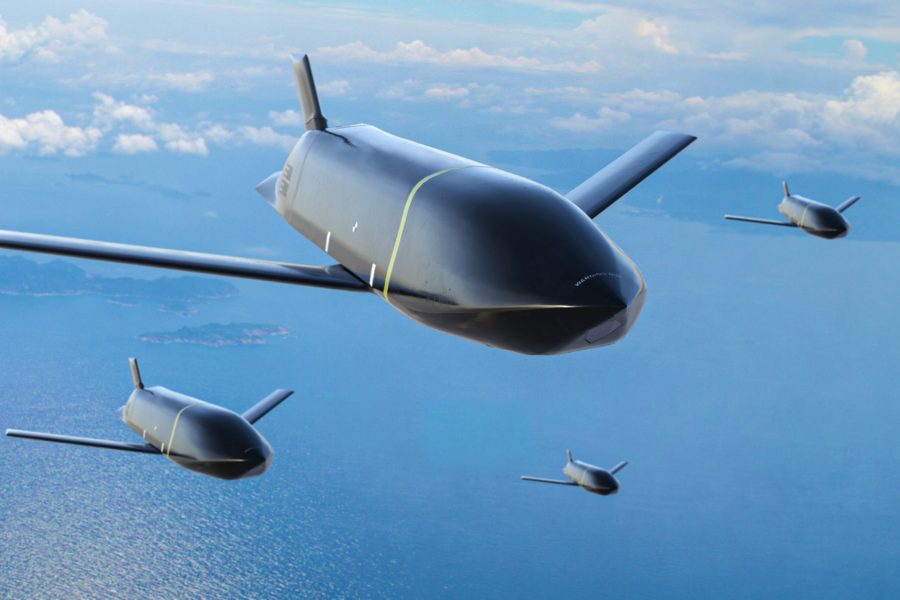
The Air Force wants a new, affordable, air-launched standoff cruise missile ready to field in 2033.
The Air Force Life Cycle Management Center announced April 6 it will hold an industry day event to conduct market research on the Standoff Attack Weapon, or SoAW, on June 17 at Eglin Air Force Base, Fla. Those interested in attending must apply by June 1.
“The intent of [the] industry day is to discuss desire attributes of an affordable future standoff attack weapon system,” according to the notice. “SoAW is the AFLCMC concept for a prospective relatively affordable air-launched standoff cruise missile against heavily defended targets intended to be fielded around 2033.”
The service previously explored the SoAW concept in an August 2022 request for information, which noted a notional fielding timeline of 2030-2033. But that notice expired later that year, and the Air Force didn’t pursue the idea further for the next few years.
Now, it appears officials are reviving the concept as interest and funding for munitions surges. The White House’s fiscal 2027 budget request, released April 1, projects a massive increase in spending on Air Force missiles
The service is requesting $11.36 billion for missile procurement, nearly triple the amount in the fiscal 2026 budget, which included $3.7 billion. Plans show those numbers continuing to rise to $16 billion in fiscal 2029.
Those procurement numbers are in addition to research and development dollars. More details on R&D for new missiles and bombs are expected to be released in the coming weeks.
Standoff weapons are those that are launched outside the range of an adversary’s weapons to strike targets. They are primarily used by non-stealthy aircraft that cannot survive long in contested airspace.
For decades, the Air Force has employed a strategy against heavily defended targets that combines single-use standoff weapons with inexpensive, stand-in weapons fired by stealthy aircraft capable of reattacking multiple times, Air & Space Forces Magazine previously reported.
The Air Force has several long-range standoff weapons already in its inventory: the AGM-158 Joint Air-to-Surface Missile-Extended Range, or JASSM-ER; the AGM-158C Long-Range Anti-Ship Missile, or LRASM; and the AGM-154 Joint Standoff Weapon, or JSOW.
But none of them are cheap.
The JASSM-ER has a range of about 600 miles. Work on an “extreme range” version is planned for delivery in 2027 with a range of 1,000 miles. Those missiles cost around $2.6 million each. The LRASM, a modified version of the JASSM for maritime use, costs about $3.6 million apiece.
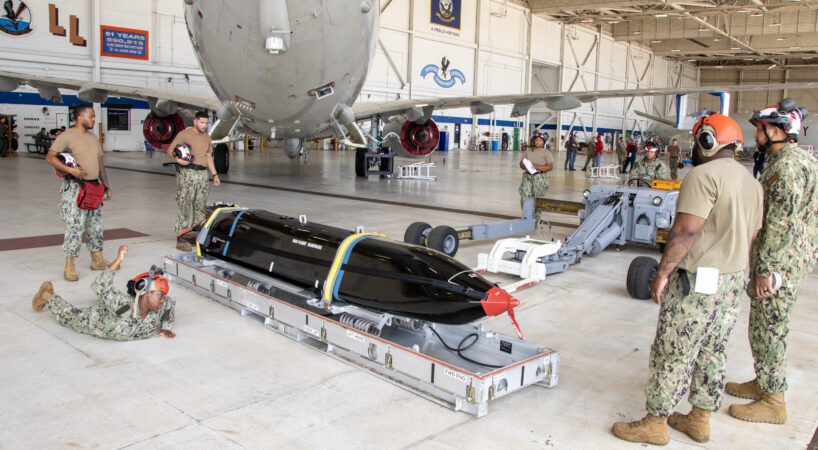
The service has been pushing for more affordable weapons with a variety of ranges and has had some success in shortening timelines.
In a March congressional hearing, Brig. Gen. Robert P. Lyons III, portfolio acquisition executive for weapons, pointed to three weapons that exemplify the service ramping up its numbers through novel testing approaches and new acquisition methods.
“Through these programs, we will be able to expand production, build up munition inventories, and more rapidly replenish munitions stockpiles,” Lyons said. “Most importantly, we will provide more munitions options to combatant commanders.”
Those included the Extended Range Attack Munition, or ERAM, and two variants of weapons in the Family of Affordable Mass Munition, or FAMM, program.
The ERAM is an air-launched cruise missile designed to strike fixed targets from standoff ranges with precision guidance at low cost.
The FAMM program arrived with the Air Force’s fiscal 2026 budget request. The program description included prototyping activities such as “integration and flight demonstrations of affordable and highly manufacturable small turbine engines, seekers/sensors, networked datalinks, collaborative autonomy behaviors, and ordnance [warhead/fuse],” according to budget documents.
The reconciliation package known as the One Big Beautiful Bill Act gave the Air Force $656.3 million to purchase 3,010 weapons under FAMM. The service is asking for another $355 million for FAMM in its 2027 budget request.
Still more development efforts continue alongside the new SoAW. On March 31, the Defense Advanced Research Projects Agency and the Air Force Research Laboratory posted notices asking industry for ideas for both a new low-cost cruise missile and methods for producing munitions propulsion, avionics, and sensors at lower cost and in higher quantities.
The first DARPA notice seeks information on “state-of-the-art development and manufacturing processes for missile propulsion systems.”
The second DARPA notice wants to better understand the industry base for avionics and sensors for air-to-air weapons.
The AFRL posting seeks a large-scale, affordable, mass-produced cruise missile capable of flying at least 350 nautical miles, costing less than $250,000 per missile.
On the opposite end of the missile spectrum, the Air Force also posted a notice seeking additional companies to help build its Stand-in Attack Weapon, or SiAW, which is currently being built by Northrop Grumman.
The SiAW is a supersonic air-to-ground missile used to defeat enemy air defenses and take out high-value, relocatable targets. The F-35, F-16, F-47, and B-21 will all eventually carry the missile.