
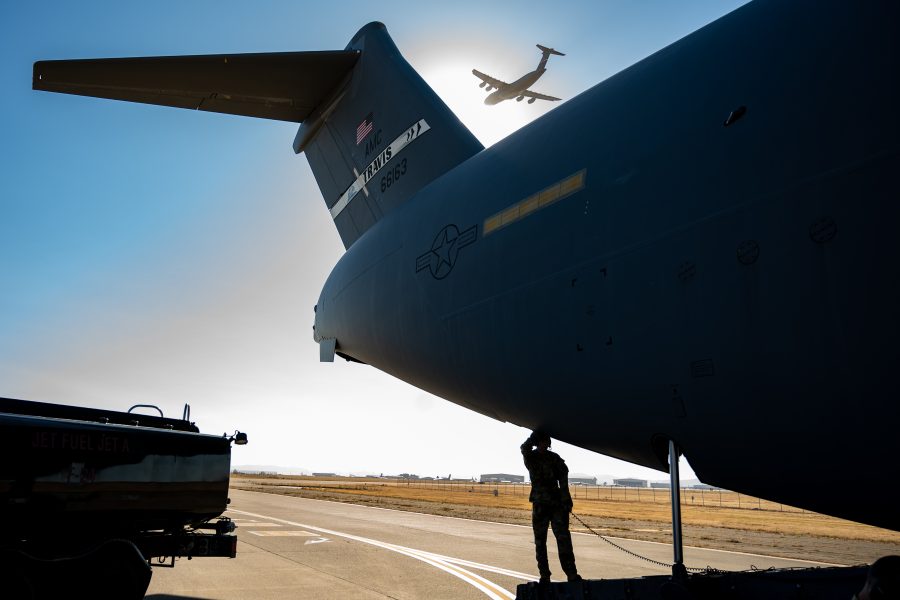
The Air Force’s airlift fleet is in desperate need of modern connectivity, spare parts, and innovations to meet growing demand. With modernization plans still in their infancy, the future is challenged.
“We do have a really large airlift fleet—it appears large, but in reality, only a fraction of it is focused on combatant commander demand,” said retired Col. Robert C. Owen, a professor at Embry-Riddle Aeronautical University, speaking Dec. 2 on a new report from AFA’s Mitchell Institute for Aerospace Studies. “In a peer conflict, the airlift fleet may not be sufficient to meet the movement, supply, and other logistical demands of the services.”
The Air Force’s transport fleet has 550 C-130s, C-17s, and C-5s, the fewest it has ever had. And new aircraft aren’t coming anytime soon. Air Mobility Command released a plan last month to start developing a Next-Generation Airlifter to join the fleet around 2038. Plans call for keeping the C-5 Galaxy fleet, already averaging 38 years old, until 2045; and the C-17, now an average of 23 years old, flying until 2075—another 50 years.
Keeping the C-17 flying for nearly 75 years will almost certainly require the Air Force to execute a service life extension program, or SLEP, Owen said.
“I can bet that AMC has worried that issue many times: How can we SLEP the C-17 and keep it flying … because the airplane is already showing old airplane traits, and to get it back, to restore it like an old war bird, is going to be a very expensive process,” Owen said.
Owen did not formally recommend a SLEP in his paper, “It’s Time to Invest: Enhancing Current and Future U.S. Air Force Airlift.” But the report does endorse moves to upgrade the C-17 and the rest of the existing airlift fleet with better command-and-control and increased maintenance.
“We need to put advanced command and control communication systems in every airlift aircraft,” Owen said. “There should never be a situation where an aircrew has to go on to unsecure frequencies to find out what the heck is going on.”
Better connectivity has been a goal for AMC for several years now, but the command recently fell short of its goal to have 25 percent of the fleet outfitted with the new tech by 2025. As things stand, Owen warned, airlift crews are left both vulnerable in enemy airspace and unable to adjust to changing mission requirements.
“Seeing that there are two Chinese fighters 120 miles away is one thing. Knowing that there were four F-22s between them and you is another thing,” he noted.
The massive C-5s have suffered from very low mission capable rates, last reported in 2024 at 49 percent. Even the relatively stalwart C-17, at 76 percent mission capable, pales in comparison to commercial airlifters. Retired Gen. Duncan J. McNabb, former head of U.S. Transportation Command, recalled how former Southwest Airlines CEO Herb Kelleher once told him his company’s aircraft had a 98 percent availability rate.
“It shows you that we need to think about it that way,” McNabb said. “Once you buy the airplane, you’ve got to make sure that you sustain it properly and you crew it properly.”
From an analytical standpoint, Owen said, “if we can buy the parts to get a 5 percent increase in availability, that’s equivalent to getting 10 more C-17s in the fleet, which would cost $3 billion to $4 billion” if they could even be purchased.
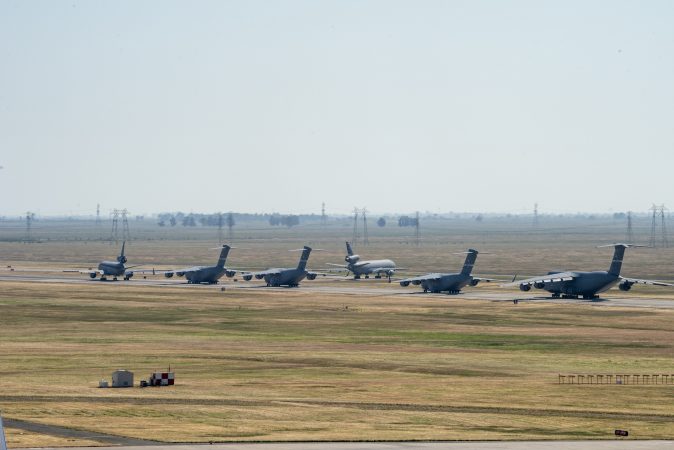
Owen and McNabb also said the Air Force needs to consider new ideas and ways to squeeze more capacity from the fleet itself. One way that can be done would be to consider expanding the Civil Reserve Air Fleet, the Air Force program that utilizes commercial aircraft on a voluntary basis. Today’s CRAF includes just 7 percent of civilian airlifters—down from a high of 15 percent during the Cold War.
Other “public-private partnership opportunities,” including commercial off-the-shelf technology, could also help supplement the airlift fleet, Owen said.
McNabb endorsed the idea of leaning more on the CRAF, even suggesting it may be necessary to outfit those commercial aircraft with defensive systems for protection so they can fly into more contested airspace. But he also suggested upgrading existing aircraft.
“With the C-130s … with modern technology, we could make them so that they could carry more, farther and more efficiently,” McNabb said. “The J model is a vast improvement over the former C-130H and all the other ones, but I would say technology has allowed it to be even better. And so I think that we should be really working hard on that.”
Long-Term
Owen’s final recommendation is for the Pentagon to provide the Air Force “additional funding to develop, procure, and field a fleet of new air transport aircraft that will be capable of moving more equipment and personnel faster, into a wider range of places, and in high-threat environments.”
That is likely to include both “a strategic airlifter optimized for long-range and high-capacity transport into developed airfields and another airlifter with the range, payload, airfield agility, and survivability needed for effective airlift operations into any type of theater that can augment inter-theater airlift flows when necessary,” he wrote.
A future Next Generation Airlifter is meant to replace the C-5 and C-17 for more inter-theater airlift, but Owen and McNabb suggested there will be a need for other platforms too.
“They’ve got concepts of very large airplanes that carry three or four times as much as a C-5 and you think about that: ‘Hey, I’m going to take it into an airfield that is out of range of precision strike from China, and then we’re going to take it forward,’” McNabb said.
He also mused about “long range drones that could deliver to these tactical small bases,” something multiple startups are exploring as well.
Owen said he conducted a separate study for the Air Force Research Institute on “what the next theater airlifter should look like: My conclusion, after looking at about 70 different programs in the past, was a turboprop-type aircraft or prop fan with a tilting wing, but not vertical.”
Any such modernization programs face headwinds, as the Air Force struggles to modernize its combat fleet with new F-47 and B-21 aircraft, more F-35s, and also the Sentinel ICBM system. But airlift cannot be ignored, Owen said.
“We are very late to the game on this,” Owen argued. “The time to start was a few decades ago and the Air Force did make a couple of false starts. But nothing came of them. So we need to really get serious and consistent and start pushing hard now.”