
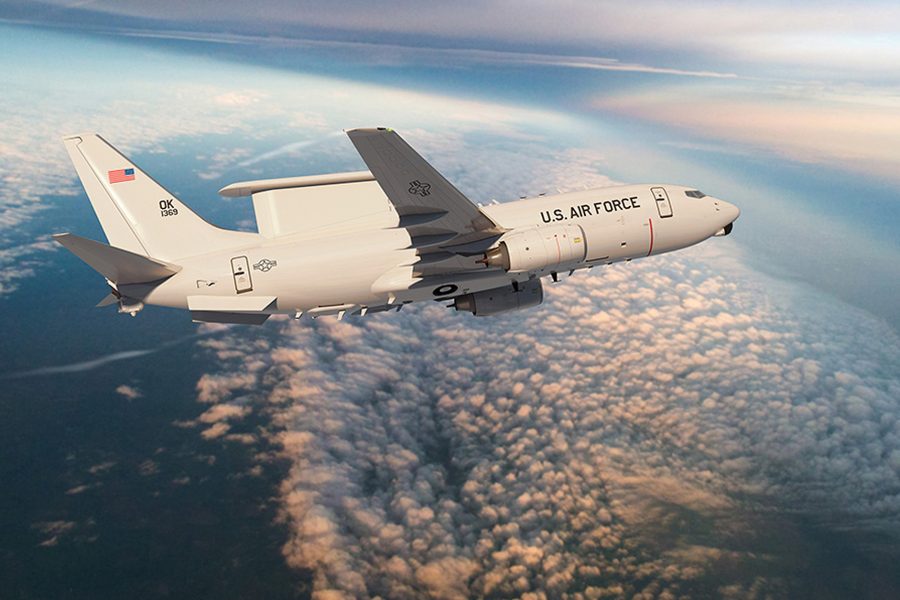
The Air Force on March 12 awarded contract modifications worth a combined $2.4 billion to Boeing to procure an undisclosed number of E-7 Wedgetail as part of the program’s engineering and manufacturing development phase and continue work on the airborne battle management aircraft’s radar.
The service did not say how many additional E-7s will be purchased under the $2.3 billion option exercise modification, which accounts for the bulk of the money.
The Wedgetail is an advanced early warning and control aircraft which could replace the Air Force’s fleet of aging E-3 Sentries.
The Air Force had previously struck a deal with Boeing, initially worth up to $1.2 billion and later definitized as a $2.56 billion contract, to build two rapid prototype E-7s.
In a statement to Air & Space Forces Magazine, the Air Force said it has approved an updated acquisition strategy for the E-7, as called for by the 2026 Consolidated Appropriations Act signed into law in February.
“This strategy executes Congressional direction to continue development and transition to an engineering and manufacturing development (EMD) phase,” the Air Force said. “The aircraft acquired for the EMD phase will allow the Air Force to mature the system design, conduct risk reduction, and perform comprehensive test and verification activities in accordance with Congressional intent.”
If Congress decides to further fund E-7, and if a production decision is made, the additional prototyping funds in these modifications would likely make it easier for the Air Force to move the aircraft into production.
The second $99 million modification will help fund Boeing’s work on the E-7’s distinctive. multirole electronically scanned array radar.
Together, the two modifications nearly double the value of the E-7 contract to just over $5 billion. Work on those contracts is expected to be completed by August 2032 and will take place at facilities in Seattle, Oklahoma City, Huntsville, Ala., and Heath, Ohio.
The contract moves come at a time when the E-7 program’s long-term future remains uncertain.
For years, top Air Force leaders pushed to bring on the E-7—which is already flown by nations including Australia—to replace the rapidly aging and retiring E-3 Sentry. Australia has sent one of its Wedgetails to help secure airspace during the war with Iran.
The E-3—commonly known as the AWACS, or airborne warning and control system aircraft—is increasingly difficult to keep maintained and airworthy, and Air Force leaders have frequently said its Cold War-era sensor technology is outdated.
The sensor in the AWACS’ 30-foot radar dome takes 10 seconds to make a complete rotation and fully refresh its view of aircraft the plane’s crew is trying to track. But the E-7’s long-distance sensor array allows operators to fix its gaze on multiple targets and rapidly refresh its view. The E-7 is also designed to operate with a smaller crew than the E-3.
But top Pentagon leaders in the Trump administration have been skeptical that the E-7 is needed. In their 2026 budget request, they proposed canceling the E-7 and replacing it with a combination of smaller Navy E-2D Hawkeye aircraft and targeting satellites.
That in turn prompted a furious pushback from Congress. In the 2026 National Defense Authorization Act and defense appropriations bill, lawmakers forbade the Air Force from canceling the prototyping program and injected $1.1 billion into the effort.
Air Force Secretary Troy Meink last month told reporters at AFA’s Warfare Symposium in Colorado that the service would follow Congress’ mandate to buy the prototype E-7s, but he was noncommittal beyond that. A March 10 Air Force solicitation for product support for the E-7 asked vendors to submit a business case for a fleet ranging anywhere in size from just the two prototype aircraft to a full complement of 26.