
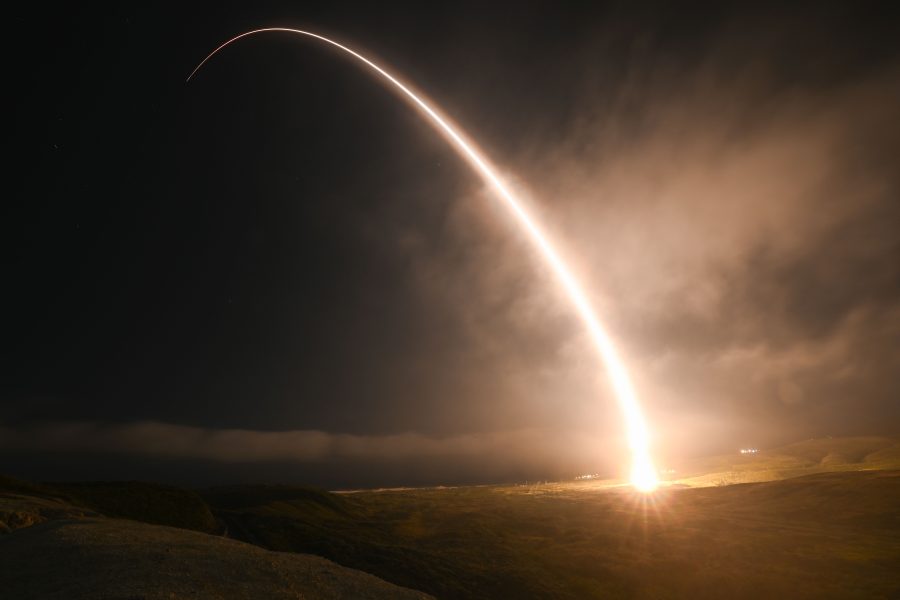
The Air Force conducted its first test of a Minuteman III intercontinental ballistic missile in 2026 on March 3, launching an unarmed missile from Vandenberg Space Force Base, Calif., equipped with two test reentry vehicles at 11:01 p.m. Pacific Time.
The service noted in its release that the test, designated Glory Trip 255, or GT 255, was scheduled years ago and “is not in response to world events.”
The test does come, however, amid rising nuclear tensions. The U.S. and Israel launched Operation Epic Fury against Iran this past weekend in part to dismantle the Iranian nuclear program, and the New START arms control treaty between U.S. and Russia expired last month.
For the test, the missile‘s two test reentry vehicles traveled more than 4,200 miles from the California base to strike a predetermined target at the Kwajalein Atoll in the Marshall Islands, according to the release.
“GT 255 allowed us to assess the performance of individual components of the missile system,” Lt. Col. Karrie Wray, commander of the 576th Flight Test Squadron, said in a statement. “By continually assessing varying mission profiles, we are able to enhance the performance of the entire ICBM fleet, ensuring the maximum level of readiness for the land-based leg of the nation’s nuclear triad.”
=
The release noted that the multiple reentry vehicles “are primarily used to increase missile effectiveness and overcome enemy defenses.”
“It is critical to test all aspects of our ICBM force, including our ability to deliver multiple, independently targeted payloads with absolute precision,” said Gen. S.L. Davis, commander of Air Force Global Strike Command. “This test validates the intricate synchronization of the weapon system, from the initial launch sequence to the flawless deployment of each reentry vehicle.”
Using more than one reentry vehicle is unusual but not unheard of in Minuteman III testing—typically, Air Force Global Strike Command conducts as many as three test launches annually, the majority of which have included only a single reentry vehicle or test payload. But as recently as November 2024, Air & Space Forces Magazine reported that Air Force Global Strike Command conducted a Minuteman III test with three test warheads. A similar three-vehicle test took place in 2023.
The use of multiple vehicles now, however, is notable given that New START, which expired in February, limited the number of warheads allowed on ICBMs to one. The Minuteman III was the first U.S. ICBM to deploy with multiple warheads, but two of the three warheads were removed from active missiles to satisfy the treaty. That change concluded in June 2014, and officials have yet to say whether they will add more warheads back with the end of New START.
Test launches involve the Air Force drawing from its fleet of 400 operational ICBMs, scattered across missile fields in Montana, Colorado, Nebraska, North Dakota, and Wyoming. The missiles are disassembled at their home site and transported by truck to the California test site.
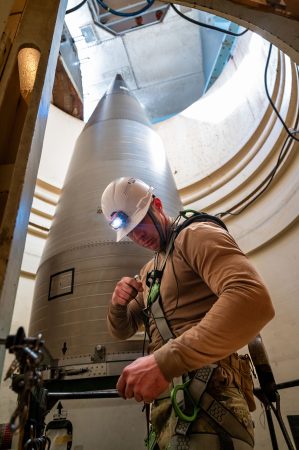
For the most recent launch, engineers and weapons experts from the 377th Test and Evaluation Group collected data on the missile’s accuracy and reliability. That data is then shared with the Department of Defense, the Department of Energy, and the U.S. Strategic Command for development and evaluation.
“The data we gather ensures our long-range strike capabilities are not just a theoretical concept, but a proven, reliable, and lethal force, ready to defend the nation at a moment’s notice,” said Davis.
Airmen with the 91st Missile Wing at Minot Air Force Base, N.D., supplied direct maintenance support.
The Minuteman III, in service since 1970, is slated to be replaced by the LGM-35A Sentinel, part of a larger nuclear modernization effort. The Sentinel is expected to have a greater range and accuracy., and the design includes a shroud atop the missile, with a propulsion system not featured on the Minuteman III, according to Northrop Grumman officials.
Senior U.S. military officials involved in the Sentinel told Air & Space Forces Magazine at AFA’s Warfare Symposium last week they were confident Sentinel would reach operational capability in the early 2030s. But given the one-for-one rate at which the ICBMs will be swapped out, Minuteman III will likely stay in service for years to come.
A September report from the Government Accountability Office said the missile would reach the end of its service life by 2026, but “now, facing delays to Sentinel, the Air Force is evaluating options to continue operating Minuteman III through 2050.”
The Air Force concluded that operating the missile on that timeline is “feasible,” according to the report.
Adding multiple warheads to existing missiles is one strategy that a congressionally mandated commission of former officials and experts chosen by Democratic and Republican leaders recommended in 2023.
The commission suggested putting warheads from aged-out Minuteman III missiles onto still operating missiles, “to keep the number of fielded, land-based warheads constant,” its report states.