
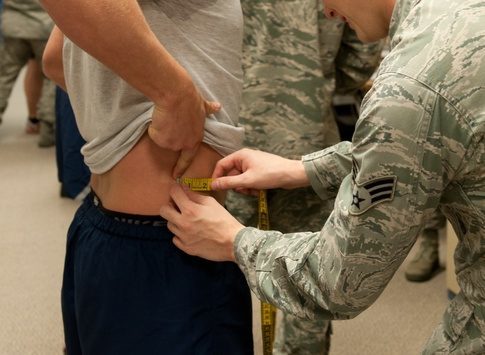
Airmen and Guardians preparing to take updated physical fitness assessments this year won’t be surprised by the Pentagon’s updated body composition standards that all service members will have to meet; the Air Force worked up similar standards three years ago.
Following Defense Secretary Pete Hegseth’s Sept. 30 directive on military fitness standards, the Defense Department has released new guidance on body composition using the waist-to-height ratio, or WHtR, method, according to a Dec. 18 memo from Undersecretary of Defense for Personnel and Readiness Anthony J. Tata.
“Body composition is a vital component for the warrior ethos and foundational to lethality and readiness,” Tata wrote in the memo, adding that the WHtR method will replace height and weight tables to evaluate body composition in all services. “Body Composition evaluation will align with medically validated, streamlined approaches, using WHtR to promote consistency and fairness across the joint force.”
The Air Force announced its shift to the waist-to-height ratio in January 2023 after the service stopped using the abdominal circumference assessment, better known as the tape test, in 2020.
The WHtR method has proven to be more effective at predicting heart attacks, blood pressure, and strokes compared to the waist circumference method, Dr. Francisco Lopez-Jimenez, a cardiologist with the Mayo Clinic, told Air & Space Forces Magazine in April 2024.
The service is currently implementing its new physical fitness assessment, or PFA, that includes the waist-to-height radio measurement to evaluate body composition. Body composition counts for 20 percent of the total score on the four-component PFA.
Under the new Pentagon guidance, body composition is calculated by dividing the waist circumference by the service member’s height. Waist circumference should be determined by using a “measuring tape parallel to the floor at the midpoint between the last palpable rib and the top of the iliac crest, which is typically at or just above the belly button,” the memo states. Height should be measured from the bottom of the soles of the feet to the apex of the skull. Measurements will be recorded in inches and rounded down to the nearest half inch.
“With consideration to the warrior ethos, lethality, readiness, and cardiovascular health, each military department will evaluate service members’ body composition twice per year,” the memo states. The upper limit for allowable WHtR for military service body composition policies shall be less than 0.55.”
The Air Force defines the waist as the midpoint between the lowest rib and the top of the hip bone. For example, an Airman who stands 69 inches tall and has a waist of 36 inches would have a waist-to-height ratio of 0.52.
The Air Force developed its new body composition standards in 2023. Airmen or Guardians with a WHtR below 0.55 are deemed a low or moderate risk for health problems such as cardiovascular diseases, stroke, diabetes, hypertension and musculoskeletal injuries, according to the 2023 announcement. Airmen or Guardians with ratios equal to or above 0.55 will be considered a high risk and “not meeting the standard.”
The Pentagon’s new guidance states that service members with ratios above 0.55 or above that exceed body fat standards will be placed in their military service’s established remedial program, will be less likely to receive promotions, and could eventually be subject to administrative separation, according to the memo.
The Air Force said it is evaluating the memo but would not comment on the issue until the service finalizes its policy to align with the Pentagon’s directive.
The Air Force paused its scoring of fitness testing Jan. 1 and will begin a diagnostic testing period on March 1 to allow Airmen a chance to work up to the new standards. Space Force Guardians have begun taking their biannual Human Performance Assessment which includes body composition evaluation similar to the Air Force’s test.
The Air Force had previously planned for the diagnostic testing period to last through August, but the new guidance says it will now be completed by June 30, and official testing will begin on July 1. Updated fitness score charts incorporating feedback from the field will be released soon, along with an updated version of AFMAN 36-2905, the Air Force Physical Fitness Program.