
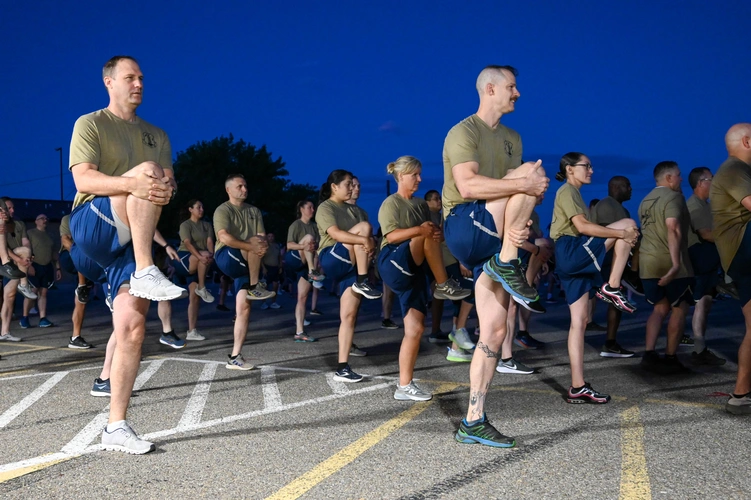
Airman will start being officially scored on the new physical fitness assessment in July rather than September and will have an alternative to a two-mile run to prove their cardio fitness, the Air Force announced Jan. 6.
The moves change the plan the service announced in September 2025, which introduced twice-yearly tests and made it mandatory for Airmen to complete a two-mile run during at least one of those tests. Now, Airmen can still do a two-mile run, but they can also choose to do a 20-meter High Aerobic Multi-shuttle Run every six months instead. The 20-meter HAMR requires participants to dash between lines 20 meters apart for timed periods as the exercise increases in intensity.
The Air Force’s previous fitness test let Airmen choose between the 20-meter HAMR and a 1.5-mile run.
The change is meant to “give Airmen a choice,” an Air Force official told Air & Space Forces Magazine. “The goal is to test physical fitness and cardiovascular fitness—both the two-mile run and the 20-meter HAMR do that equally.”
The official added that the “the HAMR is not an easy test; you’re sprinting toward the end of it and running hard to get a good score.”
In contrast, the Space Force made its own PT announcement Jan. 6, and it is going with the Air Force’s original plan: Guardians will have to do a two-mile run on at least one of the the two mandatory fitness assessments every year, starting Jan. 1.
By comparison, the Air Force paused its scoring of fitness testing Jan. 1 and will begin a diagnostic testing period on March 1 to allow Airmen a chance to work up to the new standards. But while the service had previously planned for the diagnostic testing period to last until Sept. 1, the new guidance says it will be cut by two months to end on July 1.
The Air Force official could not immediately say why the diagnostic testing period was shortened.
The latest version of the Air Force four-component PFA includes:
- Cardiovascular: two-mile run or 20-meter HAMR every six months, which counts for 50 percent of the total score
- Strength: One minute of push-ups or two minutes of hand-release push-ups. Hand-release push-ups require Airmen to lower their chest all the way to the ground and extend their hands out to the sides before pushing up again. This component counts for 15 percent of the total score.
- Core: One minute of sit-ups, two minutes of cross-leg reverse crunches, or a timed forearm plank. This component measures muscle core endurance and counts for another 15 percent of the total score.
- Body Composition: Waist-to-Height Ratio measurement that requires Airmen divide their waist length by their height in inches. For example, an Airman who stands 69 inches tall and has a waist of 36 inches would have a waist-to-height ratio of 0.52. This component counts for 20 percent of the total score.
Some officers and senior enlisted will have their fitness scores included in their performance briefs before official July 1 scoring begins, a mandate from Secretary of War Pete Hegseth, the announcement states. Colonels will be first group effected by this requirement beginning in February followed by lieutenant colonels, majors, and chief master sergeants in May 2026. These performance briefs may include results from tests completed under previous fitness standards, the announcement states.
“Your physical health is important to us, not just as a readiness metric but as a human being as well,” Chief Master Sergeant of the Air Force David R. Wolfe said in the statement. “When you’re physically healthy, you are not only happier, but in a better position to excel at your job.”
The four components of the PFA are scored differently than the past fitness test. The new test’s ratios count 50 percent for cardio, 20 percent for body composition, 15 percent for muscle strength and 15 percent for muscle endurance. In the past, it was 60 percent cardio, 20 percent body composition, 10 percent muscle strength, 10 percent muscle endurance.
Updated fitness score charts incorporating feedback from the field will be released soon, along with an updated version of AFMAN 36-2905, Air Force Physical Fitness Program, according to the announcement.
The Air Force removed the body composition measurement from the physical fitness test amid the COVID-19 pandemic in 2021. Since then, Airmen had their body composition measurements taken during their birth month or during their annual physical.
In the new PFA, the Air Force will score body composition as part of the physical fitness test again, but Airmen do not have to take it the same day as their fitness test. In 2019, officials noticed holding both events on the same day sometimes prompted Airmen to adopt dangerous practices such as taking diuretics or just avoid eating to pass the tape test.
“We care about the long-term health of our Airmen and that starts with physical fitness,” said Air Force Chief of Staff Gen. Kenneth S. Wilsbach. “The habits Airmen build by working out daily directly impact their quality of life in and out of uniform. I am confident our commanders will continue to implement a culture of fitness so our warfighters are healthy and ready.”
In addition to its fitness assessment, the Space Force is pushing its Continuous Fitness Assessment Program to encourage and track regular exercise through wearable technology.
The effort launched a Personalized Readiness Integrated Through Monitoring and Engagement study, or PRIME, in October to collect data that will refine physical readiness standards, increase exercise goals and promote long-term health habits, according to the Space Force announcement. More than 7,300 Guardians enrolled in the first window of the study, which will be followed by a second enrollment window in early 2026.