
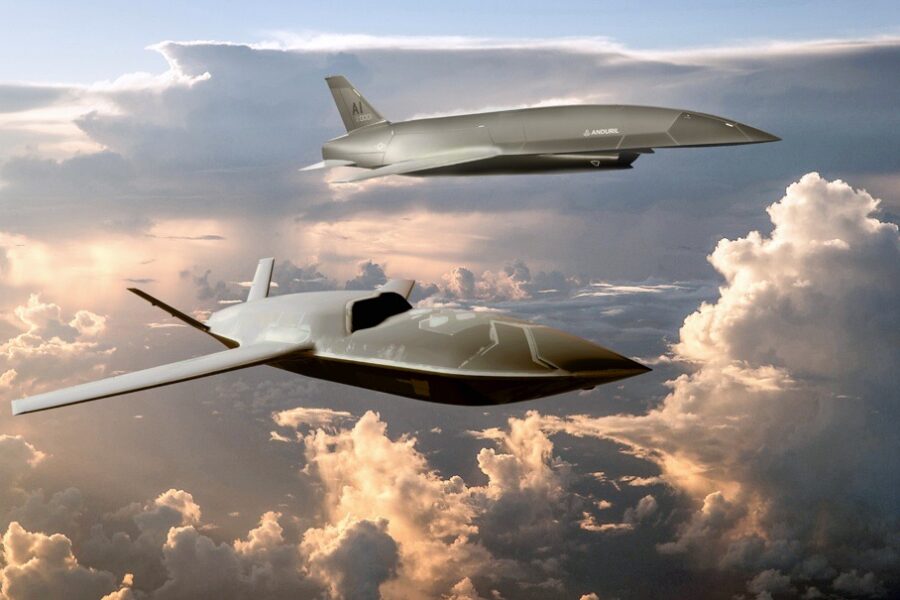
The Air Force is asking for nearly $1 billion in fiscal 2027 to start buying Collaborative Combat Aircraft in earnest, as a production decision on which semi-autonomous drones to buy looms.
Budget documents released by the Pentagon comptroller show a planned $996.5 million in CCA procurement for 2027, plus another $150 million in advance procurement to support 2028. The documents do not include the number of aircraft the Air Force is looking to buy with that money.
An Air Force spokesperson could not immediately answer a query. The service is expected to announce more details on its budget request in a few weeks.
Since fiscal 2024, the service has spent almost $1.91 billion developing CCAs, meant to fly as unmanned “wingmen” alongside manned fighter jets. This is the first time, however, that the Air Force has included procurement money for CCAs in its budget, and it is accompanied by another $1.37 billion in research and development funding—putting the total 2027 request for the program at $2.37 billion.
Before the Air Force can start buying CCAs, however, it must decide what it wants to do for “Increment 1” of the program. It has two airframes to choose from—the YFQ-42 built by General Atomics and the YFQ-44 built by Anduril—and officials have suggested they could decide to carry both types into production.
When the Air Force announced General Atomics and Anduril as finalists for Increment 1 in April 2024, it said it was planning a production decision in fiscal 2026. That decision date hasn’t moved—or gotten more specific—since, leaving a Sept. 30 deadline for the service.
The initial plan for Increment 1, articulated by then-Air Force Secretary Frank Kendall, was more than 100 CCAs on order or delivered by 2029. Kendall also said he hoped each CCA would cost about one-third of an F-35 fighter, or around $30 million or less.
Both the quantity and cost plans may be changing, though. On March 17, Director of Critical Major Weapons Systems Gen. Dale R. White said the service was considering increasing the speed and scale of production for Increment 1, though no final decisions have been made. A week later, Col. Timothy Helfrich, the portfolio acquisition executive for fighters and advanced aircraft at the Air Force Life Cycle Management Center, said that the Air Force was beating Kendall’s cost goal.
Notionally, if the price per CCA drops below $25 million, the procurement funding in 2027 would cover around 40 aircraft. There are, however, initial spare parts included in procurement funding which can affect how unit cost is calculated.
2027 Air Force Aircraft Buys
| Aircraft Type | Total Procured |
|---|---|
| B-21 | Not specified |
| CCA | Not specified |
| F-35 | 38 |
| F-15EX | 24 |
| T-7A | 23 |
| KC-46 | 15 |
| MH-139 | 4 |
| EA-37B | 3 |
| C-37A | 1 |
| TOTAL | 108-plus |
The introduction of CCA funding is the single biggest add to the Air Force’s overall aircraft procurement budget in 2027, which totals $30.64 billion. That’s a modest 1.67 percent increase over 2026, held back by a significant drop for the B-21.
As it has in years prior, the Air Force does not specify how many B-21 Raiders it is seeking to buy. But the Raider’s budget spiked to $6.47 billion in 2026, driven by extra money from the reconciliation package, and is projected to fall to $2.23 billion in 2027, still above previous base budgets.
Several key aircraft programs are holding relatively steady in 2027; the Air Force is seeking to buy 24 fourth-generation F-15EX fighters compared to 22 in 2026. Its buy of KC-46 aerial refuelers is the same as years prior at 15 airframes. And it is buying three EA-37B Compass Call aircraft compared to two the year before.
The bigger plus-ups beyond CCA are for the F-35 fighter, at 38 airframes compared to 24 in 2026, and the T-7A trainer, which goes up from 14 to 23 jets.
All told, the service is looking to procure 108 new aircraft in 2027, plus whatever number of B-21s and CCAs it buys and six smaller, hand-launched RQ-20B drones.