

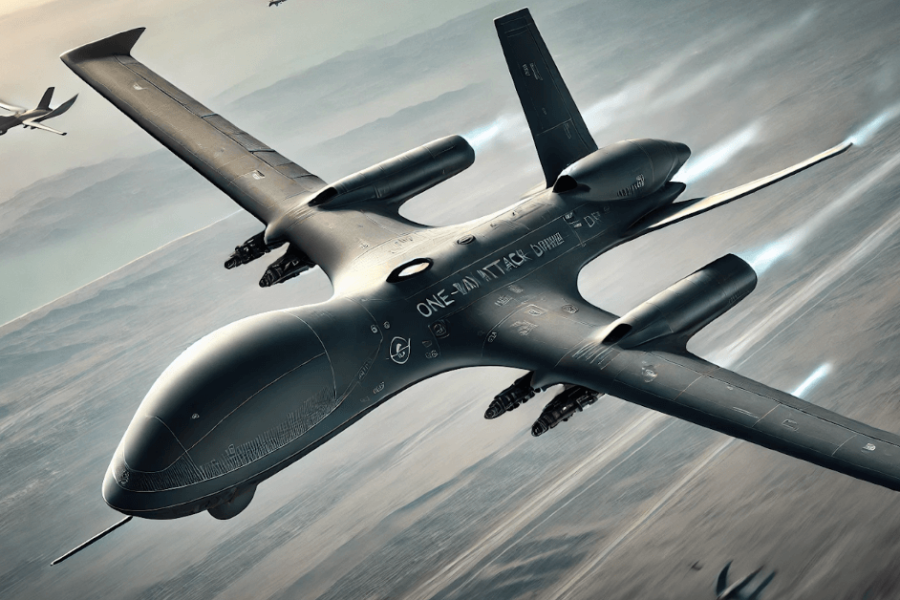
The Air Force will stand up a new unit next year to shape how the service fights with low-cost, one-way attack drones.
USAF planners began designing an experimental operations unit in the spring that will serve as a model for future units of action tasked with launching swarms of weaponized unmanned aerial systems over several hundred miles against peer adversaries such as China. If all goes as planned, the Air Force will begin to incorporate these new fighting units into the force sometime in the early 2030s, an Air Force official told Air & Space Forces Magazine.
“The details of it are still being worked out, but it is looking at things like being able to utilize UAS as a part of a formation. … So, think of an organization with tactical UASs that are able to be launched in mass to help achieve air domain effects for a joint commander,” the official said.
The effort comes as the Pentagon is racing to equip the U.S. military with hundreds of thousands of inexpensive drones. Defense Secretary Pete Hegseth launched a billion-dollar Drone Dominance Program in early December to incentivize defense firms to produce 340,000 small, low-cost tactical drones over the next two years, according to the Dec. 17 request for solutions for phase one of the four-phase effort. Hegseth’s plan follows on the heels of President Donald Trump’s Unleashing Drone Dominance executive order on June 6 aimed at bolstering the U.S. drone industrial base.
The Pentagon launched a similar effort under President Joe Biden’s administration called Replicator, meant to improve the Defense Department’s acquisition enterprise and produce thousands of cheap autonomous drones. After falling short of its goals, the effort was recently reorganized into the Defense Autonomous Warfare Group and has been placed under U.S. Special Operations Command.
Officials pushing these efforts frequently cite the rise of drone warfare in the Russia-Ukraine war as an example of the need. Ukraine has successfully adapted readily available Chinese commercial drones into formidable, one-way attack weapons such as those it used in Operation Spiderweb to attack Russian strategic airfields. Russia has also ramped up its drone operations, producing thousands of Iranian-designed Shahed drones each month.
All branches of the U.S. military are grappling with how to incorporate low-cost, expendable drones into their formations and training operations, a directive Hegseth wants to see progress on by next year. For the Air Force, which is still prioritizing a counter-drone strategy to protect its vulnerable airfields, it will involve a mindset shift from depending solely on high-end unmanned systems such as the MQ-9 Reaper, which is too expensive to be used as an expendable asset.
“You can’t mass in the way that you see small UAS and one-way attack capabilities being used in Ukraine,” said the Air Force official, adding that Hegseth’s directive may ease this transition because it pushes the idea that “small UASs—what we refer to as group ones and group twos—should be treated more as commodities and as individual weapons than as aircraft systems.”
The Pentagon sorts drones into five “groups” based on weight, speed, and operating altitude.
But to be successful, the Air Force undertaking will involve a lot more than just buying thousands of drones. The new experimental operations unit, or EOU, will have to prove out organizational requirements such as personnel needs, tactics, operational range, delivery methods, equipment, and training on top of selecting the types of drones needed for strike missions.
“When the Air Force offers a unit of action, you’re going to get a command-and-control element, you’re going to get an air base capability so that you can launch and recover personnel, and you’re probably going to get some sort of fire unit,” the Air Force official said. “You’ll get a collection of one-way attack or loitering munitions that are going to help you to be able to fulfill an air interdiction role that is going to be beyond an artillery type level.”
This will be the second unmanned EOU the Air Force has created. The service’s 53rd Wing stood up the first EOU in 2023 for the new semi-autonomous Collaborative Combat Aircraft program. The unit started out as a detachment but has grown into a squadron at Nellis Air Force Base, Nev.
The second EOU will likely be organized like Task Force Scorpion Strike—the one-way attack drone squadron U.S. Central Command recently established in the Middle East, according to the Air Force official. The task force is equipped with the Low-cost Unmanned Combat Attack System, or LUCAS, a reengineered version of the Iranian fixed-wing Shahed.
Component commands are “seeing the need to be able to have units that are organized, trained, and equipped to be able to employ these particular capabilities … so they can be ready to fight when they are called upon,” he said.
The second EOU will be a shared effort between the 53rd Wing, Air Force Special Operations Command, and Air Combat Command. It’s undecided where the new unit will be established but Nellis is a possible location, the Air Force official said. It will likely start out as an AFSOC squadron after its initial launch sometime in mid-2026 “because those are the Airmen that are using small drones today and are liaising closely with allies and partners in places like Ukraine and Taiwan,” the Air Force official said.
“But ultimately, the reason for standing up something like an EOU underneath an operational test and evaluation unit like the 53rd is so that we can start evolving that to end up in a conventional unit that has got this suite of capabilities that can employ one-way attack and loitering munitions in a manner that supports interdiction missions,” he added
While the Air Force is still considering multiple sizes of drones, the service will likely stick to fixed-wing systems rather than quadcopters, the Air Force official said. Fixed-wing systems use smaller, more efficient engines and are better suited for longer ranges and persistent loitering missions.
The second EOU will experiment with launching drones from ground and air delivery methods at ranges between 600 and 1,000 miles, the Air Force official said. For example, Agile Combat Employment-style units operating from ad-hoc bases in the Philippines could launch one-way attack drones at enemy positions located in the South or East China Sea.
“It’s small units that have a few very well-trained and well-educated folks with a with a smaller subset of folks that can do your basic skills like pulling drones out of the crate, putting the wings on and then being able to launch it,” he said.
Analyst Stacie Pettyjohn, director of the defense program at think tank Center for a New American Security, characterized the second EOU as good first step.
The Air Force has been slower to awaken to the need to focus on low-cost drone options for stand-off operations, but the service seems to be adjusting to this new operational challenge, Pettyjohn said.
“I think it is a big step for them to really be seriously thinking about how they’re going to organize, train and equip” a new type of operational drone unit, Pettyjohn said.
She did question, however, why the Air Force isn’t looking at longer ranges.
“They need more range” to be able to launch potential strikes on China’s ports and tactical targets located in coastal areas where “saturation-style attacks could be very helpful,” said Pettyjohn.
Future operational range limits will likely depend how the low-cost systems evolve in the near future, the Air Force official said.
“On the air launch side of things … the amount of range that peer adversaries like the Chinese have been able to achieve really does continue to push us further and further back,” he said. “The specific ranges are classified, but it doesn’t take a leap of imagination to show that that number of 800 miles or so would be in a sweet spot to keep us from having to be under constant air threat.”
It’s still unclear which drone groups the Air Force will focus on for its future units, but it will likely be a mix of the systems that eventually come out of the Drone Dominance Program and the Defense Autonomous Warfare Group.
“The two efforts are going to end up converging at some point in time,” the Air Force official said. “We’re going to have a wide range of capabilities that are going to be able to meet particular requirements for establishing Air Force missions.”