
JOINT BASE SAN ANTONIO-RANDOLPH, Texas—The general public has ChatGPT and it’s catching on like wildfire. The Air Force wants to give student pilots “IP GPT,” an AI tool built to help them learn the ropes of flying.
The 19th Air Force‘s Flying Training Center of Excellence is developing an AI chatbot trained on aviation publications and manuals that can act like a virtual instructor pilot to help students—and instructors—to quickly access reference procedures and assess performance. IP GPT would be a first step toward leveraging artificial intelligence to train Air Force pilots.
If successful, IP GPT will be able to coach students in simulators, freeing up time and training capacity for human instructor pilots.
Unlike large language model chatbots such as Open AI’s ChatGPT, Google’s Gemini, and Anthropic’s Claude, which are trained using troves of data, 19th Air Force is training IP GPT on only aviation-centric publications, Air Force instructions and standard operating procedures, Federal Aviation Administration and International Civil Aviation Organization guidance, and flight information publications. That data set, while smaller than those employed to build for general usage models, still spans hundreds of documents totalling thousands, perhaps tens of thousands of pages—enough to produce a reliable model, researchers believe.
Having a tool that can rapidly respond with logical answers drawn from that knowledge base would be a boon for training, said Lt. Col. Seth Hoffman, head of the Center’s Detachment 24. “I don’t want it want to be able to cue from the whole internet,” Hoffman said. “I want the whole gamut of what a pilot may have to interact with to be within this data pond, but then that’s it. I don’t want it to be a confused or clouded with everything else out there.”
Col. Brian Muto, director of the Flying Training Center of Excellence, said providing a tool like this is both logical and essential to meet future students’ expectations.
“If the students are every day on their phone using large language models, they’re going to expect it when they turn 20 and they come to fly the T-7 with us, right?” he told Air & Space Forces Magazine during a visit last month. . “And so we’ve got to get there as fast as they do.”
There’s no question in Muto’s and Hoffman’s mind that IP GPT is technically feasible. Indeed, Hoffman said advances in AI and large language models suggests a system could be ready in as little as six months. But creating the tool and using it are two different things, and significant policy barriers must be overcome before that can happen.
“There are a lot of folks in the cybersecurity realm who are like, ‘Eh, I don’t know about that,’” Hoffman acknowledged.
The first objective is a tool students and instructors can draw on. “Any time I need it, whether it’s on the ground at ground speed zero in preparation for a sortie or in post-flight, and I’m trying to look at what I’ve done and what I could do better, I want to be able to just cue up that assistant and we’ll look through everything,” Hoffman said. “Synthesize me an answer that will help me be better, whether that’s perform better as a student, or instruct better as an instructor, or what have you.”
Once the policy hurdles are cleared and IP GPT code is tested and ready, Hoffman and Muto see even greater potential for AI in flight training. Their vision includes developing a “data analytic engine” that can review flight data from a simulator or plane and grade students’ performance.
“I want to be able to go in the sim and fly a loop, and I want [the system] to see that I entered at 500 knots with a 4G pull … over the top, and I want it compared it to the pub,” Hoffman said.
Similarly, Muto envisions an AI tool to help instructor pilots prepare training scenarios and grade performance. “As an instructor pilot, I spend a lot of my time preparing for a sortie, ensuring that I know what the student need is, that I have a plan to go out and train that student, and then on the debrief, after we’ve come back from the training, assessing, ‘what are the most important things for me to teach to this student so that he or she is ready for their next sortie?’
“We think there’s a big space for AI to assist in that and give capacity back to our instructors,” he said.
Eventually, the Air Force could employ AI instructors that could coach students while they practice in the simulator. Human instructors would still have a role, but they would be reinforced by the AI assistants, which never get tired, sick, or need time off.
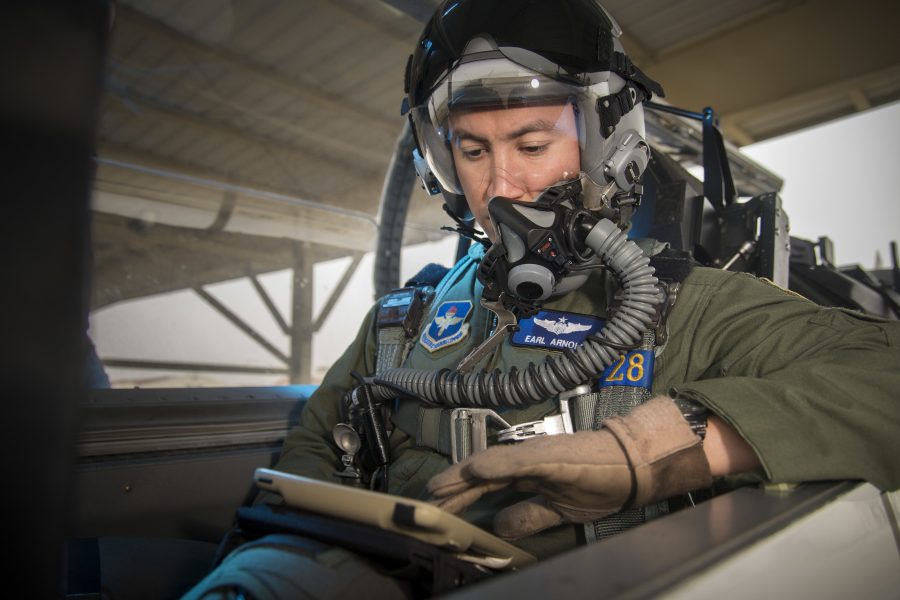
Those tools could also help fully trained pilots prepare for missions and stay sharp. “Every one of us that gets a set of wings also gets an electronic flight book… and that’s just an iPad,” Hoffman said. “Someday I want one of those applications on that iPad to be IP GPT, where student, instructor, policy-maker— whoever—can literally go to their [engine failure procedures, for example] and synthesize an answer that comes from that data pond of aviation-centered guidance.”