


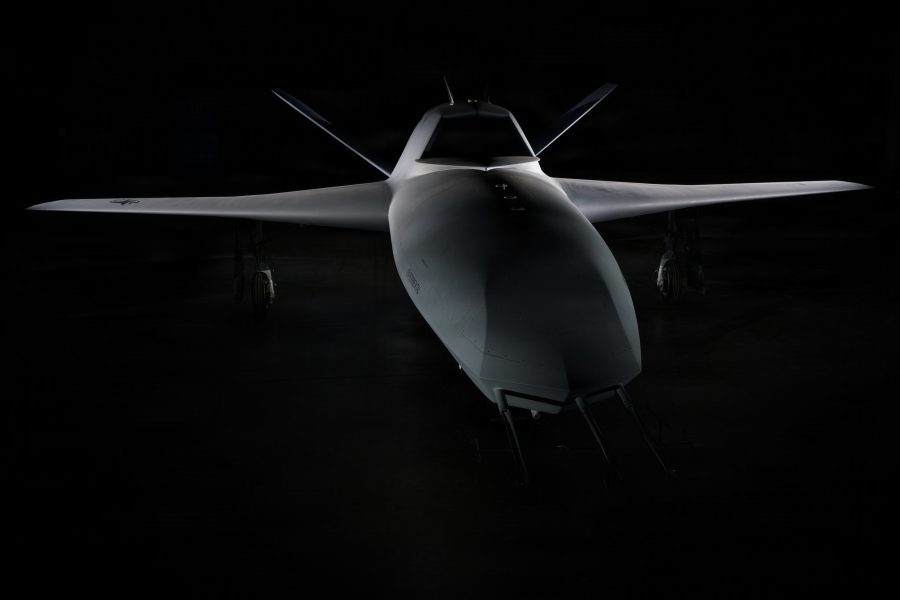
The Air Force has given Northrop Grumman’s new Project Talon aircraft the official designation of YFQ-48A, the service announced Dec. 22.
That makes Northrop’s potential competitor for USAF’s Collaborative Combat Aircraft program the third CCA to be designated an uncrewed fighter aircraft. Under Pentagon naming conventions, Y designates prototype, F means fighter, and Q means unmanned. The surprise announcement, coming just weeks after Northrop unveiled Project Talon at its Mojave, Calif., facilities, marks the aircraft as a “strong contender” for the CCA program, an Air Force release stated.
Separately, the Air Force also announced it had awarded nine contracts under Increment 2 of the CCA program, without offering a clear picture of how Increments 1 and 2 differ.
The only two previously announced CCA designators were for Increment 1 competitors, General Atomics’ YFQ-42A and Anduril’s YFQ-44A. The Air Force announced those designations in March, more than a year awarding those CCA contracts and nearly a year after Anduril and GA were named finalists. It is unclear whether there are YFQ-45 or -46 aircraft still in development, or why Northrop’s aircraft got the YFQ-48A designation.
The Air Force gave Northrop that designator at almost the same time as it announced the CCA program’s next phase. On Dec. 22, an Air Force spokesperson confirmed to Air & Space Forces Magazine that USAF awarded nine “concept refinement” contracts for Increment 2 earlier in December. Breaking Defense first reported the contracts on Dec. 19.
The Air Force spokesperson declined to name any of the nine companies, citing “enhanced security measures,” and did not say whether the YFQ-48A designation confirmed Northrop as one of the recipients. A Northrop spokesperson declined t comment.
The Air Force release on the YFQ-48A does not mention Increment 2 by name, but does state that the designation “highlights the ongoing partnership between the Air Force and Northrop Grumman and acknowledges the continued progress of the YFQ-48A as a strong contender in the CCA program.”
Northrop developed Project Talon on its own after the company failed to win an Air Force deal in the original CCA competition. Company officials did not disclose performance specifications, cost, or many details on the design, but they did say the new CCA is “significantly different” from its first design: 1,000 pounds lighter, with 50 percent fewer parts and a 30 percent faster construction time.
“The idea was to see if we could build an aircraft that had all the same capability of our original offering, and do it faster,” said Tom Jones, vice president of Northrop’s Aeronautics Division, in early December. “So the outcome was an aircraft, but the outcome we’re shooting for was the process: How do we design and build things that perform at a high level, but that we can build quickly now and can do affordably?”
Jones and other Northrop officials said then that Project Talon had not been designed specifically for Increment 2 of the CCA program nor for other competitions run by the Navy or other services.
Pursuing its work on its own drew favor from the Air Force, however, which thanked Northrop in its release. “We are encouraged by Northrop Grumman’s continued investment in developing advanced semi-autonomous capabilities,” said Brig. Gen. Jason Voorheis, program executive officer for fighters and advanced aircraft. “Their approach aligns with our strategy to foster competition, drive industry innovation, and deliver cutting-edge technology at speed and scale.”
Increment 2 Options
While the Air Force and industry officials are declining to offer any details on the nine concept refinement contracts for CCA Increment 2, seven companies are seemingly obvious contenders given their previous work with drones or new concepts they have unveiled in recent months:
- Anduril: Developed the YFQ-44A for Increment 1. Company officials have declined to discuss their plans for Increment 2 in the past.
- General Atomics: Developed the YFQ-42A for Increment 1.
- Northrop Grumman: Developed the YFQ-48A and was one of five companies to receive a development contract for CCA Increment 1 before Anduril and GA were selected as finalists.
- Boeing: Developed the MQ-28 Ghost Bat for the Royal Australian Air Force, which just recently shot down an air-to-air target in a test supported by the U.S. Air Force. Also one of five companies to receive an Increment 1 contract.
- Lockheed Martin: One of the five companies to receive a development contract for CCA Increment 1, Lockheed announced in September it was working on a CCA-like fighter escort called Vectis.
- Kratos: Developed the XQ-58A Valkyrie, which the Air Force used to test its Skyborg autonomy software that served as a forerunner to the CCA program. Company officials have said they intend to compete for Increment 2.
- Shield AI: A defense startup that initially focused on autonomy software, Shield unveiled X-BAT, its concept for a vertical takeoff and landing, semi-autonomous drone that can achieve supersonic speeds, in October.
Even if all those companies received contracts, however, there are still likely to be several less-established or well-known companies in the mix. Potential dark horses could include various new startups; BAE Systems, which has developed multiple kinds of drones; Leidos, which was a contender for the Air Force’s Enterprise Test Vehicle program; and RTX, a major defense prime that has developed drone interceptors.
The vast range of possibilities point to just how wide open the emerging drone marketplace is right now, and how open the Air Force is to consider all comers.
“These designs represent a broad spectrum, ranging from more affordable, attritable concepts to higher-end, more exquisite designs,” the Air Force spokesperson said. “This variety ensures that the program explores different approaches, optimizing for cost-effectiveness while maintaining the flexibility and capabilities necessary to enhance operational effectiveness.”
Byron Callan, a defense industry analyst at Capital Alpha Partners, called the lack of definition to Increment 2 surprising, given how long the Air Force has been talking about the program.
“I would have thought we might have been a little further along, rather than just let’s take nine and play with them,” Callan said. “Are the designs so different that this isn’t going to be a truck, per se, that just has different payloads?”