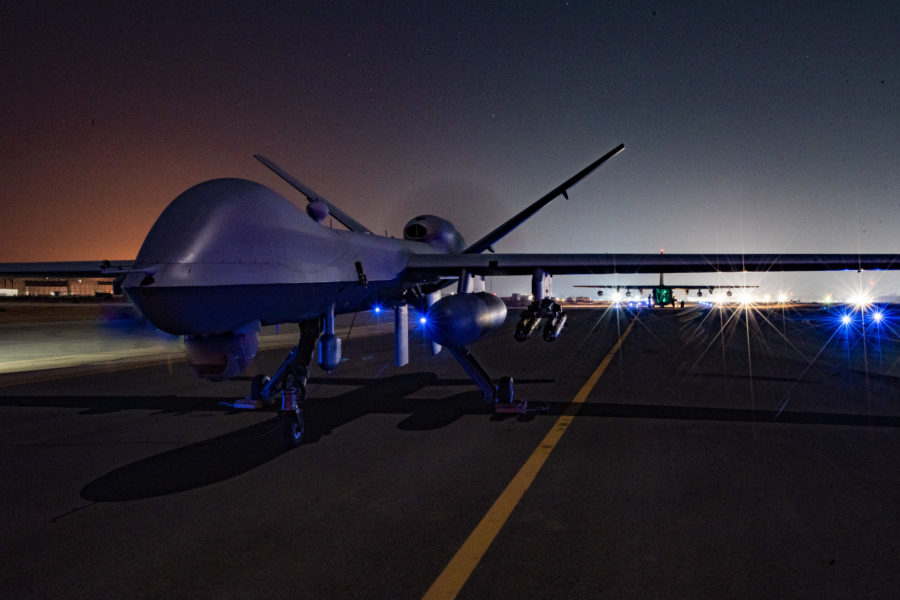
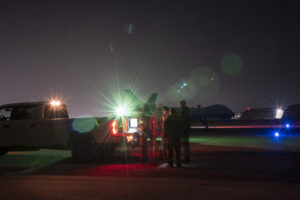
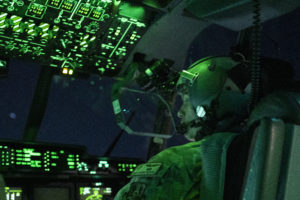
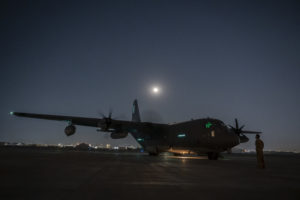
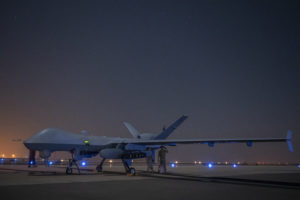
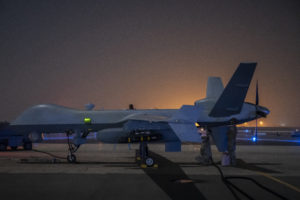
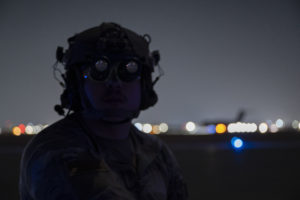
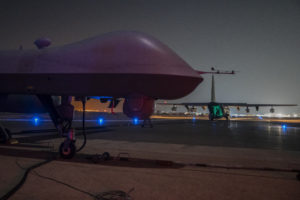
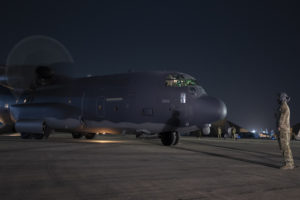
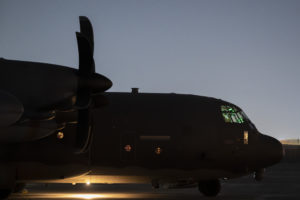
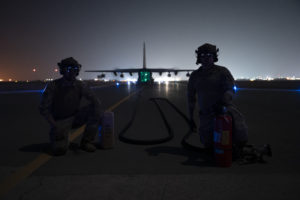
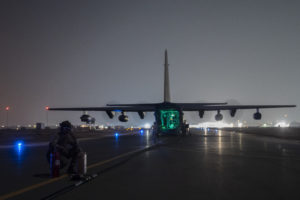
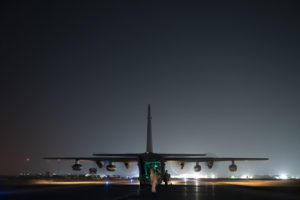
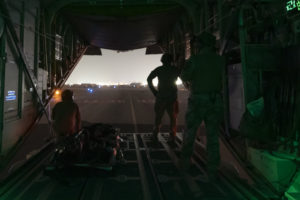
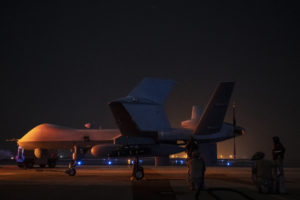
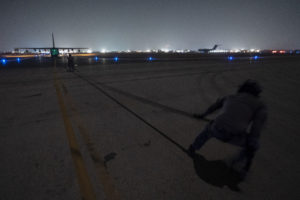
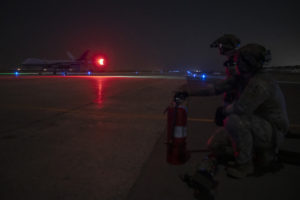
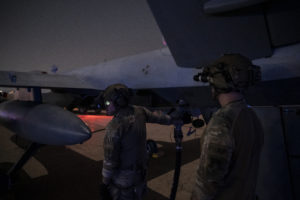
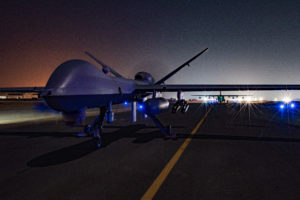
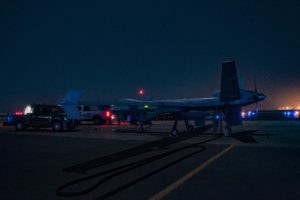
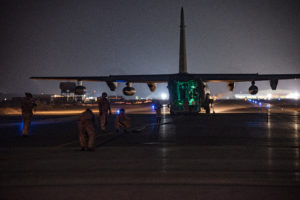
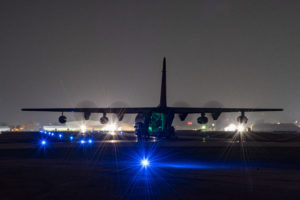
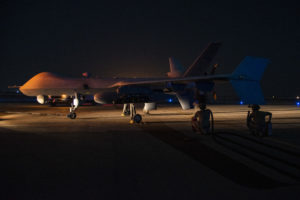
A 361st Expeditionary Attack Squadron MQ-9 Reaper and a 26th Expeditionary Rescue Squadron HC-130J Combat King II on a flight line at an undisclosed location, Southwest Asia, Dec. 10, 2022, as part of a Forward Arming and Refueling Point mission. U.S. Air Force photo by Tech. Sgt. Jim Bentley
Audio of this article is brought to you by the Air & Space Forces Association, honoring and supporting our Airmen, Guardians, and their families. Find out more at afa.org
The U.S. Air Force refueled and relaunched an MQ-9 Reaper using a technique to support aircraft away from traditional airbases for the first time in combat, the service announced Dec. 21. The aircraft also used satellite communications to reduce the number of personnel required to support the mission.
The move marks the latest push in the Air Force’s concept of Agile Combat Employment, in which Air Force personnel and equipment counter threats to central operating bases by dispersing and operating instead from numerous locations.
“A Forward Arming and Refueling Point, or FARP, accomplishes this by allowing aircraft to prepare for their next mission without having to return to an established base,” the 361st Attack Squadron said in a news release. “The operation is the first of its kind to take place in a combat area of responsibility.”
The unusual mission occurred Dec. 10 in Southwest Asia, in the U.S. Central Command area of responsibility. An MQ-9 flown by the 65th Special Operation Squadron at Hulbert Field, Fla., was refueled by an HC-130J Combat King II. The Reaper was then relaunched to continue combat operations. The aircraft was remotely piloted and conducted ground operations via SATCOM Launch and Recovery, a capability demonstrated by MQ-9 manufacturer General Atomics in 2017.
“Until recently, this operation would have been impossible,” the release from the 361st Attack Squadron said. “SATCOM Launch and Recovery allows the Mission Control Element to conduct ground operations, taxi, takeoff, and land via satellite communications. This capability significantly reduces logistics and airlift requirements when the asset forward deploys and changes the way that Remotely Piloted Aircraft warfare is conducted.”
361st Expeditionary Attack Squadron personnel “were able to refuel and prepare the aircraft for the 65 SOS to continue flying combat operations,” the release said, adding that the FARP specialists arrived aboard the HC-130.
The 361st Expeditionary Attack Squadron operates and maintains drones, including the MQ-9, in support of Operation Inherent Resolve. ISIS’s self-declared caliphate was destroyed in 2019, but the U.S. and its partners have continued their efforts to hunt down remnants of the terrorist organization and to prevent the militants from attempting a comeback.
According to the Air Force, the MQ-9 refueling and relaunching mission occurred at night on Dec. 10 at an undisclosed air base. In the early morning hours of Dec. 11, U.S. Special Operations forces conducted a helicopter raid in eastern Syria, killing two ISIS officials. It was unclear if the operations were connected, and CENTCOM did not immediately provide further details about the FARP mission.
Including the Dec. 11 operation, CENTCOM said it has conducted nine partnered operations against ISIS in Syria since resuming operations.
“The U.S. remains committed to countering the global threat from ISIS in partnership with local forces,” CENTCOM spokesman Col. Joe Buccino said in a statement on U.S. operations released Dec. 16. “ISIS continues to pursue an aggressive operational agenda, including external attacks that threaten U.S. allies and partners in the region and beyond. American forces remain in Syria partnered with local forces to ensure the enduring defeat of ISIS.”
Around 900 U.S. troops are in Syria. Air Forces Central supports the operations in missions flown by drones and manned aircraft. CENTCOM said the recent operations have required extensive planning and have not injured or killed any U.S. troops or civilians.
“The Air Force is always developing ways to act faster and more effectively around the world,” the 361st Attack Squadron said.
Audio of this article is brought to you by the Air & Space Forces Association, honoring and supporting our Airmen, Guardians, and their families. Find out more at afa.org
An important U.S. Air Force E-3 Sentry AWACS command and control plane was among the aircraft damaged in a March 27 Iranian missile and drone attack on Prince Sultan Air Base, Saudi Arabia, people familiar with the matter told Air & Space Forces Magazine.
Multiple American service members were wounded and some aircraft were damaged in a March 27 Iranian attack on Prince Sultan Air Base, Saudi Arabia, people familiar with the matter told Air & Space Forces Magazine.
The 34th Fighter Squadron won the Raytheon Trophy for its air superiority performance in 2025 in two major Middle East operations and a series of responses in the Pacific. The F-35 Lightning II squadron received the honor following its role in Operation Rough Rider targeting Houthi rebel missile sites in…
Three additional B-1B Lancers arrived at RAF Fairford on March 26, bringing the total number of bombers stationed at the U.K. base to 21—one of the largest bomber deployments in recent history.
The Pentagon formally split the combined U.S. Forces Japan and the Fifth Air Force into separate commands, ending a dual-hatted arrangement that had been in place for more than 60 years. The separation means that the former combined commander, Air Force Lt. Gen. Stephen Jost, will remain head of U.S.…
The Air Force’s nascent Collaborative Combat Aircraft program is beating former Secretary Frank Kendall’s goal of producing drone wingmen at about one-third the cost of an F-35, an official leading the effort said March 25.
Audio of this article is brought to you by the Air & Space Forces Association, honoring and supporting our Airmen, Guardians, and their families. Find out more at afa.org A photo of a B-52 Stratofortress flying with an apparent pair...
The Air Force may have used a secretive intelligence, surveillance, and reconnaissance drone over Venezuela earlier this year. Now, observers think they may have spotted an even more classified aircraft amid operations in Iran.
The Pentagon’s top weapons tester noted progress on key munitions for the Air Force in his latest report, covering everything from dogfighting missiles to hypersonics.
✓
Thank You!
Check your inbox to verify your email address and finish setting up your AFA account.
★
Welcome Back!
An account with this email already exists. Please log in to continue.
Subscribe to the Air & Space Forces Daily Report
The latest news from Air & Space Forces Magazine, as well as news from other leading publications, delivered right to your inbox every morning!
We’re sorry, there has been an error. Please review your input or try again later.