
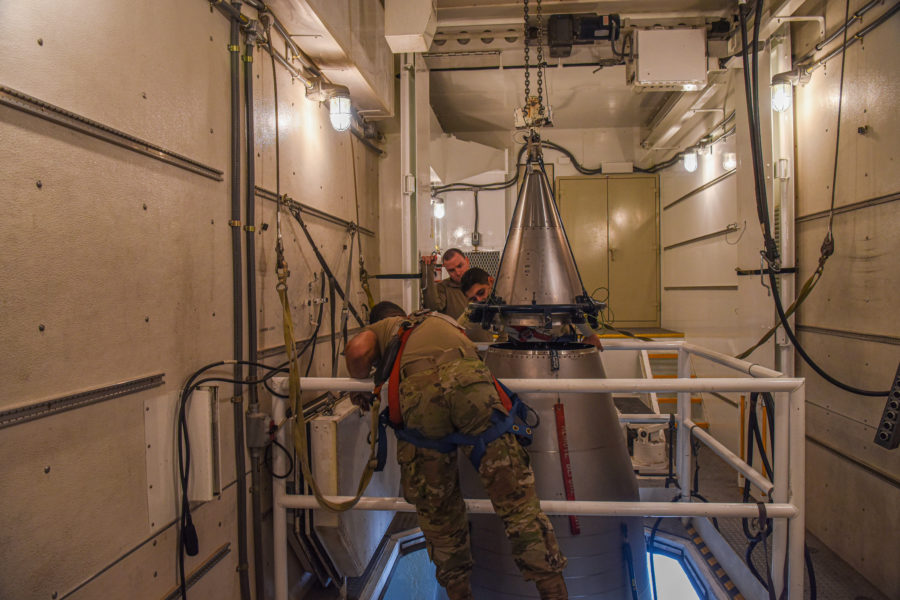
Air Force Global Strike Command has found increased rates of testicular cancer and Hodgkin lymphoma in the nuclear intercontinental ballistic missile community compared to other service career specialties, service officials said March 27.
The findings, the latest to come from a sweeping epidemiological study conducted by the U.S. Air Force School of Aerospace Medicine, were announced during a town hall meeting. They mark a change from nearly a year and a half ago, when officials said preliminary data from the first phase of the study showed no significant difference in cancer rates between Airmen who worked on ICBMs and the rest of the Air Force or the general population.
The wide-ranging Missile Community Cancer Study has been ongoing since early 2023, when renewed concerns surfaced of possible increased cases of non-Hodgkin Lymphoma at Malmstrom Air Force Base, Mont. The service previously dismissed those concerns in 2001 and 2005 reviews. Non-Hodgkin lymphoma is much more common than Hodgkin lymphoma, according to the Mayo Clinic.
The epidemiological survey, which is one part of the study, has unfolded in phases, with researchers gathering more data from different registries in each phase.
In March 2024, officials said an early phase looking at data from Pentagon electronic medical records from 2001-2021, capturing only those who were diagnosed with cancer through the Military Health System or Tricare health insurance, showed increased rates of breast and prostate cancers among the missile community compared to the general population.
In October 2024, though, when the study expanded to include data from Department of Veteran Affairs electronic medical records and both the Department of Defense and Department of Veteran Affairs’ cancer registries, going back as far as 1976 in some cases, researchers found no increased rates of any cancers.
The next phase, completed in January 2025, focused on deaths caused by cancer and found mortality rates for the ICBM community were actually lower than the general U.S. population.
More than a year later, officials revealed that the next phase of the study—which pooled data from all federal and 43 regional registries—analyzed 148,078 cancer cases from Air Force personnel who served between 1976-2010. The conclusion: testicular cancer and Hodgkin lymphoma occur at higher rates among ICBM personnel compared to other Airmen, while other cancers are diagnosed at statistically similar or lower rates.
At the March 27 town hall, officials also discussed initial data that revealed a “statistically significant higher incidence of melanoma in the missile community when compared to the general U.S. population,” according to a press release. But the skin cancer is not confined to the missileer community. Elevated cases of melanoma have also been found in the aviation community, according to the announcement, which added that epidemiologists generally have “not identified non-UV occupational exposure as a significant contributor to melanoma.”
The study will continue with an in-depth review of specific jobs, time periods, and locations, where feasible, the announcement states.
“While the Missile Community Cancer Study is making significant progress, it is critical to emphasize that the research is ongoing,” USAFSAM Commander Col. Ric Speakman said in the announcement. “At this point, we can only conclude that there is an increase in certain cancers among the missile community, not that service in the missile community causes these cancers.”
Cancer development usually occurs as a combination of multiple factors, Speakman said.
“The next step is to try to narrow down more precisely who in the missile community may have an elevated cancer incidence,” he said. “Our primary focus remains on the health and well-being of our missile community, and we will continue our work to ensure a comprehensive and accurate understanding of the findings.”
Aside from the epidemiology review, the 711th Human Performance Wing evaluated whether the practice of burning controlled items in launch control centers might lead to negative health effects for missileers.
A team of toxicologists, chemists, and engineers specializing in physics modeling and emissions measurements conducted controlled burns to simulate exposure concentrations and assess potential cancer and non-cancer risks for personnel.
The team found that the likelihood of significant long-term health effects from controlled burns to be “below occupational threshold level for elevated cancer risk,” according to the announcement. Medical officials stressed, however, that the study is not yet complete.
Now in its final stages, the study is incorporating burn testing and other assessments, to further understand potential health risks to missile community.
Since it began in 2023, the study has also looked at other environmental hazards such polychlorinated biphenyls, commonly known as PCBs, at Malmstrom and the Air Force’s other two ICBM bases, Warren Air Force Base, Wyo., and Minot Air Force Base, N.D.
PCBs are present in older electronics, and while PCB production was banned in 1979, ICBM facilities are decades old. The Air Force began phasing out PCBs at ICBM facilities in the 1980s, but it is not clear if the process was fully completed. Another major concern for missileers is radon exposure and water contamination. Radon is a radioactive gas that comes from bedrock and soil, and missile facilities are buried underground with personnel living in cramped quarters on 24-48 hour shifts.
Air Force Global Strike Command has been isolating PCB areas and continue to conduct deep cleaning to remove the potential health risks, according to the announcement.
During the town hall, leaders stressed that missileers can use the Defense Department’s Individual Longitudinal Exposure Record system to compare their service data to known exposures to cancer risks as a way of “ensuring the efficient and effective continuity of individualized health care,” the announcement states.
As a missileer, Global Strike Command boss Gen. S.L. Davis said it’s important to him that this study is done right.
“This is personal for me,” Davis said. “I appreciate the progress made so far, and I will continue to ensure a thorough review to ensure the protection of our Airmen.”