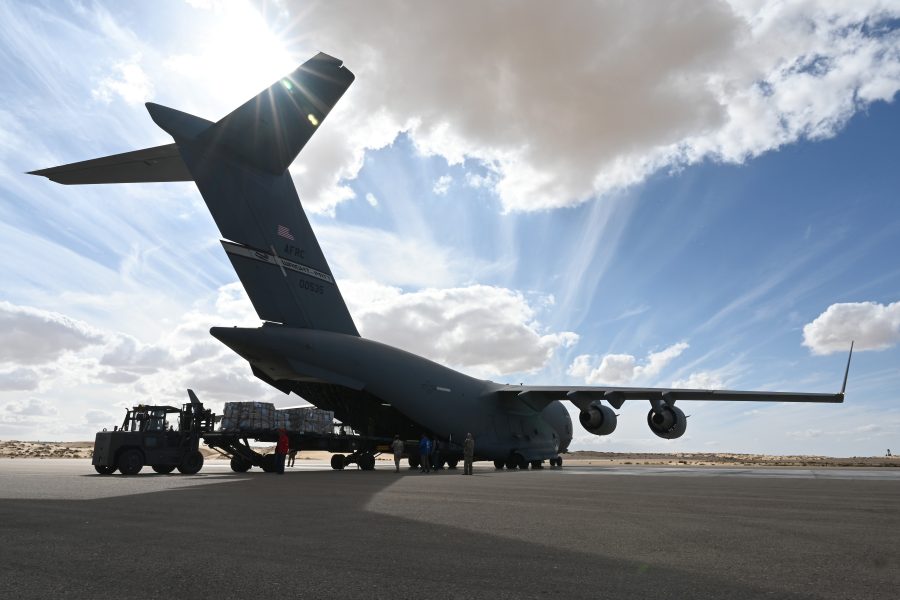
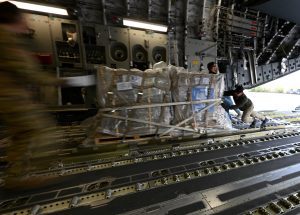
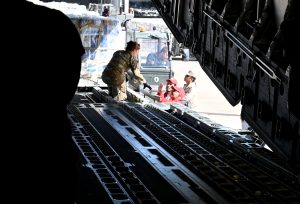
The U.S. Agency for International Development utilizes U.S. Air Force airlift capabilities to transport humanitarian aid throughout the Middle East, Nov. 28, 2023. U.S. Air Force photo by Staff Sgt. Jasmonet Holmes
Audio of this article is brought to you by the Air & Space Forces Association, honoring and supporting our Airmen, Guardians, and their families. Find out more at afa.org
A U.S. Air Force C-17 Globemaster III with humanitarian aid bound for Gaza landed in Egypt on Nov. 28, the U.S. government announced.
The flight is the first U.S. military aircraft sent to the Middle East to deliver aid for the beleaguered civilians in Gaza since the latest Israel-Hamas conflict that began Oct. 7, according to the Pentagon. U.S. officials say two more military aid flights are expected in the coming days.
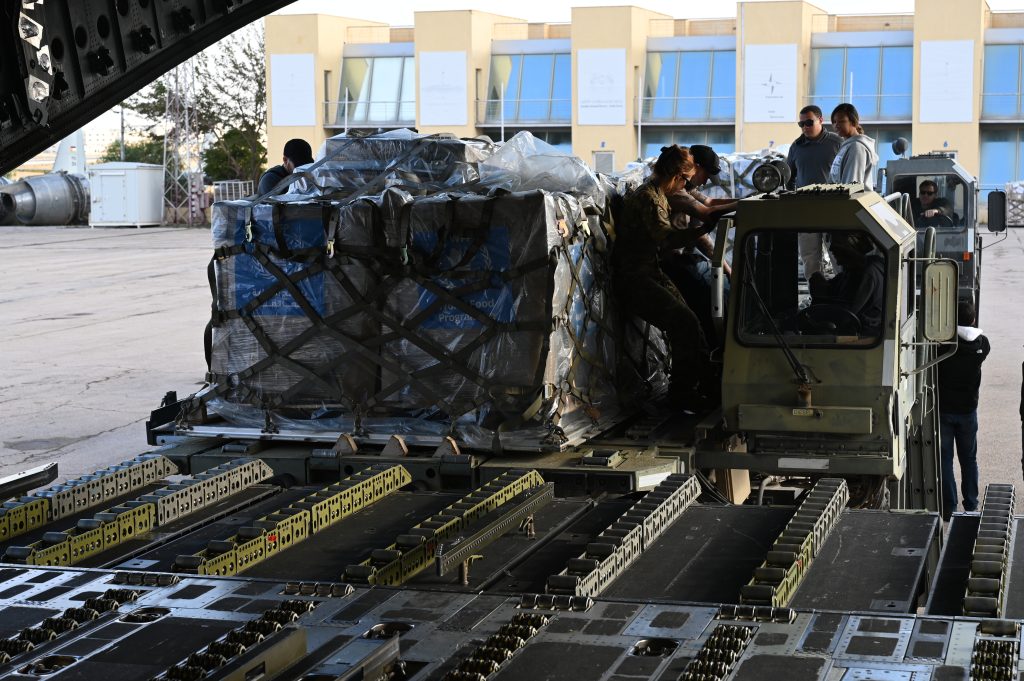
The C-17 carried 54,000 pounds of aid on behalf of the U.S. Agency for International Development (USAID), the foreign humanitarian assistance arm of the American government, USAID said.
According to publicly available flight tracking data, the C-17 that landed in Egypt on Nov. 28 is an Air Force Reserve aircraft that was operating as “REACH 202,” a typical Air Mobility Command callsign.
The aid includes “vitally needed medical supplies, warm clothing, and food and nutrition assistance to the people of Gaza,” Pentagon Press Secretary Air Force Brig. Gen. Patrick S. Ryder told reporters on Nov. 28. “This aid is in addition to the more than 500,000 pounds of food assistance delivered by the United States last week via USAID-contracted aircraft to El Arish, Egypt, for onward travel to Gaza.”
A temporary cease-fire between Israel and Hamas to free dozens of hostages captured by Hamas in exchange for Palestinians held in Israeli prisons “has also enabled a significant surge in additional humanitarian assistance to the innocent civilians who are suffering across the Gaza strip,” President Joe Biden said in a statement on Nov. 27. The U.S. military flights are a key step in the Biden administration’s efforts to increase humanitarian assistance.
“With 1.7 million people internally displaced and 2.2 million in need of humanitarian assistance, increased humanitarian supplies are essential to saving lives and alleviating suffering for the most vulnerable,” USAID said in a statement.
U.S. Air Force aerial port specialists load 24.5 metric tons of humanitarian aid destined for Gaza aboard a C-17 Globemaster III at an undisclosed airfield in the Middle East, Nov. 28, 2023. U.S. Air Force photo by Staff Sgt. Jasmonet Holmes
The aid will be delivered via the United Nations from the Northern Sinai region of Egypt to Gaza, U.S. officials said.
“From the president on down, we understand that what is getting in is nowhere near enough for normal life in Gaza, and we will continue to push for additional steps, including the restoration of the flow of commercial goods, and additional basic services,” a senior administration official told reporters.
Around 800 truckloads of aid were to be delivered to Gaza during the first four days of the pause in fighting, U.S. officials said. The pause was extended another two days after it was originally due to expire on Nov. 28. Another senior administration official said “this level or increased levels” of humanitarian aid to Gaza is still needed after the current pause ends.
Israel has made clear it intends to resume its war in Gaza to eliminate Hamas. Secretary of Defense Lloyd J. Austin III “reiterated that humanitarian aid into Gaza must increase” in a Nov. 27 call to his Israeli counterpart Yoav Gallant, according to a readout from the Pentagon.
“Understanding the importance of protecting civilian lives, innocent civilian lives, while at the same time going after the terrorist group Hamas that inflicted pain and suffering not only on the Israeli people, but on the Palestinian people—that will continue to be a priority for us,” Ryder said.
Audio of this article is brought to you by the Air & Space Forces Association, honoring and supporting our Airmen, Guardians, and their families. Find out more at afa.org
A U.S. Air Force F-22 pilot controlled a YFQ-44A Fury Collaborative Combat Aircraft this month while both aircraft were in flight, according to an Oct. 16 release, another milestone in the service’s ambitious CCA efforts.
The Marine Corps recently conducted its first-ever “ripple” release of eight Small Diameter Bomb IIs from an F-35B, a key early step in proving out the capability for all F-35 variants.
The Air Force will field operational prototypes for an autonomous drone to replace its MQ-9 Reaper in 2028, Secretary of the Air Force Troy Meink said Oct. 14.
One of the Air Force’s critical B-2 Spirit stealth bombers has returned to Whiteman Air Force Base, Mo., after an extensive course of maintenance to restore its stealth coating and preserve its structural integrity.
BAE Systems has received a contract from Lockheed Martin to install an upgraded Block 4 electronic warfare system into new F-35 Joint Strike Fighters, as well as to retrofit some older jets.
The Air Force has figured out a way for maintainers to inspect what had been a “blind spot” in F-16 engines, after problems in that area led to the catastrophic crashes of two jets in recent years.
The Air Force has begun evacuating stealth fighters, gunships, and special operations planes ahead of Hurricane Isaias expected landfall over the Gulf Coast this weekend.
The Air Force’s B-52 bomber may soon be able to carry up to 20 stealthy long-range anti-ship missiles to strike moving targets at sea, a key capability in a potential fight with China.
A reported surge of MQ-9 Reaper drones to Latin America could widen the scope of intelligence gathering and free up more strike options against cartels in the region, experts tell Air & Space Forces Magazine.
✓
Thank You!
Check your inbox to verify your email address and finish setting up your AFA account.
★
Welcome Back!
An account with this email already exists. Please log in to continue.
Subscribe to the Air & Space Forces Daily Report
The latest news from Air & Space Forces Magazine, as well as news from other leading publications, delivered right to your inbox every morning!
We’re sorry, there has been an error. Please review your input or try again later.