
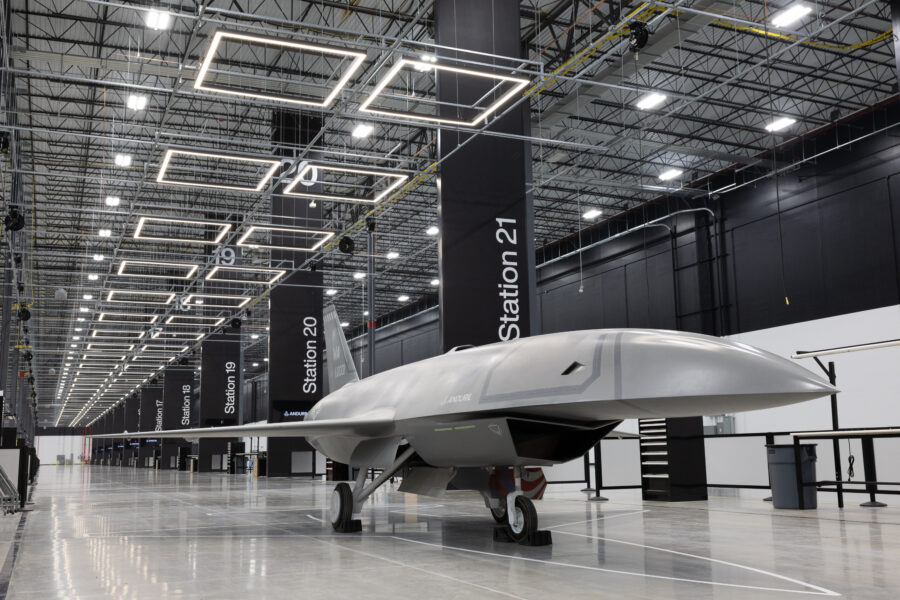
The Air Force’s nascent Collaborative Combat Aircraft program is beating former Secretary Frank Kendall’s goal of producing drone wingmen at about one-third the cost of an F-35, an official leading the effort said March 25.
“Not only have we met [Kendall’s goal], we are doing much better than that,” Col. Timothy Helfrich, the portfolio acquisition executive for fighters and advanced aircraft at the Air Force Life Cycle Management Center, said during a Defense One State of the Air Force panel discussion. “More of that information will come out in the future, but we have done very good at driving down the cost.”
CCAs are semi-autonomous drones that will be ably to fly alongside aircraft such as the F-22, F-35, and F-47, and conduct different missions like strike, recon, and electronic warfare at a lower cost and risk than a manned fighter. Anduril and General Atomics Aeronautical Systems are currently developing models for the first “increment” of CCAs, dubbed the YFQ-44A and YFQ-42A, respectively.
Helfrich declined to specify potential costs for Anduril’s and General Atomics’ CCAs. The most recent lots of F-35 and its engine put the average cost around $101 million, though that can vary significantly by variant. So the goal price for CCAs could be $34 million or lower.
As the CCA program moves into its second increment, Helfrich said, the Air Force is working with nine companies to refine their concepts.
“What we’re doing in that phase is, we’re taking these operational use cases that we’ve defined through operational analysis,” Helfrich said. “They each have some basic attributes to them. Are they runway independent? Do they need to go 2,000 miles? Those kind of things. And we are working with these companies to bring those into a certain number of concepts.”
Some of those concepts are less expensive than the first increment of CCAs, Helfrich said—but some are more exquisite, which means they have additional capabilities at a higher cost.
“We’re going to follow the data and follow the analysis, and figure out which of these provides the best return on investment,” Helfrich said. “Because you may need to buy many of the less expensive ones, or less of the more exquisite ones.”
Gen. Dale R. White, the Air Force’s Direct Reporting Portfolio Manager for Critical Major Weapon Systems including the CCA program, said at a March 17 conference that CCA’s unit cost estimates are evolving as “we’re finding a greater understanding of the operational use for these platform capabilities.”
“As we continue to explore the design space of these platforms … that really changes the landscape of how we view cost,” White said. “We’re in the early phases of that.”