
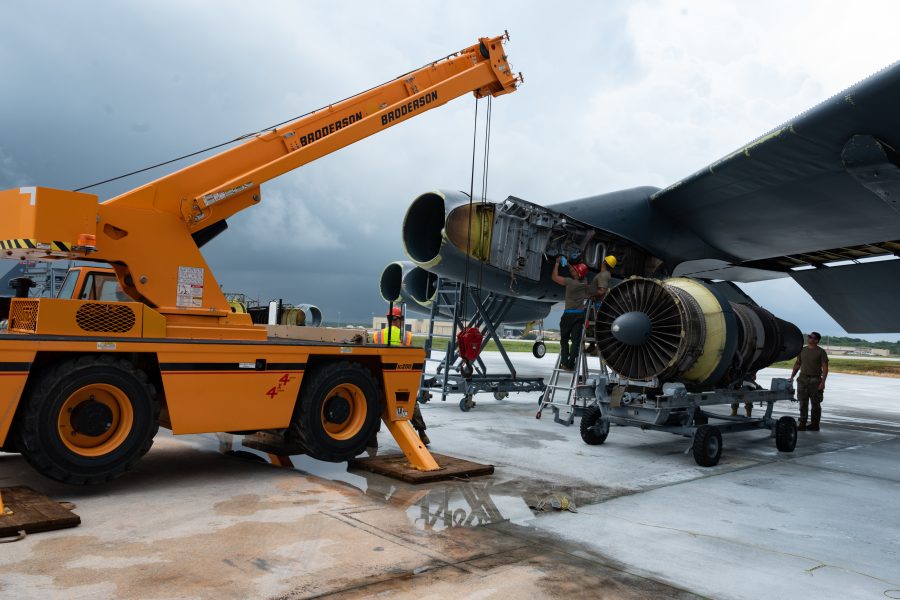
The Air Force inked a $2 billion deal with Boeing to install new engines on two B-52 bombers and begin testing of the new eight-engine configuration.
Boeing is the prime integrator for USAF’s B-52 Commercial Engine Replacement Program in which new Rolls-Royce F130 engines will be installed in place of the legacy TF33 engines that date back to the 1960s.
“The task order progresses the B-52 CERP program by completing system integration activities after Critical Design Review and modifying and testing two B-52 aircraft with new engines and associated subsystems,” the announcement states.
The Pentagon did not specify when the first jets will be ready for testing, saying only that the task order “is expected to be complete by May 31, 2033″—around the time the Air Force anticipates achieving initial operational capability with the new engines.
The F130 engine passed critical design review in December 2024, but the replacement program includes much more, including the engine struts, the electrical power generation system, and engine cockpit displays. A critical design review for the entire program is projected for April, according to the Government Accountability Office in its annual weapons report released last summer.
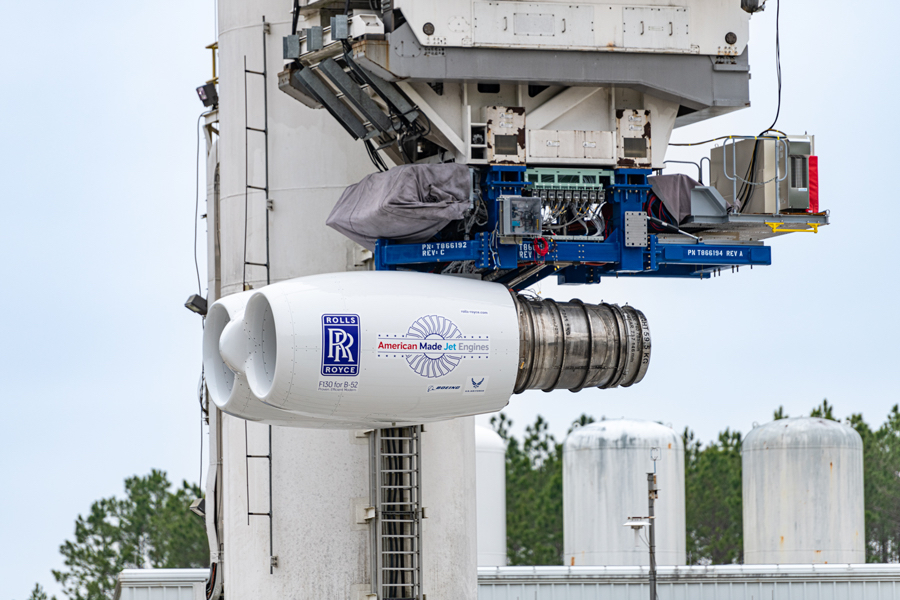
Along with the new engines, the Air Force is also replacing the radar on the B-52. Once both upgrades are installed, they will combine to form the “B-52J” variant, intended to continue flying into the 2050s, when the airframes will approach 100 years old.
The B-52 Radar Modernization Program has also signaled recent progress, with the new AN/APQ-188 radar making its first flight on a B-52 on Dec. 8. The bomber flew from San Antonio, Texas, to Edwards Air Force Base, Calif., to begin testing ahead of a production decision this year. The new radar replaces today’s AN/APQ-166 radars, which were developed in the 1980s.
The F130-equipped B-52s will also be tested at Edwards, the home of the Air Force’s main test wing. A production decision on the engine replacement program is projected in late 2028, according to reports from the GAO and the Director of Operational Test and Evaluation.
Both the engine and the radar upgrades have overcome challenges. The engine program was first delayed by needed changes to nacelle design and auxiliary engine systems, followed by engine inlet issues discovered during testing. The radar program, meanwhile, had to overcome a “non-critical” Nunn-McCurdy breach, meaning its baseline schedule or cost had grown by up to 15 percent, due to “environmental qualification, parts procurement, and software,” per the GAO.
Work progresses, however, to keep the B-52 flying for decades to come as the “standoff” component of USAF’s planned bomber force, consisting of stealthy B-21 “inside” bombers and stand-off B-52s.