
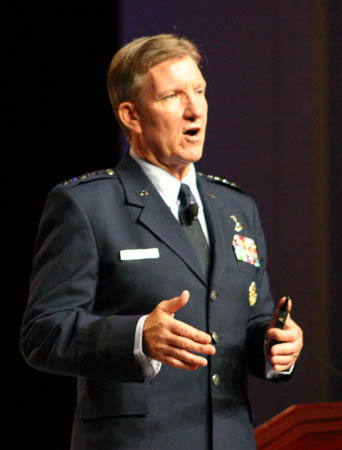
 While Pacific Air Forces commanders often make note of the size of the region—which in the words of PACAF chief Gen. Hawk Carlisle stretches from “Hollywood to Bollywood”—the Air Force and the other services have to do some more creative thinking about integrated air defense, he said. Belligerent nations such as North Korea and other potential adversaries have decided the way to keep the United States from intervening is to invest in tools that prevent US power projection, mainly missiles and anti-aircraft defenses. This is why integrating air defense, from the Army’s Patriot and THAAD batteries to the Navy’s Aegis cruisers, is critical to carrying out PACAF’s strategic vision, Carlisle told attendees at AFA’s 2013 Air and Space Conference in National Harbor, Md., on Wednesday. There are three aspects to this: attack operations, active defense, and passive defense. The United States needs to be able to do attack, when it has to, but the other two are equally important, especially passive defenses, he said. “It’s something we haven’t thought about much in a while,” said Carlisle of passive defense, but this includes dispersal, concealment of assets, flexible basing, and being able to recover airfield operations after an attack.
U.S. Northern Command plans to sign an agreement with its European and Pacific counterparts to enhance coordination and close security seams in the Arctic, a strategically vital region that spans all three commands. The agreement comes at an important moment in NORTHCOM's evolution, as its mission grows more complex.
