
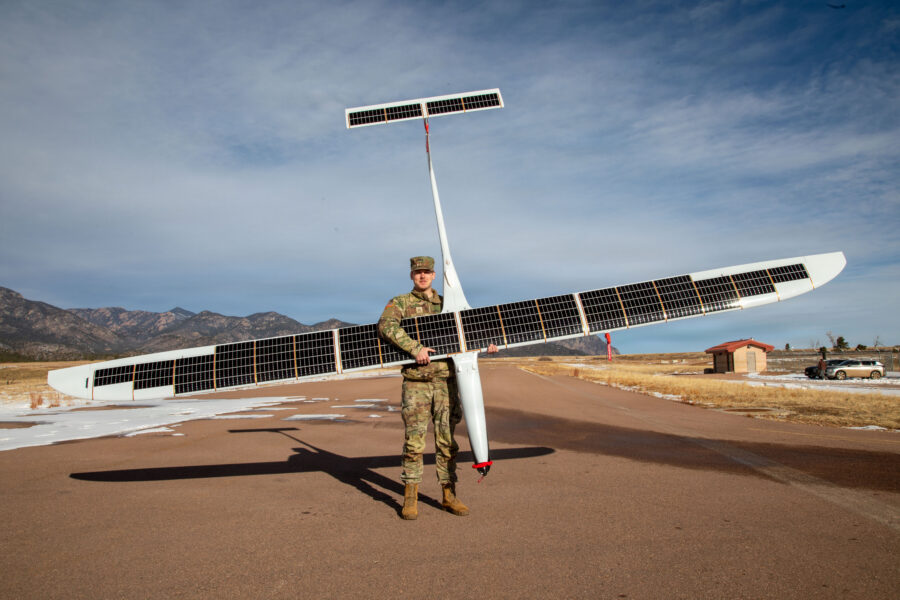
U.S. Air Forces Central has awarded an indefinite delivery, indefinite quantity contract worth up to $270 million to a California-based company to provide an ultra-long range, solar-powered drone capable of 75 hours of flight.
Kraus Hamdani Aerospace won the single-source, Indefinite Delivery/Indefinite Quantity contract with the for its KH1000ULE drone. The contract type gives the service an open timeline to purchase whatever quantity it needs up to the $270 million threshold.
The drone is meant for intelligence, surveillance, and reconnaissance, or ISR, and can act as a quarterback among other drones, relaying information and sensor data.
“A single operator can control a swarm of K1000ULE UAS through a simple user interface, identifying specific coverage areas and launching the correct number of aircraft to fulfill dynamic missions,” according to a company release.
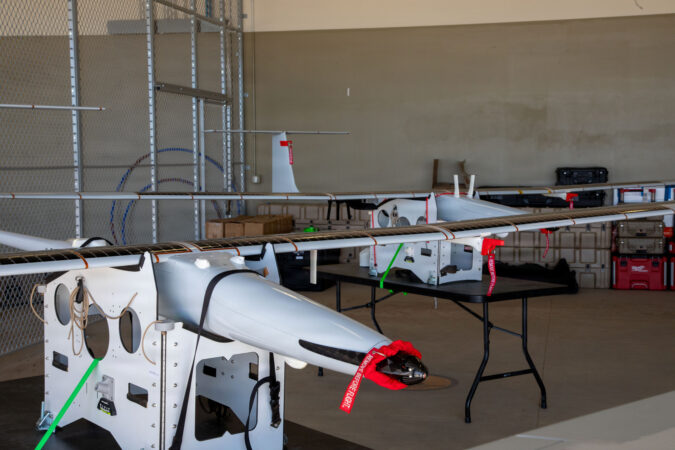
It can be carried by a two-person crew and launched from a vehicle or through vertical takeoff. It has a fully modular, open architecture with artificial-intelligence-enabled autonomy and can carry multiple payloads and sensors, according to the company’s release.
“When beyond-line-of-sight operations are critical, the K1000ULE’s secure SATCOM capability enables both ISR and resilient connectivity for U.S. forces and partner nations across the Middle East,” said Stefan Kraus, cofounder and CTO, in the release.
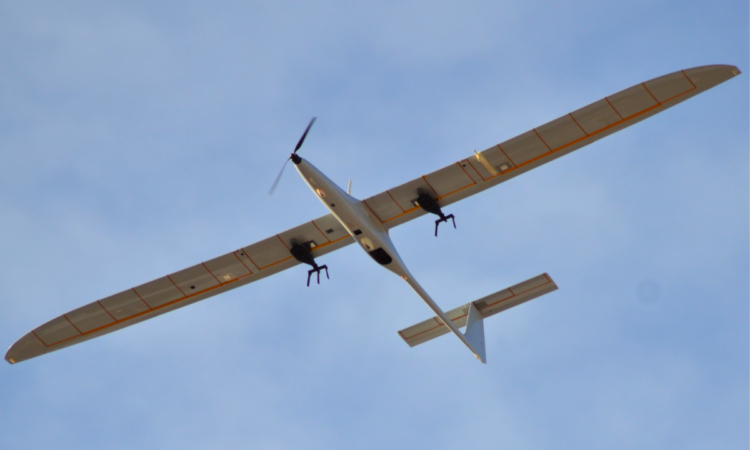
The drone can operate in coordinated swarms, called “multi-drone constellations,” which can span thousands of miles, according to the company’s website. The 20-foot-wingspan drone can operate at 20,000 feet in all weather conditions, with a range of more than 700 nautical miles.
Company officials did not immediately respond to queries from Air & Space Forces Magazine.
Though this may be the Air Force’s first major purchase of the drone, both the Army and Marine Corps have acquired small batches of the ISR drones in recent years, following multiple demonstrations in various exercises.
U.S. Army Pacific first experimented with the K1000ULE in exercises between 2022 and 2024 across the Philippines, Guam, Saipan, and Hawaii.
U.S. Navy Central was the first service to use the drone in the Middle East during its 2023 International Maritime Exercise. Subsequently, the Marine Corps acquired the drone for its Small Unit Remote Scouting System in April 2024.
The Army continued its experiments and, in October 2024, announced a $20 million contract to purchase the drone for both the 1st Multidomain Task Force and Joint Special Operations Command.
In 2023, the drone broke an endurance record for its size, weight, and class. A K1000ULE performed a 75-hour, 35-minute continuous flight at Oregon’s Pendleton UAS test range. That was more than double the 36-hour record previously held by Lockheed Martin’s Stalker VXE.
The extended range was possible, in part, by its fully electric, AI-enabled design.
The drone can “mimic nature by utilizing onboard artificial intelligence to silently glide through the air like a bird and generate clean onboard energy,” according to a company release. The system can take advantage of thermal drafts to glide or soar, reducing its engine use and conserving energy.
The K1000ULE weighs 42.5 pounds, which falls within the 21- to 55-pound Group 2 of the Pentagon’s drone classification system—putting it firmly within the department’s broader push to embrace smaller drones.
The Pentagon launched a $1 billion Drone Dominance Program in December, calling on the defense industry to produce 340,000 small, low-cost tactical drones over the next two years. That followed President Donald Trump’s June 2025 executive order “Unleashing Drone Dominance,” which sought to bolster the U.S. drone industrial base.
Drone Dominance Program Manager Travis Metz told Congress in a March 5 hearing that, initially, the program is paying about $5,000 per Group 1 drone, and the goal is to get that price down to $2,000 for one-way attack drones. The program could mass sufficient quantities of drones to shift how the services use them in tactical scenarios.
While the Army and Marine Corps have made some of the biggest moves to integrate small drones into its formations, the Air Force is making its own efforts. In December, USAF announced a new experimental unit to stand up this spring focused on launching swarms of weaponized drones over distances of hundreds of miles. The experimental operations unit would be similar to Task Force Scorpion, a one-way attack drone squadron under U.S. Central Command.
“Small UASs—what we refer to as group ones and group twos—should be treated more as commodities and as individual weapons than as aircraft systems,” an Air Force official told Air & Space Forces Magazine in December.
Task Force Scorpion relies heavily on the Low-cost Unmanned Combat Attack System, or LUCAS, a reengineered version of the Iranian fixed-wing Shahed drone, capable of flying approximately 500 nautical miles.
The LUCAS drones, which cost about $35,000 each, were first used operationally in the early days of Operation Epic Fury. CENTCOM commander Adm. Brad Cooper has called them “indispensable” in press briefings.
More recently, the Air Force Life Cycle Management Center posted a notice to industry in mid-March seeking a one-way attack drone with first-person view capability that can fit in a backpack and deliver munitions on targets more than 12 miles away.
For both ISR and strike platforms, each service is seeking more cost-effective ways to field larger numbers of drones.
Though a unit cost was not immediately available for the K1000ULE, its class of UAV is likely far cheaper than other widely used drones, such as the MQ-9 Reaper, which runs $13-16 million apiece.