
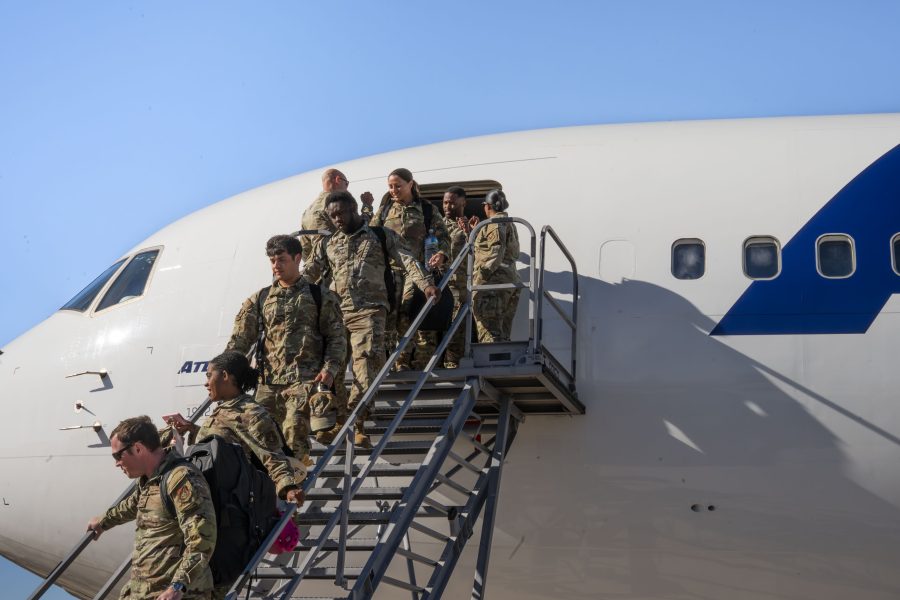
The Air Force is revising once again its deployment model, scrapping its plans for “deployable combat wings” and revamping the Air Expeditionary Wing with a new AEW 2.0 model.
The new AEW won’t return to the pick-up game AEW model of the 1990s, but will instead “form approximately 18 months prior to deployment so that its teamed, capabilities-based components can train and certify as a cohesive unit,” according to a release.
In canceling deployable combat wings, the Air Force is abandoning yet another of the initiatives launched as part of 2024’s “re-optimization for great power competition.” Other elements previously cancelled include a planned “Integrated Capabilities Command,” the down-grading of major commands, and the renaming of Air Education and Training Command as Airman Development Command.
AEW 2.0 retains the objectives of the Deployable Combat Wing while changing key elements of that approach. DCWs resource the personnel and equipment needed for a deployment ahead of time, so that Airmen could train, exercise, deploy, and reset as a collective unit. Central to each DCW was a command element, or “A-Staff;” a mission element, such as a fighter, bomber, or airlift squadron; and support elements to run the airbase or airfield and care for the needs of wing personnel.
Like that model, the AEW 2.0 seeks to minimize the number of “unit type codes,” or UTCs, needed to fill out a wing, an Air Force spokesperson told Air & Space Forces Magazine. UTCs define capabilities that comprise multiple Airmen; it take hundreds of UTCs to fill out a force package.
“The AEW will be comprised of significantly fewer UTCs than the legacy deployment construct,” the spokesperson said. The new model starts with a “core UTC” that covers both the command and control element and a base operating support element. The C2 element will not be an “A-staff,” however, but a wing operations center, the spokesperson said.
“The forces comprising the AEW Core UTC are sourced from predominantly one [major command], from as few additional bases as possible, and early in the deployment cycle to promote unit cohesion as they prepare, train, and certify together,” the spokesperson said.
The new wings will still be “modular,” with the Core UTC able to work with a wide variety of Mission Generation Force Elements, which comprise the operational forces.
“The MGFE are selected to provide expertise as required so the group and wing commanders are equipped to command effectively,” the spokesperson said. “Each wing will have its own unique set of demands that require a commander-driven employment plan that is base- and mission-specific.”
When DCWs were first introduced, commanders at the major command level objected to the construct because they thought it failed to recognize core differences between the major commands and their particular expertise. With the Air Force now under new leadership—specifically Air Force Chief of Staff Gen. Kenneth Wilsbach, who headed Air Combat Command when the DCWs were conceived—the concept has now been revised.
AEW 2.0 “will be implemented in fiscal year 2027,” which starts Oct. 1.
It has been nearly five years since the Air Force unveiled the Air Force Force Generation Model, or AFFORGEN, in an effort to better manage Air Force deployment rotations. AFFORGEN established a 24-month cycle, with four phases designed for units to prepare, certify, deploy, and reset. The goal was a predictable rhythm for presenting forces to combatant commanders and a clearer means of projecting and assessing risk and operational tempo.
What followed were a series of evolutionary changes, beginning in October 2023 with “Expeditionary Air Base” teams or XABs, that included a core nucleus of Airmen who trained together beforehand, plus additional personnel that joined the group in theater. Next came six Air Task Forces, or ATFs, which were built around teams of several hundred Airmen that came together a year before deploying; those teams then drew from a handful of bases when they deployed. The first ATF deployed in September 2025.
Deployable Combat Wings were envisioned as the culmination of that evolution. But the new AEW construct scales back on some of the biggest changes embodied in the DCW model, including interchangeable air staffs regardless of expertise and eliminating group commands.
The Air Force spokesperson said AEW 2.0 preserves “capacity to fulfill the in-garrison mission and defend the homeland,” acknowledging that the DCW concept could have left some bases undermanned.