
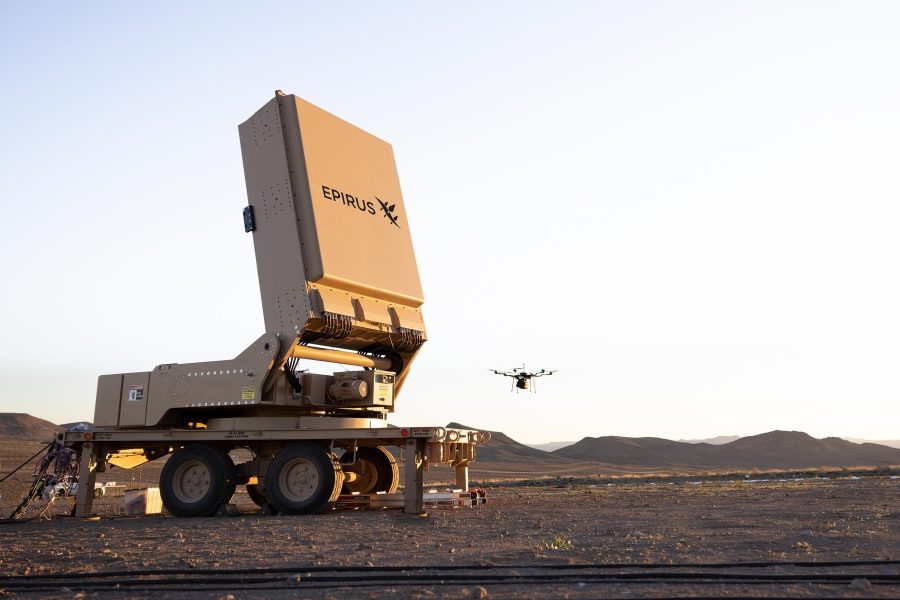
A new Air Force organization is searching for counter-drone firms to participate in a dozen or more exercises to help create operating plans by the end of this year for defending the service’s U.S.-based installations from drone attacks.
Air Combat Command selected the 319th Reconnaissance Wing at Grand Forks Air Force Base, N.D., in January to lead the Point Defense Battle Lab, or PDBL, to develop tactics, techniques, and procedures to go with industry-developed counter-drone technologies that Airmen will use in the future to protect installations in the United States.
Now, the 319th, supported by the Kansas Air National Guard’s 184th Wing, is scheduled to hold exercises during each month of 2026 where industry firms can demonstrate their counter-small unmanned aerial systems, or C-sUAS, technologies for Air Force use.
To prepare for these exercises, the battle lab recently released two broad requests for information to identify companies interested in participating in upcoming demonstrations. One RFI is looking for firms that produce systems that detect, identify, and track drones, the other RFI aims to identify companies that can produce “kinetic hard kill” solutions such as missiles and other projectiles.
“We’re going to have specialized exercises throughout the year, and we’re looking to identify those businesses now, so that we can reach out and say, ‘Hey, in July, are you available? You have capabilities that fit within the exercise that we’re planning to do,’” Senior Master Sgt. BreeAnn Sachs, a spokesperson for the 319th, told Air & Space Forces Magazine. “We’re looking at every kind of company. If there’s a company that does one specific piece of counter-UAS—detection, tracking, elimination, identification—great. If you have a technology that can do all of them, fantastic.”
The battle lab will hold at least one exercise a month, two in some cases, in undisclosed locations. Some will focus on systems to detect and track drones and others, like the five scheduled for July through October, will focus on engaging with hard-kill weapons.
“The tactics and techniques and procedures that we capture and develop through these exercises are going to be synthesized into a standard operating procedure for point defense for drones,” Sachs said, adding that the goal is complete the first iteration of the standard operating procedure within the 2026 calendar year. “Then that SOP will be given to … all Air Force installations in the United States, so that we can rapidly help all [installations] acquire and install this counter-UAS infrastructure.”
The two RFIs are looking for technologies designed to be rapidly deployed via cargo pallet and set up by small teams of up to four Airmen within two hours to counter Groups 1-3 drones—on the smaller end of the spectrum. All technologies should be capable of operating in extreme temperatures and in winds up to 30 miles per hour.
One RFI seeks firms with technology to consistently detect and track all Group 1 drones at ranges of two kilometers or greater and provide autonomous classification of detection, distinguishing small UAS from non‑UAS objects, according to the March 6 solicitation posted on Sam.gov. A secondary objective is the ability to detect and track Group 2 and 3 drones at a “minimum detection range between 50 meters and 500 meters, with preference toward shorter ranges.” The other RFI, also published March 6, is interested in firms that can produce systems using the following hard-kill solutions:
- Advanced Precision Kill Weapon System, or APKWS, midrange precision vehicle and container launchers
- Large caliber 30mm gun-based airburst/proximity close-in sustained fire
- Small caliber automated weapon stations with C-UAS fire control
- Drone-on-drone autonomous kinetic interceptors with AI-guided to terminal that can be 3D-printed to full size
- High-energy laser with a 2-20kW power range
- High-power microwave with an effective area engagement that is swarm-capable, and weather resistant
“We acknowledge that it’ll likely take multiple systems that can integrate with each other to give us a full picture and give us all the capabilities that we need to properly defend our installations from aerial threats,” Sachs said.
“Every installation is going to have different needs, different electromagnetic spectrum considerations, different considerations for if they are close to water … if they are close to mountains. So, we understand that we are going to need to be evaluating a wide range of different companies, so that we have a lot of different options available.”
Bases that have “fighters, bombers, refuelers—those are all going to be different considerations” for installation commanders when they select the right counter-drone systems for their base, Sachs added.
Companies have until April 30 to respond to either RFI, but the battle lab plans to release new requests as often every month to find specific companies for certain exercises and to catch those companies that may not have been able to make the April 30 deadlines for the current RFIs, Sachs said.
The battle lab is part of ACC’s larger Point Defense Task Force that’s similar to organizations that have been stood up in other services to attack the rapidly evolving threat that drones pose on the battlefield. The Pentagon’s Joint Interagency Task Force 401 is also working to develop counter-drone options for the services such as its plan to create an Amazon-like online marketplace where base commanders can procure counter-drone technologies that have been through JIATF-401’s user evaluations.
“This is a really dynamic threat,” Sachs said, adding that the battle lab plans to hold more exercises next year after the SOP for installations complete.
“There will be a refinement piece, so we’ll continue to evaluate this technology, so that we can offer updates to the SOP,” she said. “We can offer additional tactics and techniques and procedures; we can continue to evaluate this technology as it becomes more advanced and as new capabilities are developed and refined.”