
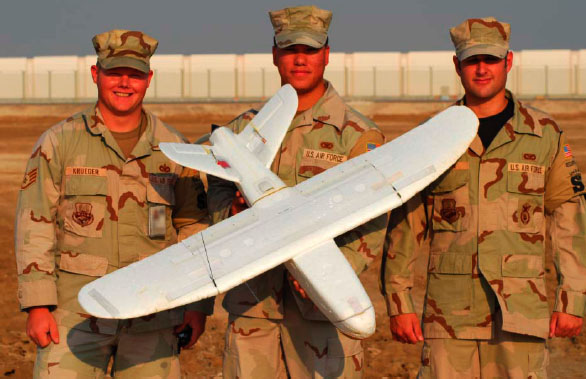
 Security Forces airmen deployed to Southwest Asia are finding an invaluable force protection asset in the form of the diminutive Desert Hawk, a small unmanned aerial vehicle that two people launch via a bungee cord and “fly” with a laptop, reports Air Force journalist MSgt. Jason Tudor. Known formally as the Force Protection Airborne Security System, the seven-pound UAV, made of foam plastic, performs day and night local reconnaissance and surveillance missions. Each FPASS comprises six aircraft (five are backups), a ground control station, and an antenna.
The Air Force has finished modifying and testing the new VC-25B Bridge aircraft that will serve as a temporary Air Force One, the service announced May 1. All that’s left now is to finish painting the jet before it starts flying this summer.