
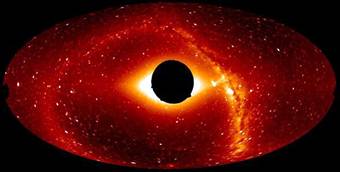
 The Solar Mass Ejection Imager experiment, orbiting the Earth about 50 miles up aboard the Coriolis satellite, has photographed more than 200 “coronal mass ejections,” since it became operational in January 2003, according to officials at Air Force Research Lab’s Space Vehicles Directorate at Kirtland AFB, N.M. The object of the experiment is to aid forecasters as they try to anticipate communication disruptions caused by destructive clouds of solar particles impacting the Earth. The SMEI has demonstrated a 30 percent improvement in the accuracy of forecasts.
Air Force Inks Deal for 22 More Boeing F-15EX Fighters
Sept. 29, 2026
The Air Force awarded Boeing a $2.38 billion contract for 22 F-15EX Eagle II fighters on Sept. 29, narrowly meeting a deadline to use funds from last summer’s reconciliation bill or face cuts.