
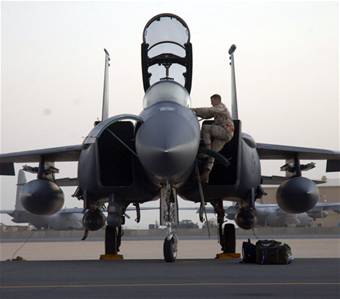
 Two F-15Es from the 379th Air Expeditionary Wing at Balad AB, Iraq, used their their electro-optical and infrared sensors to locate three individuals seen fleeing an area from which mortars were fired at Balad. It was a coordinated effort with airmen and soldiers manning Balad’s Joint Defense Operations Center, which calculated the point of origin and relayed the information to the aircraft. The Strike Eagles monitored the individuals until they stopped their vehicle at a house, when they relayed the location to the JDOC. Tests of the three suspects, apprehended by soldiers of the Army’s 101st Airborne Division, showed positive for explosive residue. Coalition officials called this extra “eye in the sky” capability from non-traditional intelligence-surveillance-reconnaissance assets a “real force multiplier.”
The Space Force awarded Northrop Grumman a $398 million contract to design and build a communications satellite prototype with advanced anti-jam and data processing capabilities. The service announced the contract for the Enhanced Protected Tactical SATCOM-Prototype program, or Enhanced PTS-P, May 15, and said the satellite will launch no sooner than…