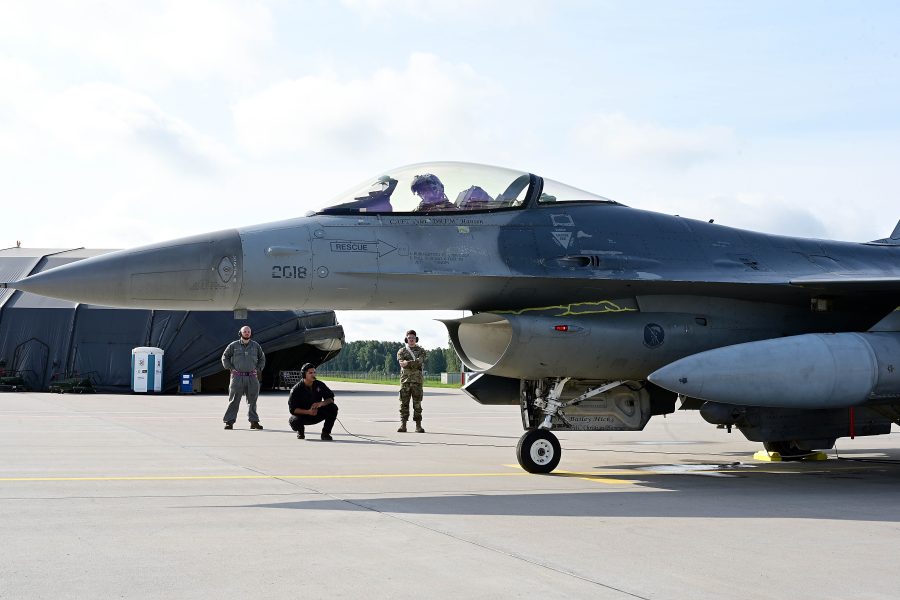
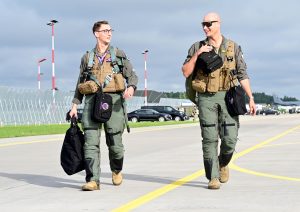
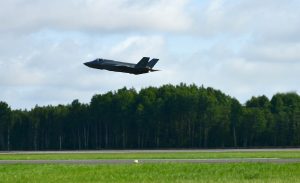
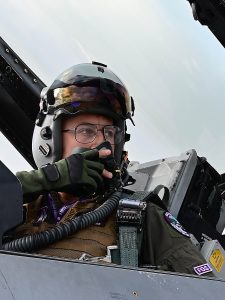
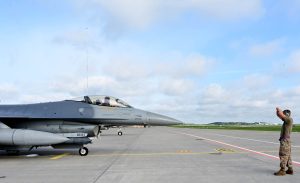
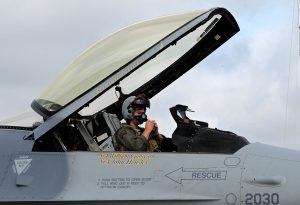
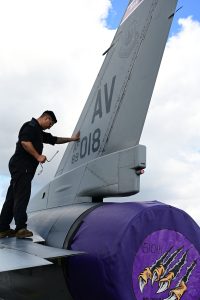
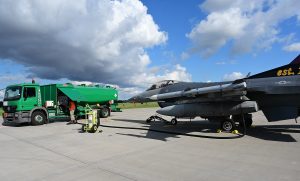
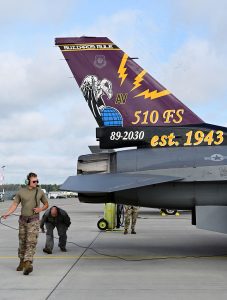
U.S. Air Force Senior Airman Andrew Cuevas (center), 510th Fighter Generation Squadron dedicated crew chief, performs a preflight inspection on an F-16 Fighting Falcon during exercise Astral Knight 23 Part 6 at Šiauliai Air Base, Lithuania, on Aug. 22, 2023. AK23-6 is an Agile Combat Employment exercise focusing on concepts designed to make us more agile in our execution, more resilient in sustaining our capability, and more lethal in delivering our combat power from austere and remote locations. U.S. Air Force photo by Tech. Sgt. Stephanie Longoria
Audio of this article is brought to you by the Air & Space Forces Association, honoring and supporting our Airmen, Guardians, and their families. Find out more at afa.org
Aircraft from every flying wing in U.S. Air Forces in Europe kicked off Astral Knight 23-6 late last week, the latest in a series of exercises across the continent focused on Agile Combat Employment.
F-16s, F-35s, KC-135s, and a C-130J are all flying in the exercise from forward operating bases in Finland and Lithuania, according to a USAFE release. From there, Airmen will participate in operations in the Arctic and Baltics, focusing on “proactive and reactive asset movements.”
The following wings are involved in the exercise:
48th Fighter Wing, RAF Lakenheath, U.K.
31st Fighter Wing, Aviano Air Base, Italy
52nd Fighter Wing, Spangdahlem Air Base, Germany
100th Air Refueling Wing, RAF Mildenhall, U.K.
86th Airlift Wing, Ramstein Air Base, Germany
435th Air Ground Operations Wing, Ramstein Air Base, Germany
At Rovaniemi Air Base, Finland, there are:
F-16s from Spangdahlem
a C-130J from Ramstein
a KC-135 from Mildenhall
F/A-18s from the Finnish Air Force
At Šiauliai Air Base, Lithuania, there are:
F-35s from Lakenheath
F-16s from Aviano
a KC-135 from Mildenhall
According to U.S. European Command, forces from Sweden and Latvia will participate as well. The exercise is scheduled to run from Aug. 18-31.
Agile Combat Employment is the Air Force’s operating concept in which Airmen and aircraft disperse from large central bases and operate from smaller, more austere locations in a “hub-and-spoke” manner to complicate an adversary’s targeting.
The concept, which first emerged in the Indo-Pacific, has quickly become a central tenet of Chief of Staff Gen. Charles Q. Brown Jr.’s vision for the service, and USAFE commander Gen. James B. Hecker recently cited it as one of his top priorities for implementing in the region.
Dating back to the end of the Cold War, allied countries used to have a well-practiced ability to service and even re-arm any NATO aircraft that landed at a NATO base, but that capability has “atrophied,” Hecker said in a recent meeting with reporters.
“We are working to get that back,” Hecker said. To do it, NATO will provision “20-25 bases … in strategic locations around Europe” with the means to support a wide variety of allied aircraft. He declined to specify which bases.
The U.S. Air Force has operated from Šiauliai in Lithuania relatively frequently and poured resources into the base as part of the European Deterrence Initiative. In 2020, officials noted that the U.S. had invested more than $27 million in 18 separate projects at Šiauliai over the last several years. More recently, F-15Es and F-35s operated from there in 2022 as part of the NATO air policing mission.
USAF forces have operated from Rovaniemi in Finland, located at the edge of the Arctic Circle, on a less regular basis. While the base was part of the Arctic Challenge Exercise spread across Scandanavia earlier this year, no American aircraft operated from there. In January 2022, a 100th Air Refueling Wing KC-135 flew alongside Finnish fighters after taking off from Rovaniemi, and Reserve KC-135s flew from there in Arctic Challenge Exercise 2021.
“Astral Knight will continue to strengthen ally and partner interoperability while validating new ways to deploy and maneuver assets during a crisis or conflict,” Lt. Gen. John D. Lamontagne, deputy commander of USAFE, said in a statement. “Regular exercises, like AK, and our permanent forward presence are essential to projecting a credible deterrence to any future act of aggression against the alliance.”
Agile Combat Employment-related concepts have been part of recent U.S. Air Force exercises in Europe including Air Defender 2023, Defender Europe 23, and Falcon Strike 2022. F-35s and F-22s deployed to the continent have also conducted ACE operations out of countries like North Macedonia and Estonia.
Audio of this article is brought to you by the Air & Space Forces Association, honoring and supporting our Airmen, Guardians, and their families. Find out more at afa.org
The Air Force’s future strategy for fighting wars could include arming bombers with air-to-air strike capabilities, the service said in a new report to Congress.
The Pentagon has concluded a new agreement to buy laser-guidance kits that turn rockets into drone-killing weapons. BAE Systems and the Defense Department announced a framework deal of up to seven years for 25,000 Advanced Precision Kill Weapon System guidance kits annually for the U.S. military.
The Pentagon and Lockheed Martin on Oct. 22 announced a framework agreement to buy F-35 Joint Strike Fighters for the next 10 years. But the deal, touted by the Pentagon as “landmark” and a first of its kind, depends on Congress granting the military authority to enter into such a…
At least two KC-135 Stratotankers that were seriously damaged during Operation Epic Fury are still undergoing extensive maintenance depot repairs, the head of Air Force Materiel Command said Oct. 21.
As the Air Force wrestles to solve the logistics of dispersed operations in the vast Indo-Pacific, it’s investing $3.5 million to help develop a new kind of aircraft: a blended-wing body freighter that’s smaller than a C-130 but larger than a Cessna for “sub-tactical” lift.
Roughly two of every five fighters in the Air Force fleet could be F-35As by 2035, according to a new fighter force structure report the service submitted to Congress on Oct. 16. Lt. Gen. David Tabor, deputy chief of staff for plans and programs, revealed the new estimate during an…
The Air Force Life Cycle Management Center is moving forward with a program to upgrade a quarter-century-old computing system for some F-16 fighter jets.
The U.S. Navy on Oct. 15 accepted a C-130J-30 Super Hercules plane that it will modify to become the first of its new nuclear command, control, and communications aircraft—a route the Air Force is considering for a similar NC3 mission under congressional direction.
More than 40 years after the original YF-117 operational prototype flew test runs from a Lockheed Martin Skunk Works facility, an F-117 returned for a $1 million refurbishment to look its best when it assumes its place in history alongside other iconic aircraft on permanent exhibit at the National Air…
✓
Thank You!
Check your inbox to verify your email address and finish setting up your AFA account.
★
Welcome Back!
An account with this email already exists. Please log in to continue.
Subscribe to the Air & Space Forces Daily Report
The latest news from Air & Space Forces Magazine, as well as news from other leading publications, delivered right to your inbox every morning!
We’re sorry, there has been an error. Please review your input or try again later.