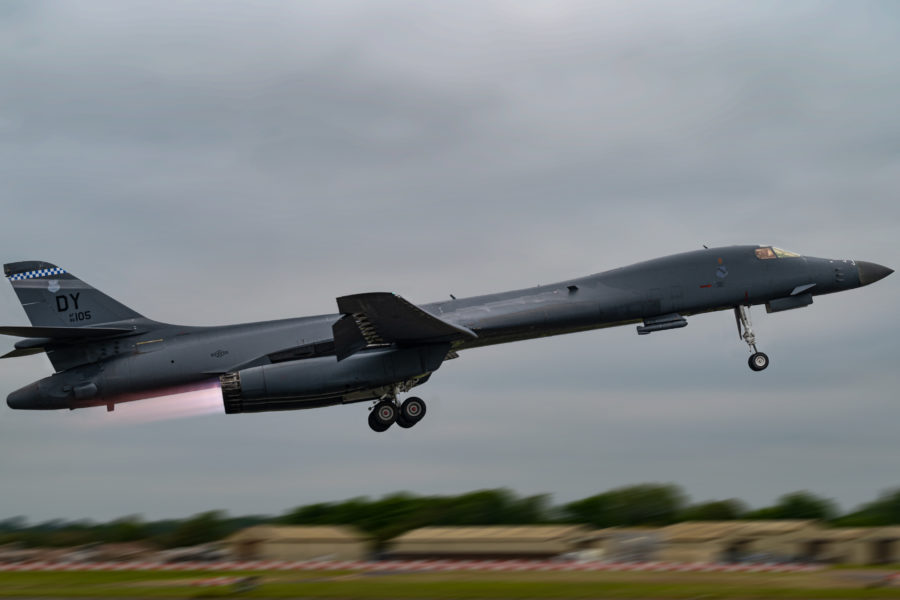
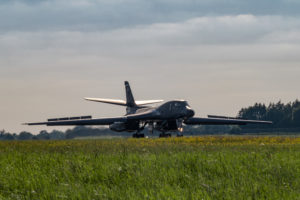
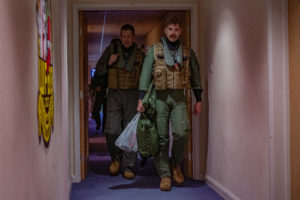
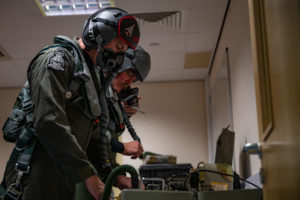
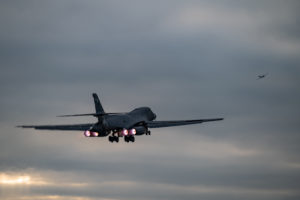
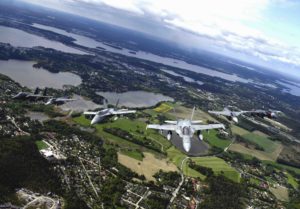
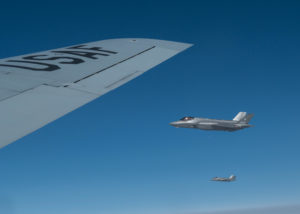
A U.S. Air Force B-1B Lancer departs the flight line at RAF Fairford, United Kingdom, Jun. 5, 2023. Two supersonic strategic bombers executing Bomber Task Force 2023-3 joined NATO and coalition aircraft during Arctic Challenge Exercise 2023 in a counter-maritime mission in the High North. U.S. Air Force photo by Senior Airman Josiah Brown
Audio of this article is brought to you by the Air & Space Forces Association, honoring and supporting our Airmen, Guardians, and their families. Find out more at afa.org
A pair of B-1 bombers flew over the North Sea on June 5, joining in on an expansive aerial exercise taking place in the Nordic region.
As part of Arctic Challenge Exercise 2023, the B-1s from Dyess Air Force Base, Texas, flew above the USS Gerald R. Ford aircraft carrier and integrated with F-35s from the U.S. Air Force and Royal Norwegian Air Force, as well as U.S. Navy aircraft.
“The U.S. Air Force and U.S. Navy routinely conduct operations in the High North alongside the Finnish, Swedish, and Norwegian Air and Naval Forces, and Arctic Challenge provided enhanced opportunities for NATO allies and partners to integrate with strategic U.S. bombers and the Ford-class aircraft carrier in a new environment,” a U.S. Air Forces in Europe press release stated.
The B-1s are in Europe as part of a Bomber Task Force deployment, based out of RAF Fairford, U.K. Since arriving two weeks ago, Airmen and aircraft have been busy. On May 23, one B-1 was intercepted by a Russian fighter over the Baltic Sea region. On May 30, a bomber flew over Bosnia and Herzegovina, in a show of support amid continued unrest in the area. And on June 1, a B-1 integrated with allied forces during a small force exercise across France and Belgium.
Their participation in Arctic Exercise Challenge, however, marks their biggest training opportunity yet—and the first time U.S. bombers have flown in the biennial exercise since it began in 2013.
In addition to the B-1s, the U.S. Air Force is flying F-35s and F-15s from the 48th Fighter Wing at RAF Lakenheath, U.K., in the exercise, as well as KC-135s from the 100th Air Refueling Wing at RAF Mildenhall, U.K., and the Maine Air National Guard.
Sweden is leading the exercise, with aircraft also stationed in Norway and Finland. The U.S., U.K., the Netherlands, Belgium, Italy, Canada, France, Germany, Switzerland, Denmark, and the Czech Republic all sent personnel and aircraft.
“By training and conducting realistic exercises in the High North, like Arctic Challenge Exercise 2023, U.S. forces and those of Allied and Partner nations hone skills, fine-tune interoperability, nurture key relationships, and acclimate to the inherent challenges posed by fighting in the Arctic’s extreme conditions,” a USAFE press release stated.
Audio of this article is brought to you by the Air & Space Forces Association, honoring and supporting our Airmen, Guardians, and their families. Find out more at afa.org
Roughly two of every five fighters in the Air Force fleet could be F-35As by 2035, according to a new fighter force structure report the service submitted to Congress on Oct. 16. Lt. Gen. David Tabor, deputy chief of staff for plans and programs, revealed the new estimate during an…
The Air Force Life Cycle Management Center is moving forward with a program to upgrade a quarter-century-old computing system for some F-16 fighter jets.
The U.S. Navy on Oct. 15 accepted a C-130J-30 Super Hercules plane that it will modify to become the first of its new nuclear command, control, and communications aircraft—a route the Air Force is considering for a similar NC3 mission under congressional direction.
More than 40 years after the original YF-117 operational prototype flew test runs from a Lockheed Martin Skunk Works facility, an F-117 returned for a $1 million refurbishment to look its best when it assumes its place in history alongside other iconic aircraft on permanent exhibit at the National Air…
A U.S. Air Force F-22 pilot controlled a YFQ-44A Fury Collaborative Combat Aircraft this month while both aircraft were in flight, according to an Oct. 16 release, another milestone in the service’s ambitious CCA efforts.
The Marine Corps recently conducted its first-ever “ripple” release of eight Small Diameter Bomb IIs from an F-35B, a key early step in proving out the capability for all F-35 variants.
The Air Force will field operational prototypes for an autonomous drone to replace its MQ-9 Reaper in 2028, Secretary of the Air Force Troy Meink said Oct. 14.
One of the Air Force’s critical B-2 Spirit stealth bombers has returned to Whiteman Air Force Base, Mo., after an extensive course of maintenance to restore its stealth coating and preserve its structural integrity.
BAE Systems has received a contract from Lockheed Martin to install an upgraded Block 4 electronic warfare system into new F-35 Joint Strike Fighters, as well as to retrofit some older jets.
✓
Thank You!
Check your inbox to verify your email address and finish setting up your AFA account.
★
Welcome Back!
An account with this email already exists. Please log in to continue.
Subscribe to the Air & Space Forces Daily Report
The latest news from Air & Space Forces Magazine, as well as news from other leading publications, delivered right to your inbox every morning!
We’re sorry, there has been an error. Please review your input or try again later.